In today's FirstScroll, we break down petrol's record-low share of India's car market and explain why the fuel meant to save petrol is scaring buyers away from it.
With that out of the way, let's dive into today's story.
The Story
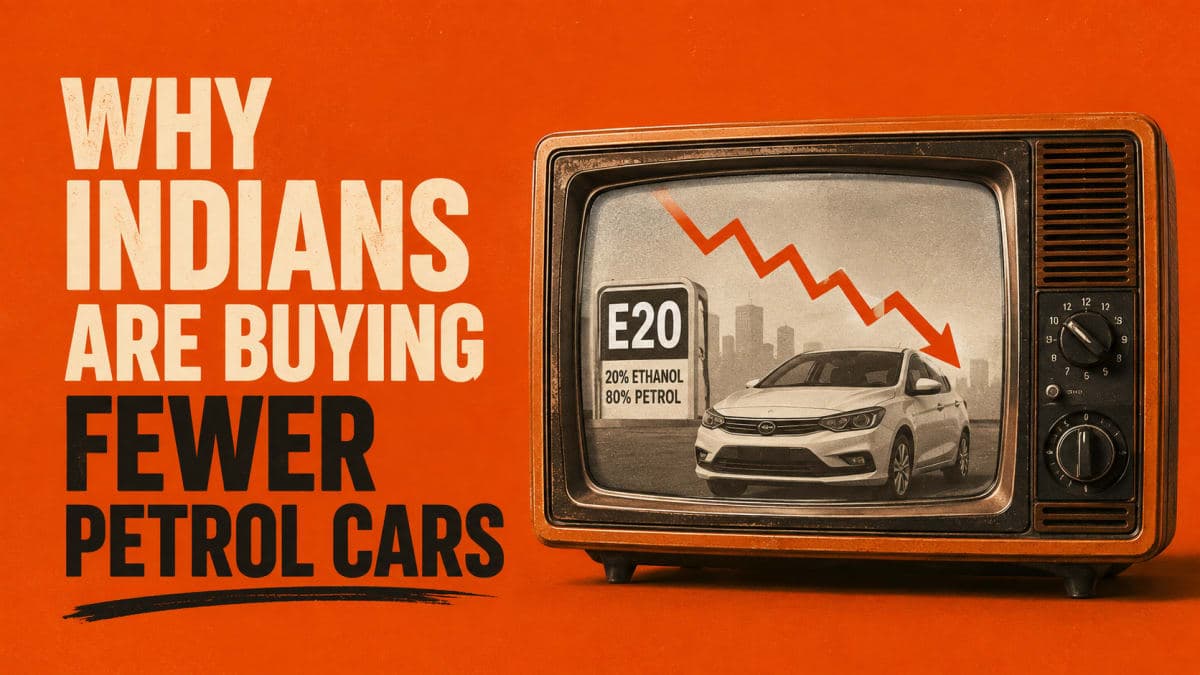
Sometime in the last year, a small blue sticker appeared on your neighbourhood petrol pump. It says E20, and most people filled their tanks without giving it a second glance.
That sticker marks one of the largest fuel experiments in the world. India now blends 20% ethanol, an alcohol distilled mostly from sugarcane and grain, into the petrol sold at every pump in the country.
The logic was elegant. Every litre of ethanol is a litre of crude oil India doesn't have to import, and we've written before about how brutal [India's oil import bill](INTERNAL: india oil import bill story) can get.
Then, the car market flinched. In July 2026, petrol's share of new car sales fell to a record 41.68%, according to FADA, the body that tracks what dealerships actually sell.
To see how fast that is, rewind the tape. Petrol held 51.75% of the market in July 2024 and 48.11% in July 2025, which means the default fuel of Indian motoring lost 10 percentage points in two years.
So here's the question: why are buyers abandoning petrol cars at the exact moment the government made petrol greener and cheaper to produce?
You see, an engine is tuned for a specific diet. Ethanol carries less energy per litre than petrol, and it behaves differently inside older engines that were never designed for a 20% blend.
That gap between chemistry and expectation turned into anxiety. Dealer surveys found buyers delaying petrol car purchases over worries about mileage and engine compatibility, and every WhatsApp forward about ruined engines made the queue at the CNG counter a little longer.
And the alternatives were standing right there. CNG took 24.67% of July's sales, hybrids 8.02% and EVs 7.90%, which together put alternative fuels at 40.59% of the market, just 1.09 percentage points behind petrol itself.
Walk through each player's incentive and the stampede makes sense. The government wants ethanol because it cuts crude imports and pays farmers for surplus sugarcane. Carmakers like Maruti are happy to sell you a CNG variant instead, because the margin is theirs either way.
The buyer's incentive is the simplest of all. If you're unsure whether the fuel will suit the engine, you switch to a car where the question doesn't exist.
But here's the twist. The biggest beneficiary of India's green fuel push isn't the EV. It's diesel.
Diesel was the fuel everyone had written off, yet its share of new car sales rose to 17.73% in July from 16.32% in June. The reason is almost comic: diesel is the one fuel at the pump that carries no ethanol at all, so it has become the anxiety-free option.
There's a second casualty too. Dealerships are sitting on petrol cars nobody wants, with over a fourth of inventory now 60 to 70 days old against a normal cycle of about a month.
Now to be clear, the panic may be bigger than the problem. FADA's own leadership says much of the anxiety comes from misinformation and poor communication, and most cars sold in recent years were built E20-ready. A delayed purchase is not a lost one, and some of those hesitant buyers will drift back to petrol once the noise settles.
So, is petrol actually dying? Not yet, but something more interesting is happening: for the first time, petrol is being forced to compete on trust, not just price. A fuel that was the unquestioned default for a hundred years now has to convince buyers it won't hurt their engine.
The irony is hard to miss. A policy designed to reduce India's dependence on imported petrol may end up reducing India's dependence on petrol cars altogether. Whether that counts as the plan failing or the plan working a little too well is something only time will tell.
Until then…
If this story helped you make sense of the E20 shift, share it with a friend on WhatsApp, LinkedIn, or X. You might also enjoy our story on PhonePe's Lunch.