Back in 2002, Elon Musk tried to buy a second hand rocket from Russia. The deal went badly. The Russians basically laughed him out of the room and treated him like an amateur.
So Musk did what he usually does when someone says no. He decided to build his own rocket company.
Fast forward to this weekend, and that so called amateur project is doing something almost no company in history has done.
If you opened your trading app yesterday and searched for “Space X,” you found nothing. No ticker. No chart. No buy button.
And yet, quietly, behind closed doors in Silicon Valley, Space X just hit a valuation so large it feels fake.
Here is the headline that made Wall Street sit up straight.
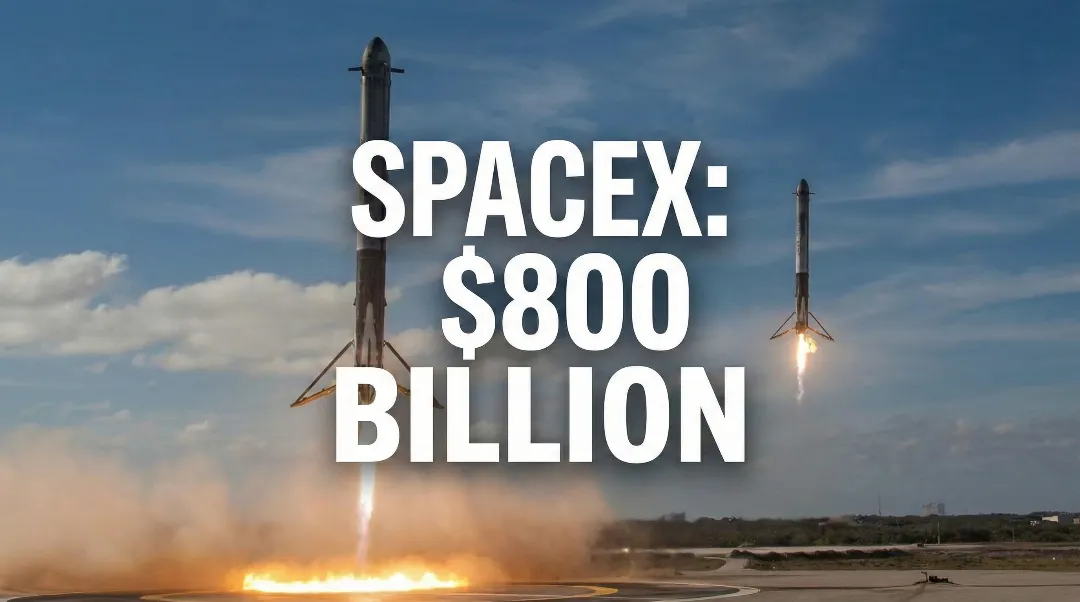
Space X is reportedly finalizing an insider share sale that values the company at around $800 billion.
Let that sink in for a second.
This private company is now worth more than Tesla. It is worth more than the entire economy of Switzerland. And it has still never done an IPO.
Most companies rush to go public once they hit $10 or $20 billion. Even staying private till $50 billion is rare. Staying private at $800 billion is completely unheard of.
What Musk has built is basically a parallel financial universe. Early investors and employees are getting insanely rich, while normal investors like you and me can only watch rocket launches on You Tube.
If Space X is not public, how are people buying shares at $800 billion valuations? Through something called a tender offer. Space X does not issue new shares. Instead, it lets early employees and investors sell their existing shares to selected big players like hedge funds. The price is fixed privately. Money changes hands. The rest of the world is locked out. It is basically a private garage sale for billionaires.
Imagine the stock market is a big public park.
Anyone can enter. Anyone can buy ice cream. Prices are visible. Rules are clear.
Space X is not in that park.
Space X is an underground nightclub hidden inside a bunker.
You know the club exists. You can hear the music from outside. You see famous people walking in. But the bouncer at the door does not let you in.
Inside, people are agreeing among themselves what things are “worth.” Outside, everyone else is guessing.
That is what a private valuation really is. It is just what the people inside the room agree to pay.
That is the uncomfortable question.
The bullish story is strong. Space X dominates launches. Starlink is scaling and already generating real revenue. In many ways, Space X is becoming the infrastructure layer for space, like railroads were for America.
But here is the catch.
Valuation is not revenue.
Investors are paying $800 billion today because they are betting on a future where Starlink connects the planet and Space X stays central to space activity for decades.
If Starship faces delays, if regulations tighten, or if growth disappoints, that valuation can shrink fast. And when Space X eventually goes public and everyone is allowed to buy shares, the scarcity premium can fade.
What looks magical in a private room can look very ordinary in public daylight.
Space X is proving something important about modern markets.
In 2025, you do not need the public stock market to build a near trillion dollar company. If your technology is powerful enough and your story is compelling enough, private capital will chase you all the way to Mars.
And one last mind bending detail.
Elon Musk owns roughly 42% of Space X. At this valuation, his net worth jumps massively on paper. It puts him on a very real path to becoming the world’s first trillionaire, at least on spreadsheets.
Not bad for a guy who once got laughed out of a rocket deal.
The Bottom Line: Public markets are no longer the only game in town. One of the biggest wealth creation events of our generation is happening behind closed doors.
Fun fact: A private $800 billion valuation is a reminder that “worth” can be a room, not a reality. The moment the doors open to public markets, that number has to survive daylight.
If market noise stresses you out, you are not alone. That is exactly why we built First Scroll.
It is a daily, five minute, mobile first finance read that explains what happened, why it matters, and what to remember without hype or panic.
If this article helped you think clearly today, you will enjoy reading First Scroll every morning.
Subscribe to First ScrollSources: Times of India ($800 B valuation) | Economic Times (IPO context) | The Guardian (Space X coverage)