There is a reasonable chance that someone in your family owns TCS shares.
Maybe your parents bought them years ago and tucked them away like a digital gold sovereign. Maybe they sit quietly in a mutual fund you contribute to every month via a SIP.
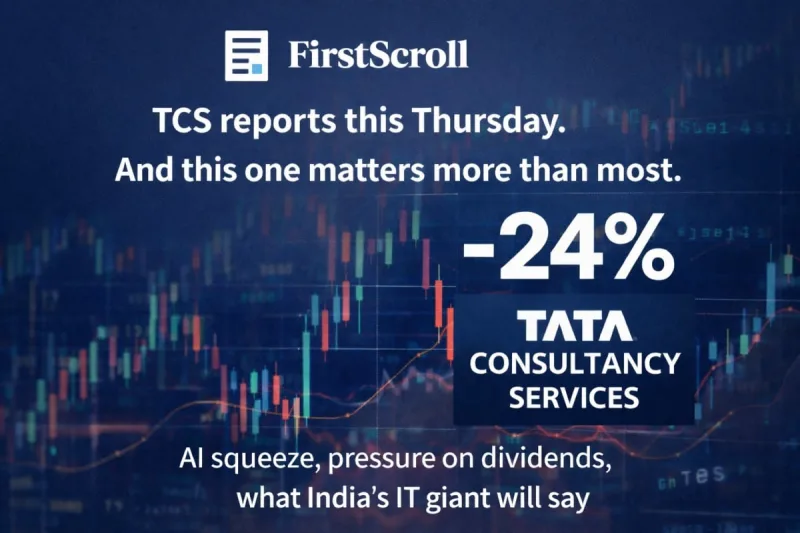
TCS is arguably India’s most widely held blue-chip stock, owned directly or indirectly by tens of millions of households. Which makes the fact that it is down 24% this year worth paying attention to.
On Thursday, April 9, Tata Consultancy Services will report its results for the January to March quarter.
The board will also consider a final dividend payout for the year. Both numbers will land after market hours, followed by a high-stakes management call at 7 PM.
For a company that was once considered as "safe as a fixed deposit" by an entire generation of Indian investors, the recent volatility is genuinely disorienting.
The stock hit a 52-week low of ₹2,348 in late March. To put that in perspective, the stock has shed roughly a quarter of its value in just a few months.
The Rewind
To understand why everyone is holding their breath for Thursday, we have to look back at the mess that was last quarter.
In the December quarter, TCS reported a 14% drop in net profit. On the surface, it looked like a disaster.
However, it was mostly due to "one-offs" unusual, non-recurring expenses. Specifically, there were new government labor laws and a hefty legal claim that ate into the bottom line.
If you stripped those away, the business actually looked okay. But markets are like nervous cats; once they’ve been spooked by a surprise, they stay jumpy.
Q4 is supposed to be the "clean" quarter the one with no excuses and no hidden legal bills.
The Core Explanation
The big number everyone will be hunting for is something called Constant Currency Revenue Growth.
When a company like TCS earns most of its money in US dollars but reports in Indian rupees, the numbers can look fake. If the rupee weakens, the revenue looks like it grew, even if the business stayed flat. "Constant currency" ignores the exchange rate and tells us how much work TCS actually did.
But there is a bigger elephant in the room than just currency fluctuations. It's called Generative AI.
TCS employs over 600,000 people. Its business model has historically been built on "linear growth" if you want to do more work and make more money, you hire more people.
Now, AI tools are making it possible to write code, test software, and manage data much faster.
While that sounds great, it creates a "deflationary" problem. If an AI can do in one hour what used to take a junior engineer five hours, TCS can't bill the client for those five hours anymore.
The Real Insight
Why does this really matter? Because we are witnessing a pivot in the very foundation of the Indian economy.
For thirty years, India has been the "back office of the world." TCS was the crown jewel of that era.
The current stock price slump isn't just about a bad quarter; it’s a crisis of faith. Investors are asking: Can a giant ship like TCS turn fast enough to become an "AI-first" company before its old business model shrinks?
There is a silver lining, though. While AI might shrink old contracts, it’s creating a brand-new market for "AI-centric" deals estimated to be worth up to $400 billion globally.
TCS has already started signing its first AI data center clients. The race is on to see if the new revenue can outrun the disappearing old revenue.
The Broader Impact
This isn't just a story for people who trade stocks.
If you are a consumer, the health of TCS is a proxy for the health of the white-collar job market in India. If TCS stops hiring or slows down, the "trickle-down" effect hits everything from real estate in Bengaluru to car sales in Noida.
For investors, Thursday will be about the dividend. In a year where the stock price has been a nightmare, a healthy dividend payout is the only thing keeping many retail investors from hitting the "sell" button.
Finally, there is the geopolitical angle. The ongoing tension in West Asia has put pressure on global clients in manufacturing and retail. These companies are facing higher energy costs and might decide to put their big "digital transformation" projects on hold.
If TCS management sounds worried about global spending, it’s a signal that the global economy is still on shaky ground.
What to watch for:
The Dividend: Is it high enough to reward the patient "buy and hold" crowd?
The AI Talk: Is the management talking about real revenue from AI, or just "exploratory pilots"?
FY27 Guidance: This is the first time we’ll hear their official outlook for the coming year.
Thursday evening will tell us if the 24% dip was a massive buying opportunity or a warning sign of a changing world.
And that’s why this single earnings report could set the tone for the entire Indian tech industry for the rest of 2026.