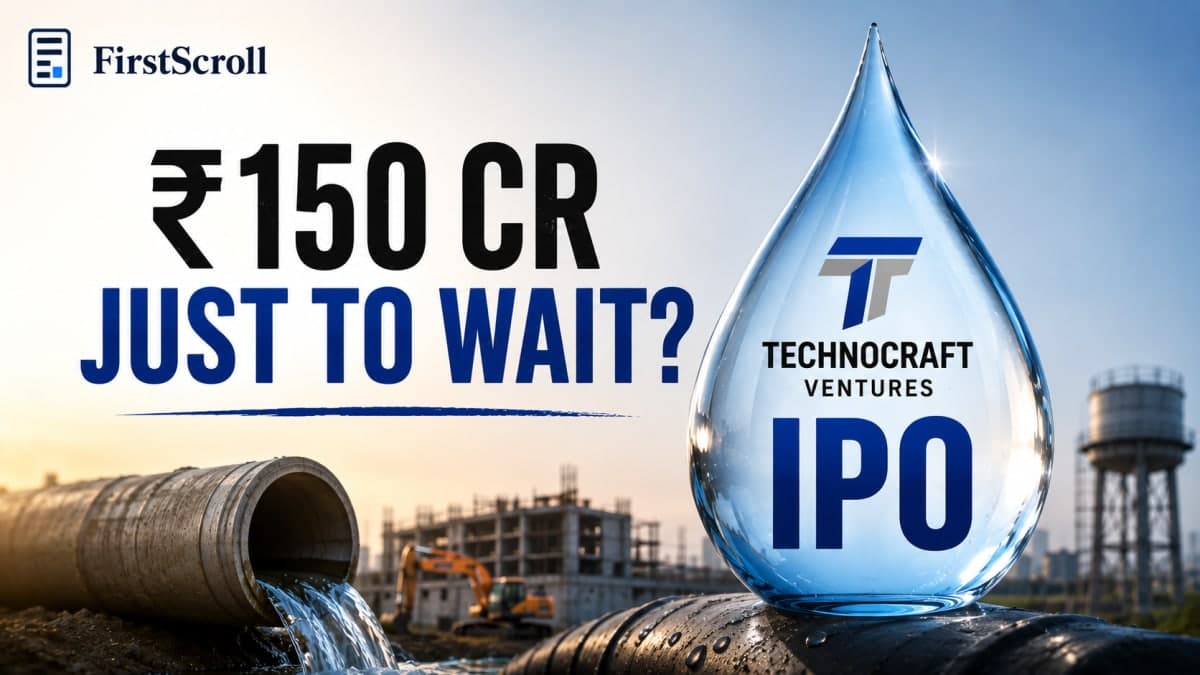
In today's FirstScroll, we break down the Technocraft Ventures IPO and explain why a company with a ₹1,320 crore order book is raising money not to build anything new, but simply to wait.
With that out of the way, let's dive into today's story.
The Story
Think about what happens before clean water reaches your tap. Or where the water goes after it leaves your bathroom.
Somewhere under your city, there's a maze of pipelines, pumping stations and sewage treatment plants that somebody had to design, dig and build. Usually in cramped urban lanes where you can't just tear up the road. And usually for a government department that takes its own sweet time paying the bill.
For over 25 years, a Noida-based company called Technocraft Ventures has made its living doing exactly this. Water supply schemes, sewerage networks, treatment plants and roads, almost entirely for state governments across Uttar Pradesh, Uttarakhand, Rajasthan and Delhi. It even does microtunneling, a technique for boring sewer lines under a city without digging it open.
Then, last week, this quiet builder of unglamorous things went public. The company launched a ₹251.88 crore IPO at a price band of ₹200 to ₹212, and investors showed up. The issue was subscribed over 3 times by Day 2, and the grey market premium hovered around 6 to 11% above the issue price.
On paper, the excitement makes sense. Revenue has grown at a 23.5% CAGR to ₹345 crore, and the company sits on an order book of ₹1,320 crore. That's nearly four years of revenue already signed and sealed.
But look at where the IPO money is going and something odd jumps out. Of the ₹201.51 crore fresh issue, ₹150 crore goes to "working capital requirements". Not a new factory. Not new machines. Not an acquisition.
So here's the question: why does a profitable company with four years of confirmed orders need ₹150 crore of public money just to keep the lights on?
You see, Technocraft is what the industry calls an EPC contractor, short for Engineering, Procurement and Construction. It's a [turnkey model](INTERNAL: what is an EPC company), which means the company handles everything: it designs the project, buys the cement and pipes, hires the workers, builds the thing, and often maintains it afterwards.
And here's the catch baked into that model. The contractor pays for everything upfront. The client, in this case a government water board, pays later. Sometimes much later.
Between winning a tender and getting paid, Technocraft has to buy materials, pay salaries, and park crores with banks as guarantees, essentially security deposits proving it won't abandon the project halfway. All of that money sits locked up for months. Accountants call this gap working capital, and in government EPC work, it's a hungry beast.
That ₹1,320 crore order book? It's not a pile of cash. It's a pile of promises. Every rupee of it must first be spent by Technocraft before it comes back with a margin attached.
This is where the IPO comes in. For the company, the logic is simple: more cash in hand means it can bid for bigger tenders, post larger bank guarantees, and execute more projects at once without choking. The government's push through schemes like the Jal Jeevan Mission and AMRUT has created a flood of water and sewage tenders, and you can only catch as much of it as your balance sheet allows.
And for the promoters? Well, they're taking a little something off the table too. Alongside the fresh issue, promoter entity Kartikey Constructions is selling 23.76 lakh shares worth about ₹50 crore through an [Offer for Sale](INTERNAL: offer for sale explained), essentially an exit door where the money goes to the seller, not the company.
But here's the twist. That headline order book isn't entirely Technocraft's to keep. Roughly ₹917 crore of it is being executed through joint ventures with partner firms, so a chunk of that future revenue gets shared.
There's more. The company carries higher debt than most listed peers, and nearly all its work comes from a handful of state governments in one corner of India. If even one big client, say a state utility, slows down its payments or changes political priorities, the working capital problem the IPO is meant to solve comes roaring back.
Now to be clear, none of this makes Technocraft a bad business. Its margins and return on capital stack up well against established peers, and at a P/E of about 19, it's priced below several larger listed infrastructure companies. The valuation isn't asking you to believe in a miracle, just in continued execution.
So, is this IPO really about growth? Well, in a way, yes. But it's growth of a very specific kind: the ability to survive the wait between building India's water infrastructure and getting paid for it. In the EPC business, the winner isn't always the best engineer. It's often just the one with the deepest pockets and the most patience.
Whether Technocraft's newly filled war chest lasts long enough for the government's cheques to arrive is something only time will tell.
Until then…
If this story helped you make sense of the Technocraft Ventures IPO, share it with a friend on WhatsApp, LinkedIn or X.