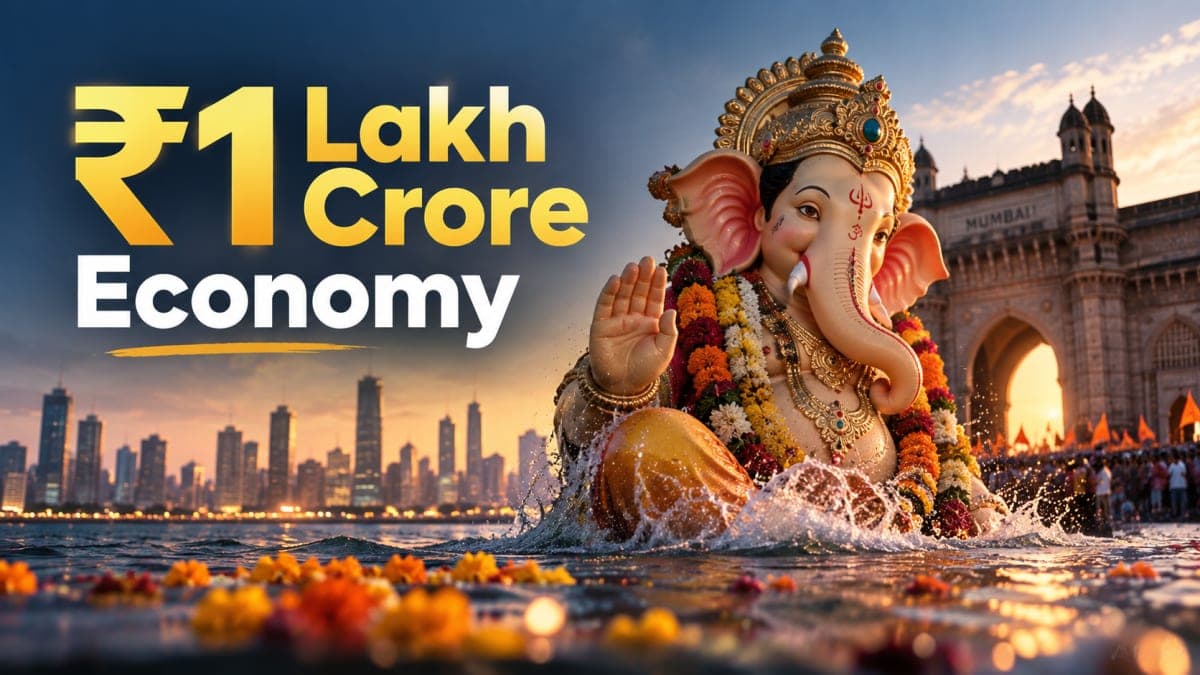
In today's FirstScroll, a Ganesh Chaturthi special we break down how one festival pumps close to a lakh crore rupees through a single city, and why almost everything that money buys is built, on purpose, to be destroyed within eleven days.
Happy Ganesh Chaturthi from all of us. With Bappa home, let's dive into today's story.
The Story
Walk through Mumbai this week and you are walking through one of the largest bursts of economic activity India produces all year. The idols tower over entire streets. The pandals are the size of buildings. Lakhs of people are on the move, trains booked solid for weeks, sweet shops working through the night, electricians and decorators and drummers all suddenly in furious demand.
Put a number on it and the scale is hard to believe. Independent estimates peg the economic activity generated by Ganesh Chaturthi in Mumbai alone at around ₹1 lakh crore, putting the festival in the same conversation as Diwali. The idol-making industry across Mumbai and Pune is worth over ₹500 crore on its own.
Now here is the strange thing nobody stops to notice in the middle of the celebration. Almost every rupee of that is spent on something designed to last barely a week and a half.
So the question is, how does an entire economy this large run on products that are built, deliberately, to be dismantled, dissolved, or immersed within eleven days?
This is worth sitting with, because it flips how we usually think about value. Normally, we associate worth with durability. A house, a car, a gold chain, these hold value because they last. The Ganesh economy does the opposite. The idol is immersed. The pandal, a temporary temple that can cost anywhere from lakhs to crores of rupees to build, is taken down. The decorations come apart. The most expensive things in the whole affair are the most temporary. By any ordinary logic of economics, this looks like building fortunes out of sandcastles.
And that comparison points straight at one of the oldest arguments in economics, one worth understanding because it explains far more than a festival.
There is a famous thought experiment called the "broken window." Imagine a boy smashes a shopkeeper's window. Terrible, obviously. But look, says an optimist, now the shopkeeper must pay a glazier, who earns money, who then spends it elsewhere, and round it goes. The broken window created work. So is breaking windows good for the economy?
The catch, and it is the whole point, is what you do not see. The shopkeeper's money went to replacing something he already had, instead of a new pair of shoes or a book or a tool that would have left him genuinely better off. The glazier gained, but the shopkeeper's forward progress was quietly cancelled. Activity is not the same as wealth. Money changing hands is not automatically money creating something new.
So does the Ganesh economy fall into that trap, a lakh crore of effort spent rebuilding the same thing every year, running fast just to stand still?
Here is where it gets interesting, because the honest answer is: partly, and in the ways that matter, no. And seeing why teaches you to read the "activity versus wealth" question properly, rather than mechanically.
Consider where the money actually lands. A huge share of it flows to artisans, the murti-karigars who spend months shaping idols, to electricians, transporters, flower sellers, sound-system operators, and temporary workers, exactly the kind of people for whom this festival is the single biggest earning window of the year. For a Konkan village, Ganesh Chaturthi triggers a massive reverse migration, as lakhs working in Mumbai and Pune travel home, injecting city wages straight into the rural economy for a fortnight. That is not a broken window. That is a genuine, large-scale transfer of income from richer hubs to poorer ones, and from consumers to skilled and unskilled labour who need it.
This is the part the broken-window logic misses when applied too bluntly. The festival is not only replacing a destroyed idol with an identical one. It is buying something real that the durable-goods view cannot price: the gathering, the devotion, the two weeks of demand that keep thousands of craft livelihoods alive. The "product" being consumed is the experience and the faith, and the idol is just its vessel. You are not meant to keep it, any more than you are meant to keep a concert after it ends. The temporariness is the point, not a flaw.
But here's the twist, and this is where a clear-eyed look earns its keep. There is a cost in this economy that the ₹1 lakh crore figure does not capture at all, and it is paid by everyone, believer or not. Many idols are still made of Plaster of Paris, which does not dissolve cleanly and pollutes the very water bodies it is immersed in, along with the paints and chemicals that go in with it. That environmental damage is a real cost of the celebration, but it appears on no invoice and in no economic estimate. It is the classic externality, a cost pushed onto the commons, silently, while the spending shows up only as a cheerful headline number.
And this is exactly where the money story and the modern shift meet. A wave of green entrepreneurs has begun making idols from clay, terracotta and recycled materials, and these eco-friendly idols often command a premium price. That higher price can feel like a nuisance, but look at what it really is: it is the hidden environmental cost being dragged onto the invoice and paid honestly, up front, instead of being dumped into a lake. When you pay more for a clay idol, part of what you are buying is a cost the cheaper idol was quietly passing to everyone else.
Now, why should you care about the economics under a festival you may simply want to enjoy? Because it hands you a lens you will use all year. Every time a headline claims that some event, a disaster to rebuild after, a war, a spending spree, "boosts the economy," ask the broken-window question: is this creating new wealth, or just churning money to replace what was lost? And ask its partner: what costs are being left off the ledger entirely? Learn to see both the unseen replacement and the unpriced cost, and you will read the economy far more clearly than the headline number allows.
So the paradox of an economy built to be destroyed in eleven days is not really a paradox. Some of it is genuine wealth, income reaching hands that need it and an experience no durable good can replace. Some of it is churn. And some of its true cost is quietly kept off the books. The festival, like the economy around it, is worth celebrating and worth seeing clearly at the same time.
May Bappa clear the obstacles ahead, and may the ledger, this year, tilt a little more toward clay.
Ganpati Bappa Morya.
Until then…
If this gave you a new way to see the festival's numbers, share it with a friend on WhatsApp, LinkedIn or X.