In today’s FirstScroll, we explain the Strait of Hormuz crisis. Why a 33 km strip of water between Iran and Oman has thrown global oil markets into chaos, and what it means for India’s economy, your fuel bill, and BFSI portfolios.
The Story
Picture the busiest highway in your city. Now imagine someone parks a truck across all lanes. Traffic doesn’t slow down. It stops. That’s essentially what happened to global oil markets on the night of February 28, 2026.
The Strait of Hormuz is a narrow strip of water between Iran and Oman. It’s just 33 kilometres wide. And every single day, roughly 20 million barrels of oil pass through it. That’s about 20% of the world’s total petroleum consumption flowing through a corridor narrower than the distance between Connaught Place and Dwarka.
When the US and Israel launched coordinated airstrikes on Iran under Operation Epic Fury, strikes that killed Iran’s supreme leader Ali Khamenei, the fallout was immediate. Iran’s Revolutionary Guard Corps broadcast a message over international maritime radio: no ship is allowed to pass.
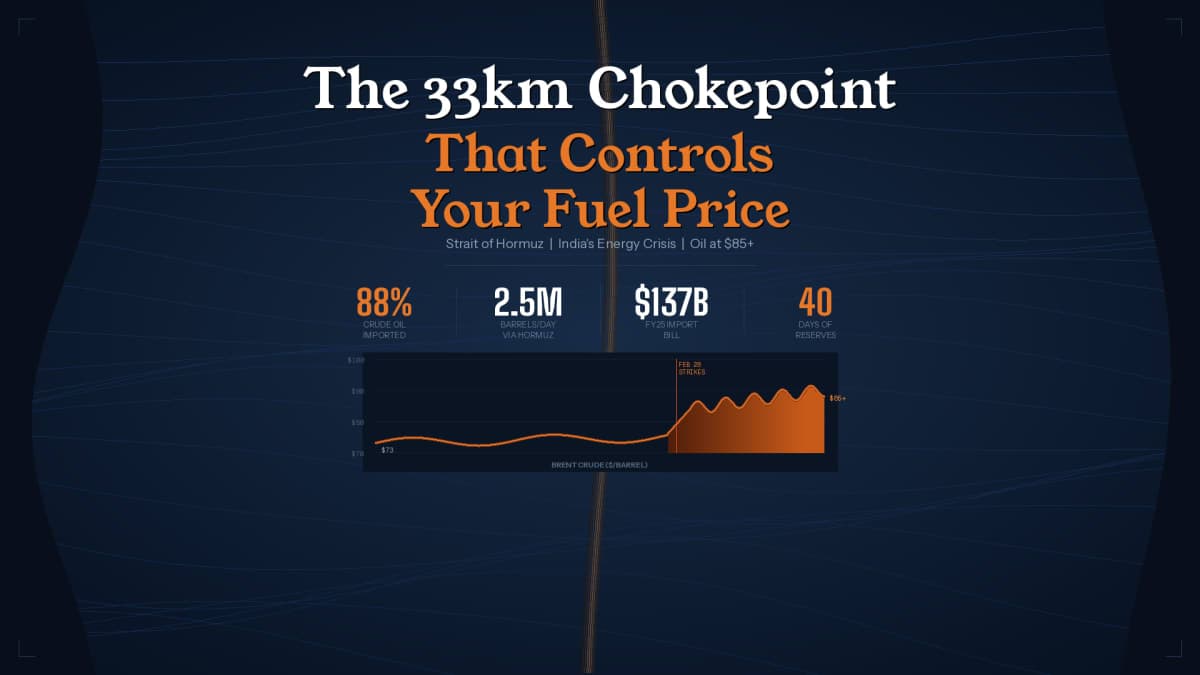
Within 48 hours, tanker traffic through the strait collapsed by over 85%. Five tankers were damaged. Two crew members were killed. Over 750 ships, including 100 container vessels, got stranded or rerouted. And Brent crude, which closed at $73 on Friday, gapped up to the $85–90 range when markets opened on Monday.
For India, this isn’t a distant geopolitical drama playing out on a TV screen. It’s a direct hit to the national economy. Here’s why.
Why India Should Be Worried
India imports about 88% of its crude oil. Let that number sit for a second. For every 100 barrels our refineries process, only 12 come from domestic production. The rest arrive on ships. And more than half those ships sail through the Strait of Hormuz.
According to data from energy analytics firm Kpler, India’s crude imports via Hormuz average about 2.5 million barrels per day. That’s roughly half of the country’s total crude imports of just over 5 million barrels per day.
But it’s not just crude oil. About 53% of India’s LNG (liquefied natural gas) comes from Qatar and the UAE, both of which ship through Hormuz. And roughly 80 to 85% of India’s LPG, the cooking gas that powers over 300 million households, also transits this route.
So when Iran effectively shut the strait, it didn’t just threaten petrol prices. It threatened the gas that heats your dinner and the jet fuel that keeps airlines running.
But Wait. Iran Didn’t Actually Blockade the Strait.
And that’s what makes this so interesting. Iran didn’t formally declare a naval blockade. It didn’t need to. What it did was far more elegant. It made transit economically impossible.
Here’s how. War-risk insurance premiums (the special insurance ships need to pass through conflict zones) spiked by over 50%. Several major insurers outright cancelled coverage effective March 5. For a Very Large Crude Carrier (VLCC), the premium increase alone adds a quarter million dollars per transit.
When you combine that with the physical threat (damaged tankers, missile strikes, IRGC patrol boats), most commercial operators just stopped sailing. Maersk and Hapag-Lloyd, two of the world’s biggest shipping companies, suspended all transits.
In other words, the strait wasn’t closed by a blockade. It was closed by economics. Insurance withdrawal did the work that military interdiction didn’t need to.
And the knock-on effects were brutal. European natural gas prices nearly doubled in three days. Qatar halted LNG production after an Iranian drone struck its Ras Laffan facility. Houthi forces in Yemen resumed Red Sea attacks, forcing even more ships onto the 40-day Cape of Good Hope detour around Africa.
How Much Buffer Does India Have?
India isn’t caught completely off-guard. The country holds about 100 million barrels of crude in combined reserves, stored in underground caverns at Mangalore, Padur, and Visakhapatnam, in refinery tanks, and on ships currently sailing towards Indian ports.
According to Kpler’s lead analyst Sumit Ritolia, this could cover 40 to 45 days of imports if Hormuz flows are fully cut off. Government sources put a slightly different number: 25 days of crude and 25 days of refined products, including volumes in transit.
Either way, India has weeks of cushion, not months.
For context, China has six months of reserves. Japan’s cover 254 days. South Korea’s cover 208 days. India’s position is structurally thinner, well below the IEA’s recommended 90-day benchmark. And the government has acknowledged this gap and says it’s working on expanding to 90 days.
The government has also directed oil marketing companies to stop exporting petroleum products for now, to build up the domestic buffer. And they’ve been clear: no immediate plans to hike petrol or diesel prices.
But the math is unforgiving. India spent $137 billion on crude oiāl imports in FY25. In just the first 10 months of FY26, the bill already stood at $100.4 billion. And analysts at JP Morgan estimate that for every $10 increase in average crude price, India’s annual import bill swells by $13 to $14 billion.
The Russia Wildcard
Now here’s where things get ironic.
Over the past few years, India dramatically increased its purchases of discounted Russian crude. That strategic pivot now provides unexpected insulation, because Russian oil, shipped from Baltic and Arctic ports, doesn’t transit Hormuz at all.
India had recently agreed to wind down Russian crude purchases as part of a trade deal with the US. But that deal is now in limbo after the US Supreme Court struck down Trump’s country-based tariffs.
The geopolitical irony writes itself: the very Russian crude the US pressured India to stop buying is now the most logical alternative supply source, in a crisis triggered by US military action.
Kpler notes that Russian cargoes currently floating in the Arabian Sea without firm buyers could be absorbed quickly. But even if India pivots to other sources (West Africa, Brazil, the US), there’s a hidden cost. Middle Eastern crude reaches Indian ports in 4 to 7 days at 40 to 70 cents per barrel in freight. Crude from the Americas? That’s a 25 to 45-day voyage at $2.50 to $4 per barrel. Roughly 5x the shipping cost.
What’s Happening in Markets?
Indian equities slid sharply in early March. Midcaps got hammered, with several stocks down 40 to 50% from recent peaks. Foreign investors pulled $751 million from Indian equities on March 2 alone, reversing a strong February inflow.
The sectoral damage reads like a textbook oil-shock playbook. Oil marketing companies face margin compression. Aviation stocks are bleeding from surging jet fuel costs. Paint and lubricant makers face input cost headwinds. On the flip side, upstream explorers like ONGC may benefit, but only if prices stay elevated.
Interestingly, Morgan Stanley sees this as a buying opportunity. Their bull-case projects Sensex at 107,000 by December 2026, arguing India absorbs oil shocks better today: lower oil intensity, deeper domestic participation, healthier corporate balance sheets. History tentatively supports this. Past crude spikes led to sharp drawdowns followed by recoveries.
But this crisis is different. A dead supreme leader. A multi-front regional war. Houthi resurgence. The historical playbook may not apply cleanly.
The Bottom Line
The Hormuz crisis is essentially a stress test of India’s energy infrastructure, fiscal resilience, and geopolitical positioning, all running simultaneously.
For anyone in BFSI, the to-do list is immediate. Credit analysts need to reprice energy-sensitive sectors. Equity strategists need crude-at-$80, $90, and $100 scenarios. Fixed income teams need to reassess inflation and rate trajectories. And anyone in wealth management should probably be having a calm, data-driven conversation with clients right about now.
Military analysts suggest active hostilities may not exceed four weeks. India’s reserves roughly align with that window. If this holds, markets recover. If the strait stays shut longer and Brent crosses $100, we’re in uncharted territory for a generation of market participants who’ve never traded through a genuine energy supply crisis.
The next 30 days will tell us whether this is a shock to absorb or a structural shift to navigate.
Either way, a 33-kilometre strip of water just reminded the world who’s really in charge.
If this story helped you understand the Hormuz crisis better, share it with a colleague on WhatsApp, LinkedIn, or X.