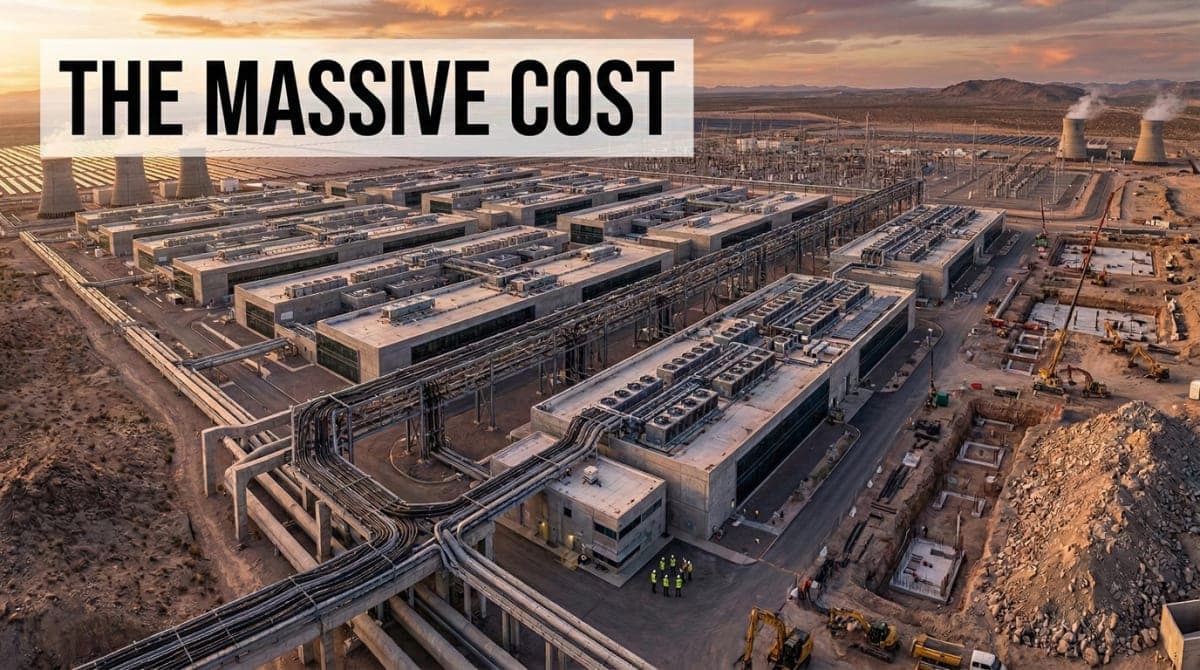
If you walked into a high-end electronics store today, you’d see rows of sleek laptops and VR headsets. But if you could peer into the budgets of the world’s five largest tech companies, you wouldn’t see much interest in the hardware you can touch. Instead, you’d see a staggering $700 billion being funneled into something much more ethereal: AI infrastructure.
That is nearly the entire GDP of Switzerland, being spent in a single year, on chips, cables, and cooling systems.
Why is this happening now? Well, the "AI gold rush" just entered its second, more expensive phase. Last month, Nvidia the company that basically owns the pickaxe market for this gold rush reported record-breaking quarterly revenue of $68.1 billion. That’s a 73% jump from just a year ago.
But here’s the kicker: despite these "off the charts" numbers, investors are starting to get a little twitchy. Nvidia’s stock actually dipped slightly after the news. It’s a classic case of "what have you done for me lately?" in the world of high finance.
To understand why $700 billion is a gamble of historic proportions, we have to look back at how we got here.
The Rewind
For decades, the tech industry followed a predictable rhythm. You’d build a piece of software (like Excel or Facebook), and then you’d run it on standard servers. If you needed more power, you just bought more of the same servers. It was linear. It was manageable.
Then came the "Generative AI" explosion.
Suddenly, the old servers weren’t enough. AI doesn't just "calculate"; it "thinks" (in a mathematical sense) by processing trillions of connections simultaneously. To do that, you need a specific type of engine called a GPU.
In 2023 and 2024, the goal was simple: buy every GPU you can find. It was a mad scramble to build the "brain."
The Core Explanation
Now, the game has changed. We aren't just building the brain anymore; we are building the "factories" to house it.
Think of it like the early days of the automotive industry. First, someone invented the engine. But to make cars a part of daily life, you needed to build massive assembly lines, pave thousands of miles of roads, and set up a global network of gas stations.
That is what the $700 billion is paying for. It’s going toward:
- Data Center Real Estate: Buying up land with massive electricity connections.
- Energy Infrastructure: Tech companies are now essentially becoming energy companies, even investing in small nuclear reactors to keep the lights on.
- Networking: It’s not enough to have fast chips; they have to talk to each other at lightning speed. Nvidia’s networking business alone grew 3.5x to $11 billion recently.
But here’s the interesting part: Nvidia is already pivoting. They’ve halted production of some older AI chips to focus on their next-gen platform, called "Vera Rubin."
Why? Because the tech world is moving from "training" AI (teaching it to speak) to "inference" (using it to actually do things).
The Real Insight
So, why does this really matter?
Because we are witnessing the birth of the "Agentic Economy."
Until now, AI has been a chatbot you talk to. "Hey, write me a poem about a toaster." That’s fun, but it doesn't change the world's GDP.
The next phase the one that requires $700 billion is about AI Agents. These are systems that don't just talk; they act. An AI agent won't just tell you which flights are available; it will book the flight, handle the visa, schedule the Uber, and reschedule your meetings if the flight is delayed.
To run millions of these "agents" simultaneously, you need a level of computing power that makes today's supercomputers look like calculators.
The Broader Impact
For companies, this is a "do or die" moment. If you don't automate your middle-office tasks with agents, your competitor who just saved 40% on labor costs certainly will.
For investors, the risk is a "bubble" scenario. If that $700 billion in spending doesn't translate into actual profits for the companies buying the chips, the music might stop. We saw this with the fiber-optic craze of the late 90s; we built the internet's "roads," but it took a decade for the "cars" (businesses) to show up.
For consumers, it means the "digital ghost" in your phone is about to get a lot more capable and a lot more expensive to maintain.
And that’s why this seemingly astronomical spending isn't just a corporate vanity project; it’s the foundation for the next decade of how we live and work.