Picture this. Iran has effectively closed the Strait of Hormuz. Oil prices have spiked to levels not seen since 2022. Brent crude touched $128 a barrel in early April. California gas prices crossed $6 per gallon. The biggest oil supply disruption in history is unfolding in real time.
Now guess what the S&P 500 is doing.
Hitting record highs.
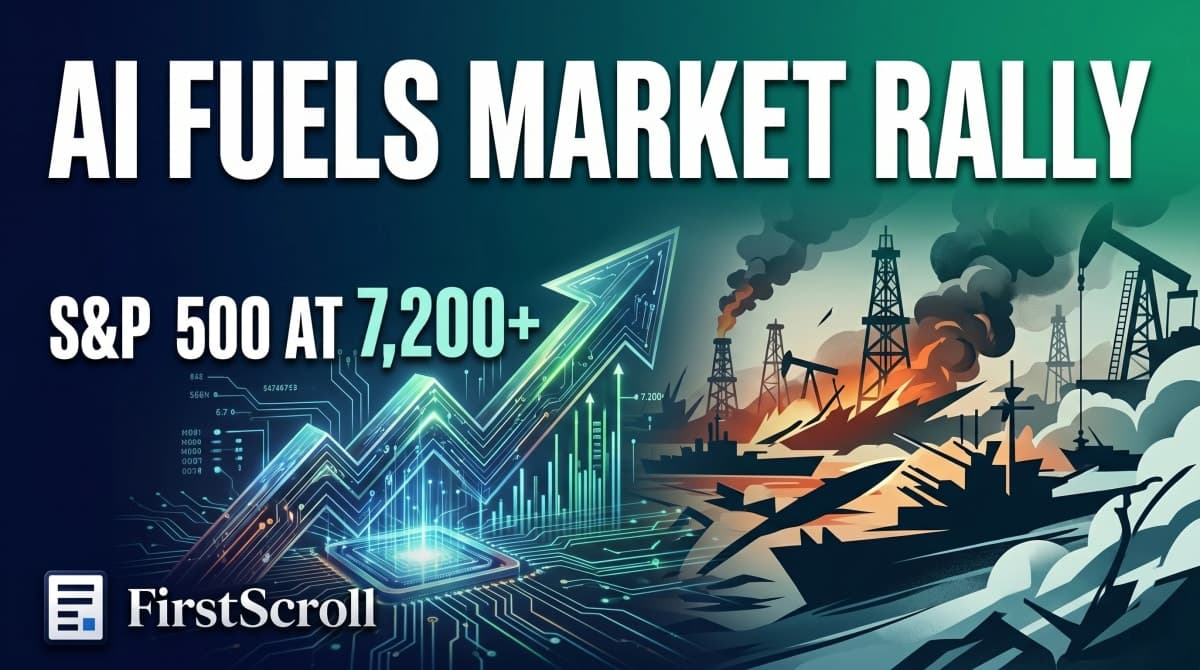
On April 30, 2026, the S&P 500 closed above 7,200 for the first time ever, settling at 7,209.01. The Nasdaq hit fresh all-time highs. The Dow jumped nearly 800 points. And this isn't a one-day fluke. The S&P 500 is up nearly 4% since the Iran war started. The Nasdaq is up nearly 9%.
Wait, what?
You'd expect a global oil shock to crater equities. That's the textbook reaction. Higher oil leads to higher inflation, which leads to higher interest rates, which crushes stock valuations.
So why is the most expensive stock market in the world rallying through a geopolitical catastrophe?
The answer has three letters. AI.
Let's break it down.
The numbers behind the rally
First, just how big is this rally? Let's get the data straight.
Since the recent market low on March 30, 2026, the S&P 500 has rallied more than 12%, and the Nasdaq Composite has rallied more than 18%. The S&P went from being in correction territory in March to record highs by late April, a complete round trip in about 30 trading days.
The S&P 500 closed above 7,000 for the first time on April 15. Two weeks later, it crossed 7,200.
Even more telling? Volatility has collapsed. The VIX (Wall Street's "fear gauge") dropped 10.21% on April 30 alone. The 9-day VIX fell 18.40%. The number of NYSE stocks hitting new 52-week highs jumped from 78 to 143 in a single day. The number hitting new lows fell from 40 to 28.
This isn't fear. This is euphoria.
And it's happening while Brent crude is still trading around $111 per barrel, with US WTI just shy of $100. Oil isn't crashing. Stocks should not be at record highs. But they are.
Why is this happening?
There are five forces driving this strange rally. Let's go through them one by one.
Force 1: AI is eating everything
This is the biggest one. According to Mark Zandi, chief economist at Moody's, AI and tech stocks now account for almost half of the S&P 500's market capitalisation.
His exact words: "Those stocks run on their own dynamic independent of anything, including the war in Iran."
Read that again. Half the S&P 500 is essentially decoupled from the global macro environment. As long as AI capex and AI revenue keep growing, those stocks will keep climbing, regardless of what's happening in the Strait of Hormuz.
According to research firm Strategas, the tech sector is estimated to account for 60% of earnings growth in the S&P 500 this year. Sixty percent. From one sector.
When tech earns, the index moves. And tech is earning like crazy.
What changed? Earlier in 2026, there was real scepticism about whether AI was just an expensive boondoggle. Big players like Meta and Microsoft were spending billions on chips and data centres, but where was the actual revenue? Then came Q4 2025 and Q1 2026 earnings. The revenue showed up. AI subscriptions are growing. Cloud revenue is accelerating. Enterprise customers are signing multi-year contracts. The doubt has flipped to belief almost overnight.
Force 2: Earnings have been ridiculous
Look at what came out of Q1 2026 earnings:
Caterpillar popped nearly 10% on April 30 after posting better-than-expected results and raising its annual revenue outlook. It's now up over 160% in the past year. The reason? Construction demand has surged because of the AI buildout. Data centres need physical infrastructure. Caterpillar makes the equipment that builds the infrastructure that houses the AI that's driving the rally. The flywheel is real.
Qualcomm jumped 16% on Q2 earnings beat.
Intel jumped 23% on a single day after stronger-than-expected earnings and an upbeat forecast.
Eli Lilly rose 7% after blowing past earnings expectations and raising full-year sales guidance to $82-85 billion.
The earnings story is so strong that even Meta's 9% drop (caused by raising AI capex guidance to $125-145 billion, which spooked some investors) wasn't enough to derail the broader rally.
Force 3: The "TACO" trade
This one's fun. There's a phrase Wall Street is using behind closed doors: TACO. It stands for "Trump Always Chickens Out."
Investors have been conditioned, economists say, to believe that President Trump will back off any economic confrontation if the pain becomes too intense. Tariffs scaled back. Strikes called off. Negotiations restarted. Every time markets have priced in the worst, Trump has pulled back, and stocks have rallied on relief.
Right now, despite the US naval blockade of Iranian ports remaining in place, Wall Street is betting that a diplomatic resolution is coming. They've seen this movie before. They know how it ends.
The bet might be wrong this time. But for now, it's powering the rally.
Force 4: The "buy the dip" reflex
Investors have spent the past year being trained that every dip in the market is a buying opportunity. Trade war scare? Buy. Iran tensions? Buy. Inflation panic? Buy. Each time, the market has rewarded the buyers.
As Matt Maley, chief market strategist at Miller Tabak, put it: investors are essentially assuming the oil disruption will not severely hurt the global economy or corporate profits. That assumption has been right enough times that it now drives behaviour automatically.
FOMO is the engine. From institutional investors to retail traders, no one wants to be the person who sat out the next leg up. So they buy. The market rises. More people FOMO in. The cycle continues.
Force 5: Hedge funds went all in
Here's a wild stat. According to Goldman Sachs data, hedge funds bought a record $86 billion in stocks over five trading sessions in mid-April.
That's one of the fastest stock-buying surges on record, driven mainly by systematic, trend-following strategies. Goldman estimates that hedge funds could add another $70 billion if the momentum continues.
When the smart money buys this aggressively, prices move. And when prices move, more money chases the move. It's a self-reinforcing loop that can run for weeks before it breaks.
What it means for India
This isn't just a Wall Street story. It directly affects Indian markets in several layered ways.
Indian IT stocks are riding the wave. TCS, Infosys, HCL Tech, Wipro and Tech Mahindra all generate the majority of their revenue from US clients. When American tech budgets expand because of AI, Indian IT services benefit through implementation, integration and migration deals. The big question is whether AI eats into traditional IT services revenue, but for now, the AI buildout is creating more work, not less. Every enterprise rolling out AI tools needs someone to build the data pipelines, integrate the systems, and retrain the workforce. That's billable hours.
Indian semiconductor and electronics manufacturing. Companies like Dixon Technologies, Kaynes Technology, and Syrma SGS are benefitting from the global AI hardware boom. India's electronics manufacturing services (EMS) ecosystem is finally hitting scale right when global demand is exploding. The PLI scheme has played a quiet role here, attracting global names to set up Indian manufacturing.
FII flows have turned positive. When Wall Street is in risk-on mode, foreign capital flows back into emerging markets. India has been a net beneficiary of this rotation. The Nifty has been quietly tracking higher even with all the geopolitical noise. After months of FPI outflows in late 2025, money has started trickling back, and a sustained rally on Wall Street typically translates into stronger flows for Indian equities.
Indian metal stocks are getting a double kick. The World Bank projects aluminium, copper and tin will all hit all-time highs in 2026, driven by data centre construction, EVs and renewable energy. That's pure tailwind for Hindalco, Vedanta, Hindustan Copper, and JSW Steel. The bigger story here is structural. The metals supercycle isn't a one-year thing. It's a decade-long demand story driven by physical infrastructure for the digital economy.
The flip side: Indian oil refiners and aviation are squeezed. Reliance, IOC, BPCL, HPCL, IndiGo and Air India all face higher input costs because of crude prices. The AI rally lifts some Indian boats. The oil shock sinks others. This is why the Nifty hasn't tracked the S&P 500 perfectly. India's index has more energy and traditional sector weight than the US benchmark, which limits how much of the AI euphoria translates locally.
The bear case (because someone has to say it)
Before you mortgage the house to buy NVIDIA, here's what could go wrong.
Valuation extreme. Tech stocks are not cheap. The S&P 500 is trading at multiples that historically correlate with weaker forward returns. If earnings disappoint even slightly, the air can come out of this rally fast.
The oil shock is real. Even if Wall Street wants to look past it, California gasoline crossed $6 per gallon, the highest since 2023. That's real consumer pain. And consumer pain eventually flows into earnings.
The diversification mirage. BlackRock has flagged that long-term government bonds failed to offset equity declines during the Iran war. The traditional 60/40 portfolio is broken. If stocks fall, there's no obvious hedge waiting to save you.
Concentration risk. If half the S&P 500 is tech, then the index isn't diversified. It's a tech bet wearing a diversification costume. When the tech cycle turns, and it always does eventually, the entire index goes with it.
The TACO trade might fail. What if Trump doesn't back down this time? What if the Iran conflict drags into the second half of 2026? Stocks priced for a quick resolution will reprice fast for a long one.
The bigger picture
Here's the strange thing about this market. It's running on belief.
Belief that AI will keep delivering revenue growth at the current pace. Belief that the oil shock is temporary. Belief that Trump will broker a deal. Belief that the Fed won't have to hike. Belief that earnings will keep beating. Belief that the buyer behind you is bigger than the seller in front of you.
Most of these beliefs might be right. The AI capex cycle is genuinely massive. Earnings are genuinely strong. The economy is genuinely resilient.
But "most" isn't "all." And when a market is priced for everything to go right, even one thing going wrong becomes a problem.
For Indian investors, the takeaway is simple. Don't fight the tape. The AI rally is real, the global tailwinds are real, the FII flows are real. But don't get blinded by the headlines either. Stay invested in your core themes. Be selective in expensive sectors. Keep some powder dry for the day the music slows down.
Wall Street is partying like it's 1999. The smart move is to enjoy the dance while watching the door.
The S&P 500 closed at 7,209 last week.
The next round number is 7,500.
The number after that? Nobody knows. And that's where things get interesting.