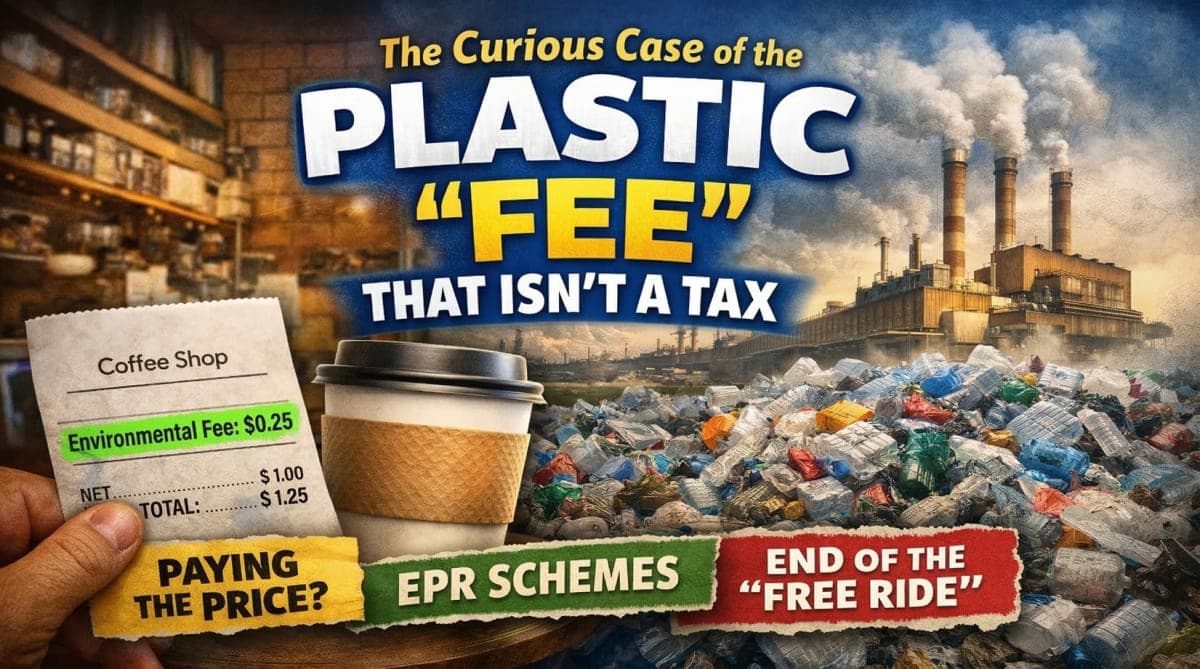
Imagine walking into your favorite coffee shop, ordering a latte, and noticing a small 10-cent surcharge on your receipt labeled "Sustainability Fee." You might shrug it off as a minor annoyance, but behind that dime lies a massive, invisible shift in how the global economy handles trash. We are currently witnessing the birth of a world where "waste" is no longer a footnote in a company's ledger, but a primary cost of doing business.
The Great Plastic Pivot
In recent months, a wave of new regulations across Europe, parts of the U.S., and India has forced consumer goods giants to rethink their entire supply chains. It’s not just about "going green" for the sake of a PR campaign anymore; it’s about the bottom line. Governments are shifting the financial burden of cleaning up plastic from the taxpayer to the producer.
Why does this matter right now? Because for decades, companies could wrap a product in layers of non-recyclable film, sell it, and walk away. The cost of picking up that wrapper from a beach or burying it in a landfill was someone else's problem—usually the local government’s. That "free ride" for plastic is officially coming to an end.
The Era of "Throwaway" Economics
To understand where we’re going, we have to look at how we got here. In the 1950s, plastic was hailed as a miracle material. It was light, sterile, and most importantly incredibly cheap. It allowed companies to ship food across continents without it spoiling.
For years, the economic model was simple: Extract, Make, Dispose. Companies paid for the raw materials (oil and gas) to make the plastic, but they didn’t pay for the "end-of-life" costs. If a plastic bottle took 450 years to decompose, that wasn't a liability on a balance sheet; it was just a fact of nature. This created a massive "externality" a fancy economic term for a cost that a business creates but doesn't actually pay for.
Breaking the "Linear" Chain
But here is where the story gets interesting. Regulators are now introducing something called Extended Producer Responsibility (EPR).
Think of EPR as a "return-to-sender" policy for the entire industrial world. Under these rules, if a company puts 1,000 tons of plastic into the market, they are legally responsible for ensuring a specific percentage of it is collected and recycled.
Shutterstock
Explore
If they can't prove they’ve collected it, they pay heavy fines. This creates a brand-new marketplace. Suddenly, a discarded shampoo bottle isn't just trash; it’s a "credit" that a company needs to balance its books.
Now, you might wonder: why can't they just recycle everything and call it a day?
The problem is that most plastic isn't actually designed to be recycled. It’s often a "cocktail" of different polymers, dyes, and adhesives that are nearly impossible to separate. In the old world, the cheapest option was to make new (virgin) plastic from oil. In the new world, because of EPR fees, using recycled plastic even if it's more expensive to process starts to look like the smarter financial move.
The Real Insight: A Shift in Value
Why does this really matter? Because we are seeing the internalization of environmental costs.
For the last century, our GDP growth was partly subsidized by the environment. We grew fast because we didn't account for the "debt" we were racking up in landfills and oceans. By putting a price on plastic waste, we are finally seeing the "true cost" of a product.
When a company realizes that a specific type of red dye in their packaging makes the plastic unrecyclable and therefore doubles their EPR fee they change the design overnight. Innovation isn't happening because of a sudden surge in corporate soul-searching; it's happening because the math has changed.
The Ripple Effect
This shift hits everyone in different ways:
- For Companies: It’s a race to simplify. We are seeing a move toward "monomaterials" packaging made of only one type of plastic so it's easier to process.
- For Investors: Sustainability reports are no longer "fluff." They are now risk assessments. A company with a high plastic footprint is essentially a company with a high hidden tax burden.
- For Consumers: Yes, some of these costs will trickle down to the price of your groceries. But it also means you’ll start seeing weirder, more innovative packaging like paper-based bottles or refill stations that would have been "too expensive" just five years ago.
The "Plastic Tax" isn't just a way for governments to collect money; it’s a signal to the market. It tells every CEO that the era of "sell and forget" is over. We are moving toward a "Circular Economy," where the goal is to keep materials in use for as long as possible.
And that’s why a tiny fee on your coffee cup is actually a sign of the largest structural change in manufacturing since the Industrial Revolution.