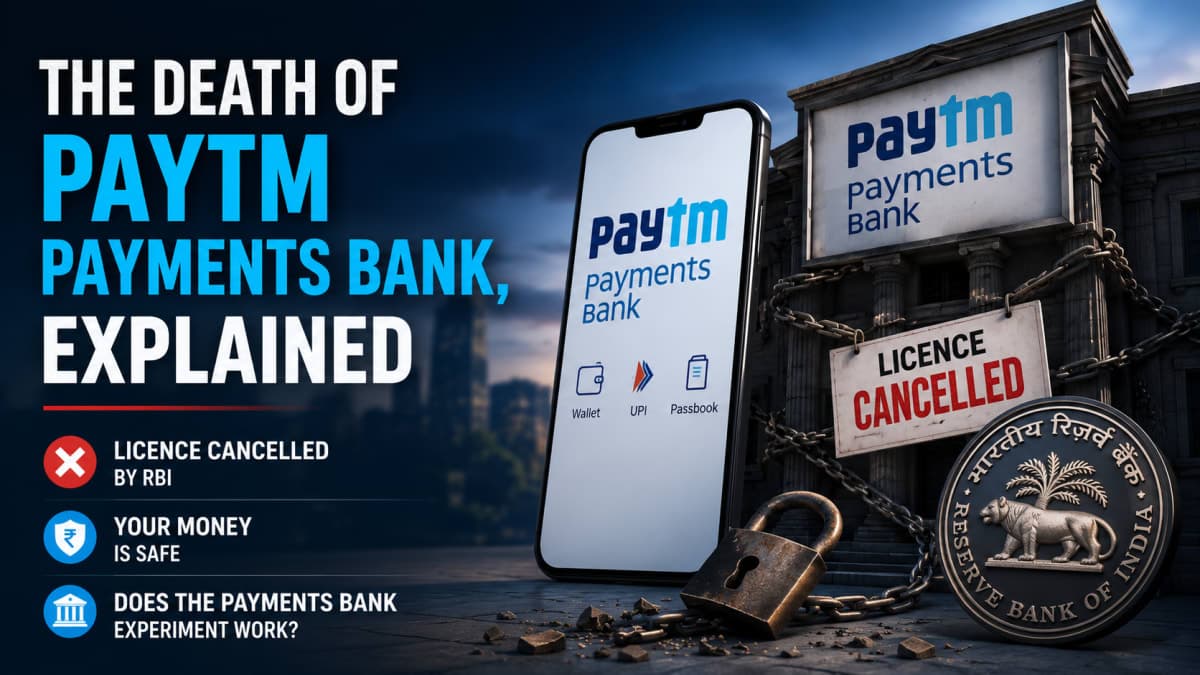
In today's FirstScroll, we unpack why the RBI finally cancelled Paytm Payments Bank's licence, what happens to your money, and the bigger question nobody's asking: does India's payments bank experiment even work?
Before we begin: if you like your business news minus the jargon, in one quick scroll every morning, hit subscribe. Already in? You're awesome. Now, let's scroll in.
The Story
Remember demonetisation? November 2016. Cash vanished overnight, and one blue-and-white app suddenly appeared on every shop counter in India. "Paytm karo" became a verb before most of us knew what a digital wallet even was.
A few months later, in 2017, Paytm got something even bigger. A banking licence. Not a full one, mind you, but a special kind called a payments bank licence. And for a while, it looked like the future of Indian banking had arrived.
Then, on April 24, 2026, the story ended. The RBI cancelled Paytm Payments Bank's licence with immediate effect, prohibited it from doing any banking business, and said it would approach the High Court to formally wind the bank up.
Wait, what exactly is a payments bank, you ask?
Good question. Back in 2014, a committee set up by the RBI had a clever idea. India had millions of people, especially migrant workers and low-income households, who had money but no bank account. So why not create a lighter, tech-first bank just for them?
Enter the payments bank. It could accept deposits, but only up to ₹2 lakh per customer. It could issue debit cards and enable payments. But it could not lend money or issue credit cards. And to keep things ultra-safe, it had to park 75% of its deposits in government securities.
In simple terms, a bank with training wheels. All the deposit-taking, none of the risky lending.
The RBI handed out approvals to 11 players, and Paytm's version quickly became the biggest of the lot, powering crores of wallets, savings accounts and FASTags.
So what went wrong?
Compliance. Or rather, the chronic lack of it.
For years, the RBI kept flagging problems at the bank: KYC irregularities, weak controls, and concerns about how closely the bank's operations were tangled with its parent, One97 Communications. Warnings turned into penalties. Penalties turned into restrictions.
Then came the hammer blow. In early 2024, the RBI barred the bank from accepting any new deposits after March 15, 2024. No wallet top-ups. No FASTag recharges. Nothing. The bank could only let customers withdraw what was already there.
Think about that for a second. A bank that cannot accept deposits is like a restaurant that cannot serve food. It was still technically open. But it was already finished.
So the licence cancellation in April 2026 wasn't really a sudden death. It was a death certificate for a patient who had flatlined two years ago. The RBI's stated reasons? Persistent non-compliance and management practices detrimental to public interest, invoked under Section 22 of the Banking Regulation Act, the law that decides who gets to call themselves a bank in India.
Okay, but I use Paytm every day. Should I panic?
Short answer: no. And this is where you need to separate two things people constantly mix up.
Paytm, the app you use, is run by One97 Communications. Paytm Payments Bank was a separate entity that sat underneath some of its services. The app, UPI payments, QR codes, Soundbox, ticket bookings and Paytm Money all continue to work, because Paytm shifted these services to partner banks like Axis, HDFC, SBI and Yes Bank back in 2024.
As for money stuck in the bank itself, the RBI has explicitly assured that the bank has enough liquidity to repay every single depositor in full. Remember, 75% of deposits were sitting in government securities all along. The training wheels did their job. And as a backstop, every bank deposit in India is insured up to ₹5 lakh under DICGC, well above the ₹2 lakh cap these accounts had anyway.
Even Paytm's parent company shrugged. It said there's no fresh financial impact because it had already written off its entire investment in the bank back in March 2024.
So if nobody loses money, why does this matter?
Because of what it says about the model itself.
Payments banks were India's grand financial inclusion experiment. Eleven approvals were granted. Several players surrendered their licences before even starting. Others shut shop after burning cash. And now the biggest, most recognisable name in the pack has had its licence torn up.
Here's the uncomfortable math. A bank that cannot lend cannot earn the interest income that keeps normal banks alive. It survives on wafer-thin fees from payments and transfers, in a country where UPI made payments free. So payments banks were squeezed from birth: not enough revenue to build robust compliance systems, and not enough margin for error when regulators came knocking.
Paytm Payments Bank didn't just fail its compliance tests. It exposed how hard it is to build a viable bank when the rulebook takes away your biggest source of income.
So there you have it. The app survives. The deposits are safe. But India's boldest banking experiment just lost its poster child. And the next time someone pitches "banking for the unbanked," the RBI's first question will probably be a simple one. Who pays for the compliance?
Until the next scroll…
Enjoyed this one? Share it with that friend who still says "Paytm karo" at every chai tapri, on WhatsApp, LinkedIn and X.
Disclaimer: This article is for informational purposes only and is not investment advice. Please consult a SEBI-registered financial advisor before making investment decisions.