The Story
Think about your smartphone for a second. It’s essentially a slab of glass and metal powered by a fingernail-sized piece of silicon. For decades, India has been great at writing the software that runs on that silicon, but we’ve had a “missing middle.” We didn’t make the chips, and we certainly didn’t own the blueprints for them.
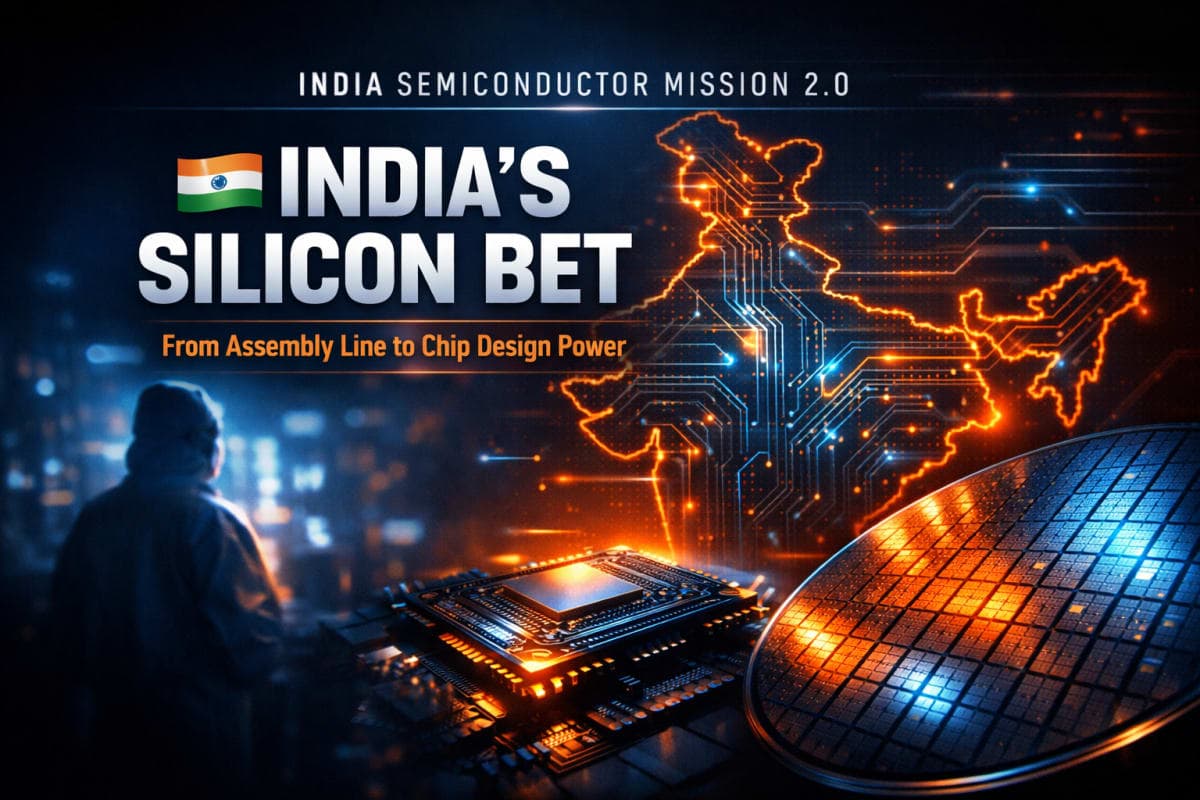
Last week, however, the government decided it was time to move from being the world’s “back office” to its “brain factory.” Enter: India Semiconductor Mission (ISM) 2.0.
The Foundation: Beyond the “Screwdriver” Economy
If ISM 1.0 (launched in 2021) was about getting companies to set up massive “Fabs” the multi-billion dollar factories that print chips ISM 2.0 is about the ingredients and the recipes.
Sidebar: A “Fab” is a semiconductor fabrication plant. It is arguably the most complex manufacturing facility on Earth, requiring a dust-free environment 100 times cleaner than a hospital operating room. Even a single speck of dust can ruin a multimillion-dollar wafer.
In the Union Budget 2026, the government allocated a fresh ₹1,000 crore specifically for this second phase. But don’t let that number fool you. It sits on top of a massive ₹8,000 crore total financial outlay for the year to support a sector projected to be worth $110 billion by 2030.
For years, India’s electronics industry was largely an “assembly” play what many call the screwdriver economy. We imported the parts and put them together. But chips are different. They are the highest point of the value chain. If you don’t make the chips, you’re always just a customer, never the creator.
The Big Reveal: Owning the “Recipe”
Here is where it gets interesting. Under ISM 2.0, India is shifting focus toward “Indian Semiconductor IP” (Intellectual Property).
What does that mean? Think of it like this: Instead of just paying a Taiwanese giant like TSMC to set up a factory here to make their chips, the government is incentivizing Indian startups to design the actual architecture of the chips.
One big win already on the board? The DHRUV64.
It’s an Indian-designed 64-bit microprocessor that can be used in everything from 5G towers to your car’s dashboard. Developed by C-DAC, it represents a “Made in India” brain that doesn’t rely on Western blueprints. As of early 2026, Indian startups have already completed 16 “tape-outs” that’s industry-speak for finishing a design and sending it to be printed.
The “Why” Behind the Billions
You might wonder, “Why are we spending so much on tiny pieces of silicon when we have other pressing needs?”
The answer lies in Technological Sovereignty.
Recent global disruptions the pandemic and geopolitical tensions showed us that if the world runs out of chips, the world stops. Cars couldn’t be finished, medical devices were delayed, and even simple household appliances became expensive.
By building a domestic ecosystem, India is doing more than just creating a new industry; it’s buying an insurance policy against future global shocks.
So What? The Personal Impact
Why should you care if the chip in your next microwave or EV is “Designed in India”?
The Jobs Shift:
ISM 1.0 creates factory jobs (operators and technicians). ISM 2.0 creates high-value R&D jobs. We’re talking about shifting from “blue-collar” assembly to “white-lab-coat” innovation.
The Price Tag:
As more of the value chain moves to India from the chemicals and gases used in Fabs to the design tools the cost of electronics for Indian consumers could eventually stabilize or even drop, as we reduce expensive imports.
The Talent Hub:
With over 60,000 Indian engineers being trained through partnerships with global giants like Lam Research, your younger cousin might soon be graduating as a “Chip Architect” rather than just another “Software Developer.”
The Road Ahead: 3nm and Beyond
We’re still a long way from catching up to giants like Taiwan or South Korea, who are already looking at 2-nanometer (nm) technology.
Sidebar: In the world of chips, smaller is better. A 2nm chip is significantly faster and more energy-efficient than a 28nm chip. India’s roadmap currently aims for the 3nm and 2nm nodes by 2035.
The competition is fierce. The US, Japan, and the EU are all throwing hundreds of billions of dollars at their own chip industries. India’s edge? We already provide 20% of the world’s chip design talent. We’ve been designing the world’s chips for 30 years we just haven’t been doing it for Indian companies.
The Closing
If ISM 1.0 was the foundation clearing the land and pouring the concrete ISM 2.0 is the first floor of a very expensive, very high-tech house.
The goal is ambitious: to design and manufacture 70–75% of domestic chip demand by 2029. It’s a high-stakes game where the cost of entry is billions of rupees and the margin for error is measured in nanometers.
Until then… we’ll keep tracking the “tape-outs” to see which Indian startup becomes the next global silicon superstar. 😉