The Curious Case of the Tax Cut That Wasn’t
You’ve probably heard the news: the government just slashed fuel taxes by a staggering ₹1.5 lakh crore. On paper, it’s one of the biggest "gifts" to the Indian taxpayer in recent memory, yet if you visited a petrol pump this morning, you likely noticed something strange. The price on the digital display didn’t budge by a single paisa.
How can the government give up a mountain of tax revenue roughly equivalent to the entire annual budget for rural employment and still leave you paying the same price for a full tank?
What’s Happening?
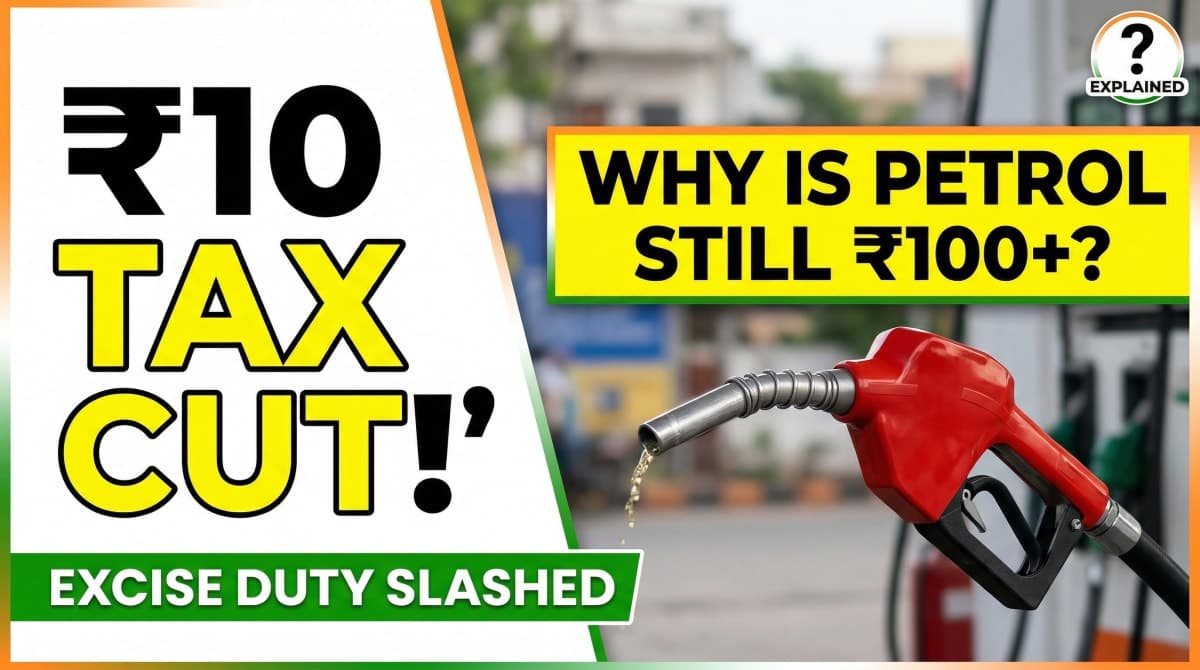
On March 26, the Finance Ministry dropped a bombshell. They slashed the excise duty on petrol from ₹13 per litre to just ₹3, and they effectively wiped the tax on diesel down to zero.
By all accounts, this should have been a moment of celebration for every vehicle owner in the country. Petroleum Minister Hardeep Singh Puri hailed it as a "visionary" move to protect the common man.
But as the dust settled, a confusing reality emerged. The retail price at the pump remained frozen. To understand why, we have to look at a map of the Middle East and a very specific set of corporate bank accounts.
The Rewind
To see how we got here, we have to go back to late February. Geopolitical tensions between the U.S., Israel, and Iran shifted from a simmer to a boil.
Almost overnight, the global energy market panicked. Crude oil, which had been comfortably sitting at $70 a barrel, suddenly rocketed toward $120. For a country like India, which imports nearly 85% of its oil, this was an economic nightmare.
But here’s the twist: India’s retail fuel prices haven't actually moved since April 2022.
For four years, through the war in Ukraine and various global shocks, the price at your local pump has been kept behind a glass "freeze" by the state-owned Oil Marketing Companies (OMCs) the giants we know as IOCL, BPCL, and HPCL.
The Core Explanation
Think of these OMCs as a massive sponge. When global oil prices go up, the government doesn't always let the pump prices rise because that would make everything from bus tickets to tomatoes more expensive.
Instead, they ask the OMCs to "absorb" the hit.
But a sponge can only hold so much water. With global crude hitting $100–$120 a barrel, these companies weren't just taking a hit; they were hemorrhaging cash. Experts estimated they were losing roughly ₹24 on every litre of petrol and ₹30 on every litre of diesel they sold.
Scroll Note: Oil Marketing Companies (OMCs) These are the state-run firms that buy crude oil, refine it, and sell it to you. Because they are government-controlled, they often prioritize "price stability" over their own profits to prevent inflation from spiraling out of control.
When the government announced this massive tax cut, they weren't trying to lower the price you see at the pump. They were trying to throw a life jacket to these drowning companies.
The Real Insight
Why does this really matter? Because it reveals a massive, invisible subsidy.
The tax cut acts as a "buffer." By lowering the tax, the government essentially told the oil companies, "We’ll take less money so you can cover your losses without raising prices on the public."
It’s a clever political move. If the government had let prices rise, there would be protests in the streets. If they did nothing, the oil companies might eventually go bust or stop being able to buy new crude.
By cutting taxes, they’ve chosen a third path: taking the hit on the government’s own balance sheet.
But here’s the catch. This "gift" to the OMCs only covers about 30% to 40% of their total losses. They are still technically selling fuel at a loss; they’re just losing less than they were last week. This is why your petrol price didn't go down it was already being "artificially" held down, and this tax cut simply makes that holding pattern sustainable for a little longer.
The Broader Impact
This isn't a free lunch. That ₹1.5 lakh crore in lost tax revenue has to come from somewhere.
For the government, it means a much tighter budget. They might have to borrow more money or cut spending on infrastructure and social schemes to plug this hole. It’s a gamble that global oil prices will eventually drop back down before the treasury runs dry.
For investors, it’s a mixed bag. The state-run oil companies are safer than they were a week ago, but they aren't exactly "profitable" yet.
Meanwhile, private players like Reliance are facing a new hurdle. To ensure fuel stays in India, the government added a heavy "export tax." If you want to sell your fuel to Europe or the US to make a quick buck on high global prices, you now have to pay a massive exit toll to the Indian government.
The Takeaway
So, the next time you see a headline about a "massive tax cut" and wonder why your wallet doesn't feel any heavier, remember the OMCs.
You aren't paying less for petrol, but the government is paying a lot more behind the scenes to make sure you don't pay more.
And that’s why this record-breaking tax cut resulted in a grand total of zero change at the pump.