In today's FirstScroll, we unpack why India just changed the way it calculates GDP and what these new numbers reveal about the real state of our economy.
The Story
Imagine you've been tracking your fitness using a weighing scale from 2011. It's been a loyal companion, but let's be honest your lifestyle, diet, and exercise habits have completely changed in fifteen years. If you want to know how healthy you actually are today, you need a modern scale that understands your current body.
That's exactly what the Indian government just did with our economy.
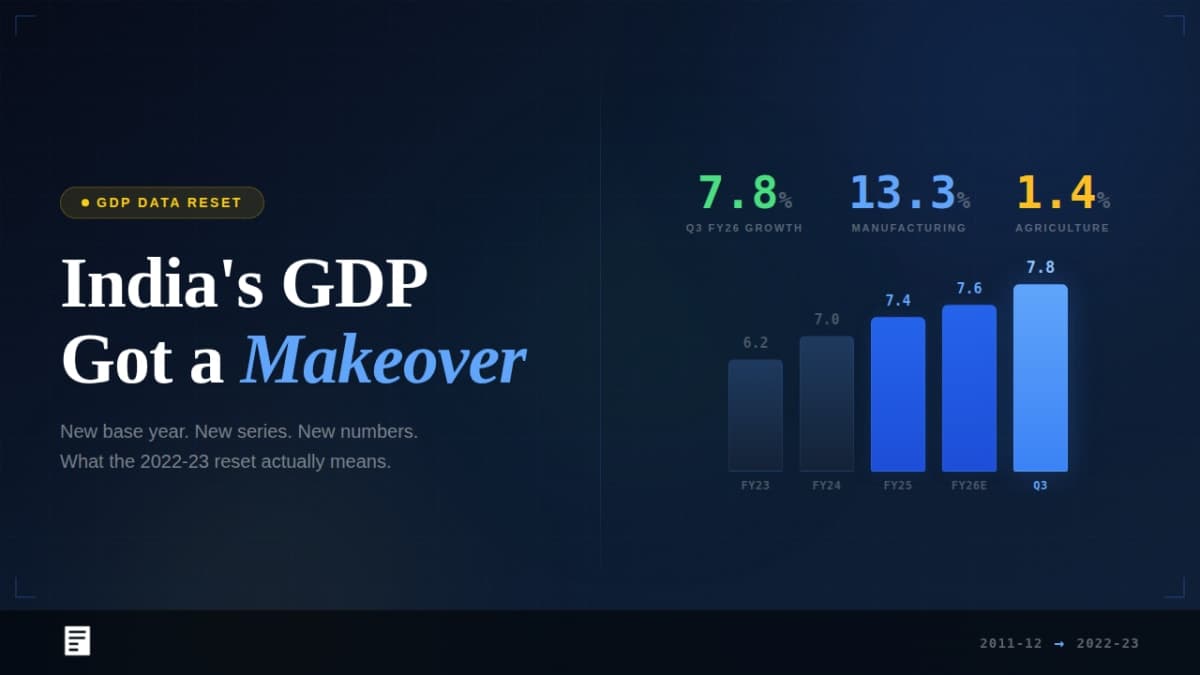
On Wednesday, the Ministry of Statistics and Programme Implementation (MoSPI) officially retired the old 2011-12 "scale" for measuring Gross Domestic Product (GDP) and replaced it with a brand-new base year: 2022-23. Along with this reset, they dropped the latest growth numbers.
The results? Interesting.
But first why does a "base year" even matter?
GDP measures the total value of all goods and services produced in a country. To compare today's output with the past without getting distorted by rising prices, economists anchor everything to a "base year" a constant benchmark. By shifting that benchmark from 2011 to 2022, the government is trying to capture the real India of today: one shaped by Digital India, a booming quick commerce and gig economy, and a manufacturing base that simply didn't exist a decade ago.
Think of it this way: in 2011, your "market basket" probably didn't include 5G data plans, EV charging, or OTT subscriptions. By updating the base year, the GDP calculation finally starts seeing these industries for what they are.
The new scoreboard
Under the revised framework, India's GDP growth for Q3 FY26 (October–December 2025) came in at 7.8%. That's a notch below the 8.4% from the previous quarter but it comfortably beat most analyst estimates. The full-year growth projection for FY26 has also been revised upward, to 7.6%.
And the standout performers aren't who you'd expect.
Manufacturing surged 13.3%, signalling that the Make in India push may finally be hitting its stride. On the other end, agriculture limped along at just 1.4%. It's the classic tale of two Indias one building high-tech factories, the other still at the mercy of the monsoon.
Here's the catch
The headline numbers look impressive, but the composition of that growth is drawing scrutiny. A significant share of the 7.8% is being driven by government spending and large-scale infrastructure investment highways, bridges, railways. Private consumption you and me spending on clothes, cars, and coffee is growing, but not at the same pace.
So where does that leave us?
On one hand, the revised data series cements India's position as the fastest-growing major economy in the world. It also corrects some historical distortions, revealing that manufacturing was healthier over the past two years than earlier estimates suggested.
On the other hand, the average Indian may not feel 7.8% richer. When growth is fuelled more by factories and capex than by everyday spending, it takes longer for that prosperity to reach the common person's wallet.
So What?
The GDP reset is essentially a software update for how we measure the country. It doesn't create more money but it gives us a far more accurate map of where the money is moving.
For you, this means the sectors worth watching (and perhaps investing in) are shifting. The old champions of the 2011 era are making way for a manufacturing- and services-led boom. India is no longer just the world's back office; it's becoming the factory floor.
The numbers are encouraging. But the real test? Whether this growth eventually reaches India's rural heartlands where, for now, the reset hasn't changed much at all.
Until next time…
Changing the scale doesn't change your weight but it does change how you plan your next meal.
If this helped you understand why India's GDP numbers just changed, share it with a friend on WhatsApp, LinkedIn, or X.