In today's FirstScroll, we look at the most ironic IPO in Indian history. The company that runs the stock market is about to join the stock market. Every trade you've ever placed quietly paid this company a toll. Now, for the first time, you can own a piece of the toll booth itself. But the fine print has three twists you need to know.
The Story
Here's a fun question. Every time you buy a stock, who makes money for sure?
Not you, your stock might fall. Not the seller, they might have sold too early. But one player earns on every single trade, win or lose, bull market or crash: the exchange where the trade happens. And in India, that means one name above all, the National Stock Exchange.
On June 17, 2026, NSE filed its draft papers with SEBI for an IPO worth about ₹30,000 crore, set to be the largest listing in Indian history, beating Hyundai Motor India's record. The house that hosts the market is finally joining the market.
To understand why this is such a big deal, you first need to see what an incredible business an exchange actually is.
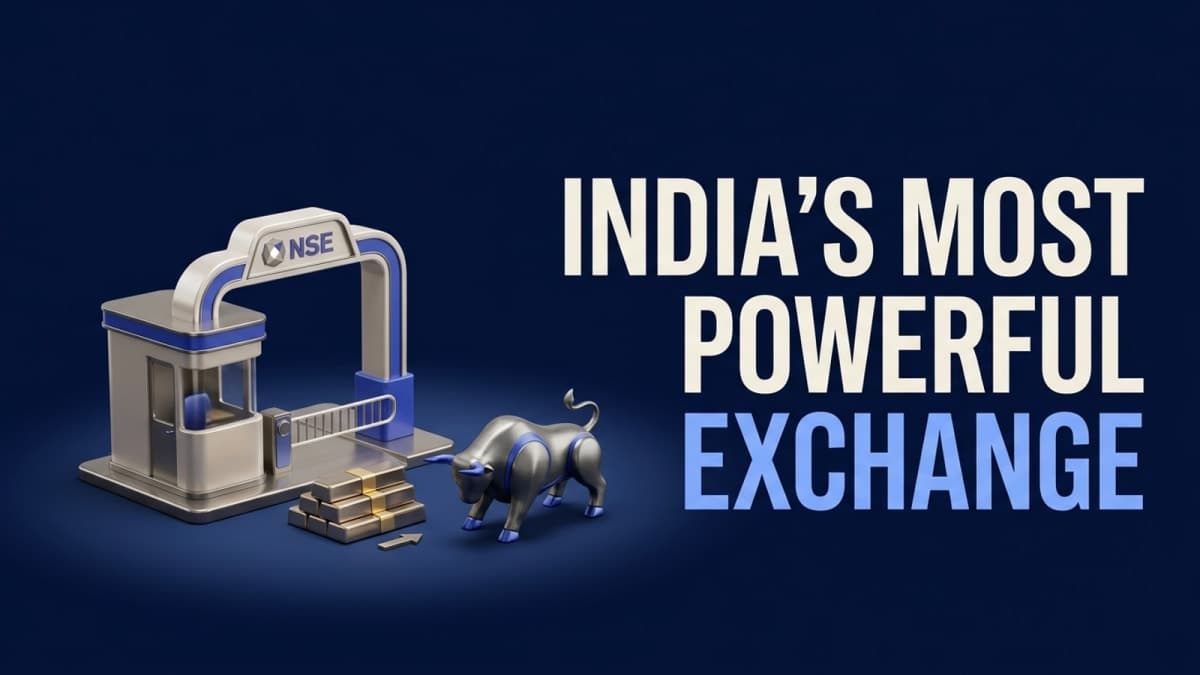
The toll booth on every trade.
Think of NSE as a giant toll road. Every share bought, every option traded, every future settled, a tiny fee flows to NSE. Individually, these fees are microscopic. But NSE processes an ocean of them: in FY26 it handled a peak of 2,189 crore order messages in a single day, executing over 20 crore trades daily.
Millions of tiny tolls, every trading day, forever. That's the business. And its grip on Indian trading is nearly absolute: around 93% of the cash market, 99.8% of equity futures, and about 75% of equity options. By number of trades, it's the largest exchange on the planet. BSE, the older rival, is a distant second in almost everything.
Now look at what that dominance produces. NSE earned a profit of ₹10,302 crore in FY26 at a net margin of around 55%. Read that margin again. For every ₹100 NSE earns, ₹55 is pure profit. For comparison, Nasdaq, a global exchange peer, runs at about 21%. Even the money sitting in the system works for NSE: it holds over ₹30,000 crore in members' margin and settlement money, which quietly earns interest on the side.
A near-monopoly, toll-based income, 55% margins, and a 32% return on equity. It might be the single best business model in India. So why has it taken until 2026 to list? That's where the story darkens.
The scandal that delayed the party for a decade.
NSE first tried to go public back in 2016. Then a bomb went off: the "colocation" scandal, allegations that some high-speed traders got unfairly early access to NSE's price data feeds, letting them front-run everyone else. In a business whose entire value is trust in a fair market, this was poison.
Years of investigations, court battles, and management churn followed. The saga finally closed in June 2025 when NSE paid ₹1,387 crore, the largest settlement SEBI has ever taken, and SEBI issued its no-objection certificate in January 2026, with the Delhi High Court tossing out a last legal challenge weeks later. A decade lost, but the runway finally cleared. NSE still carries a ₹1,391 crore provision for ongoing legal matters, a scar it discloses openly.
So the toll booth is finally up for sale. Should you be excited? Before you answer, here are the three twists in the fine print.
Twist #1: NSE gets zero rupees from this IPO.
This is a 100% Offer for Sale. Meaning: no new shares, no fresh money flowing into NSE to grow the business. Every rupee raised goes straight to the existing shareholders who are selling, SBI, GIC Re, Canada's pension fund CPPIB, Morgan Stanley and others (LIC is keeping its full 10.72% stake).
Nothing illegal or unusual about that. But understand what you're buying: you're not funding NSE's future. You're buying out its early investors, who are cashing in after decades. When smart institutional money sells, it's always worth asking why they're selling now.
Twist #2: The monopoly's profit is actually falling.
Here's the uncomfortable number. NSE's FY26 profit fell about 15.5%. How does a near-monopoly's profit fall? Because of where its money really comes from.
Transaction charges make up nearly 79% of operating revenue, and options alone contribute about 60%. In other words, NSE's fortunes rise and fall with the F&O casino, the same derivatives frenzy where SEBI's own studies show most retail traders lose money.
And SEBI has been deliberately cooling that casino: fewer weekly expiries, bigger lot sizes, stricter norms. Sound familiar? It's the exact same regulatory squeeze that hit Zerodha's profits. When the regulator turned down the options tap, everyone drinking from it, brokers and the exchange alike, felt it. The most powerful exchange in India has the same single point of failure as the brokers trading on it.
Twist #3: The price assumes perfection.
At the discussed valuation of around ₹5 lakh crore, NSE would list at roughly 48 times its annual profit. That's a rich price for a company whose earnings just went backwards, even a world-class one. Bulls argue a 55%-margin monopoly with India's growing investor base deserves a premium. Bears note that recent richly-priced IPOs have listed below their issue price, and that NSE's biggest profit engine sits squarely in SEBI's crosshairs. Both sides have a point, which is exactly why the final price band matters more than the hype.
Oh, and one delicious irony to finish: since an exchange cannot list on itself, NSE's shares will trade only on BSE, its arch-rival. The king of Indian markets will ring the bell at the competitor's house.
So, what is the NSE IPO really?
It's a chance to own the toll booth of Indian investing, arguably the country's finest business model: near-total dominance, fees on every trade, 55% margins, and interest income on the side. But it arrives wrapped in three asterisks: the company itself gets nothing from the sale, its profit is currently shrinking because its options-heavy engine is being deliberately cooled by the regulator, and the asking price leaves little room for error.
The deeper lesson is one we keep bumping into: in any gold rush, the surest money is made by whoever sells the shovels, or in this case, whoever runs the mine's front gate. Every trader can lose. The exchange always collects.
The only question now is what price you should pay to become the collector.
Until next time...