In today's FirstScroll, we look at why the RBI's Monetary Policy Committee meeting this week, April 6 to 8, may be the most uncomfortable policy sitting in years, and what it means for your loans, your grocery bill, and the direction of Indian interest rates.
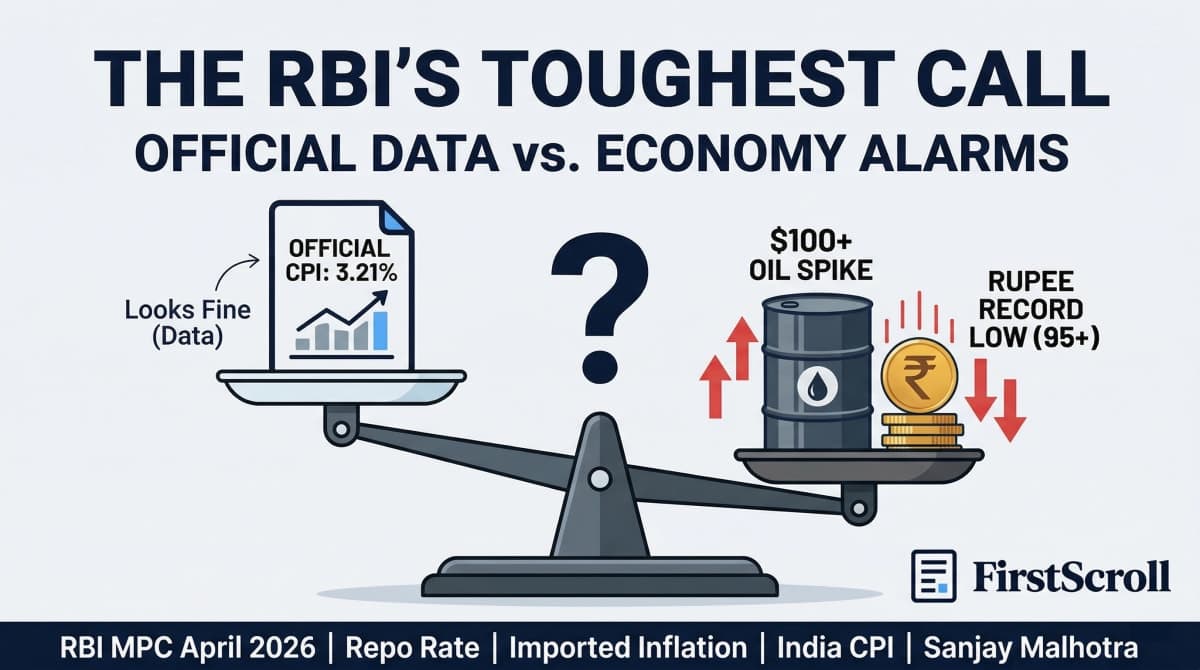
Open the government's inflation data from February 2026 and it tells a reassuring story. Consumer price inflation sat at 3.21%, well below the RBI's 4% target. Comfortable. Benign. The kind of number that, not long ago, would have had home loan borrowers hoping for another rate cut.
But open your LPG bill. Or check what a truck of vegetables costs to transport from Nashik to Delhi right now. A very different story starts to emerge.
The Story
The RBI's six-member Monetary Policy Committee, headed by Governor Sanjay Malhotra, meets on April 6, 7, and 8. The policy outcome will be announced on the last day of the meeting at 10 AM. New Kerala Almost every analyst in the country expects the same outcome: the repo rate will stay unchanged at 5.25%, with the central bank maintaining a neutral stance. Prokerala That much looks settled.
What is not settled is the conversation happening behind that decision. And that conversation is genuinely uncomfortable.
Repo Rate The interest rate at which the RBI lends money to commercial banks overnight. When the RBI cuts it, banks can borrow cheaper and ideally pass that on to you as lower home loan and business loan rates. When it raises it, borrowing costs go up across the board. The RBI had been cutting rates since February 2025, bringing the repo rate down by a total of 125 basis points, from 6.5% to 5.25%, as inflation stayed low and growth needed a boost. That cutting cycle now appears to be over.
Here is the problem in simple terms. India's CPI inflation of 3.21% in February 2026 belongs to what analysts are calling a pre-pass-through world. Policy Circle Oil prices, freight costs, and exchange-rate weakness take weeks and months to filter through to the things you actually buy. The shock from the West Asia conflict only began hitting India's economy in early March. The February inflation number, in other words, was measured before the damage landed.
And that damage is real. As per an RBI research paper from last July, a 10% increase in global crude prices could raise headline inflation by around 20 basis points. Business Today Crude has risen by over 55% since late February. Do the maths and you start to understand why economists are no longer relaxed about the inflation pipeline, even if the official CPI print still looks fine today.
Imported Inflation When the prices of things India buys from abroad go up, that cost eventually shows up in everyday goods at home. India imports nearly 88% of its crude oil, so a global oil price spike feeds into transport costs, fertiliser prices, and then food and manufactured goods. This kind of inflation cannot be fixed by raising interest rates, because rates cannot create more oil supply. But if it stays high long enough, it can change how people expect prices to behave, which then becomes its own problem for the central bank.
And that's where it gets interesting. The RBI is not just watching inflation. It is also watching the rupee, which touched a record low near 95 to the dollar on March 30, falling more than 4% in March alone. Policy Circle A weaker rupee makes imports more expensive, which feeds back into inflation. It also makes India less attractive to foreign investors who measure their returns in dollars. The real dilemma for the RBI, as Madhavi Arora of Emkay Global put it, is drawing the line between forex intervention and tolerance. Business Today Defending the rupee aggressively drains domestic liquidity. Letting it fall freely invites speculation.
So the RBI sits at the intersection of two problems that pull in opposite directions. Raising rates would help signal seriousness about inflation, but it would also hit investment and consumption at a point when the external shock is already doing some of that work. Policy Circle Holding rates steady is safer for now, but runs the risk of the RBI falling behind if inflation quietly seeps into core prices over the next few months.
HSBC's economists put it plainly: they believe the April 8 meeting will be all about communication, specifically to address market anxiety around the oil price shock. The RBI is expected to outline scenarios, sensitivities, and the broad contours of how it will respond if things get worse. IANS News That is a very different kind of MPC meeting from one that simply announces a rate move.
But here's the thing. The RBI also just got a fresh mandate. On March 25, the Ministry of Finance notified a new five-year inflation target, keeping it at 4% with a tolerance band of 2% to 6%, covering the period April 2026 to March 2031. New Kerala That mandate is clear. If oil prices remain above $100 per barrel for a sustained period and inflation breaches the upper band of 6%, there is a real possibility of a rate hike by the end of FY27 The Tribune, according to Bank of Baroda's analysis. That is the scenario no home loan borrower wants to see.
What to watch next: the CPI print for March 2026 releases on April 13, five days after the MPC meeting ends. That number will be the first real data point that captures the early impact of the oil shock on Indian prices. Watch it closely. If it comes in meaningfully above the February reading of 3.21%, the RBI's prolonged pause story will start getting uncomfortable very quickly. The six months after this week's meeting may matter more for your EMI than this week's decision itself.
Until next time, keep scrolling. 📜