The Story
Imagine you’re running a small fast-food joint. You sell burgers for ₹100, and your profit margin is a slim ₹5. Now, the government suddenly increases the "fryer tax" from ₹2 to ₹5 per burger. Just like that, your entire profit is gone. You’re working for free, or worse, you’re losing money on every sale.
This is exactly how many retail traders felt on February 1, 2026.
During the Union Budget 2026, Finance Minister Nirmala Sitharaman dropped a bombshell on the trading community: a significant hike in the Securities Transaction Tax (STT). While long-term investors barely blinked, the derivatives (F&O) crowd saw their world shift in an instant. The Sensex plummeted 2,000 points in a single session a "bloodbath" that wiped out over ₹6 lakh crore in wealth.
The Foundation: What Exactly is STT?
Before we dive into the "why," we need to understand the "what."
STT is a direct tax levied on every purchase and sale of securities listed on recognized stock exchanges like the NSE and BSE. It was introduced in 2004 to replace Long-Term Capital Gains (LTCG) tax (which has since made a comeback).
Unlike Income Tax, which is only paid on your profits, STT is paid on the total value of your transaction, regardless of whether you made a profit or a loss. It’s like a "toll" you pay just to drive on the highway.
The most critical thing to understand about STT is that it is collected at source. You don't "file" for it; your broker automatically deducts it the moment you hit the "Sell" button.
The Big Reveal: The Budget 2026 Shift
So, what changed? Let’s look at the numbers because the percentages tell a story of a deliberate crackdown.
1. The Futures Blowout
The tax on Equity Futures saw the most dramatic jump from 0.02% to 0.05%.
- In plain English: That’s a 150% increase.
- In money terms: If you sell a futures contract worth ₹1 crore, you used to pay ₹2,000 in STT. Now, you’ll pay ₹5,000.
2. The Options Squeeze
Options trading, the darling of the retail crowd, didn't escape either.
- On Premiums: The rate was hiked from 0.10% to 0.15%.
- On Exercise: If you let an Option expire in-the-money (ITM), the tax jumped to 0.15% of the intrinsic value.
| Transaction Type | Old Rate | New Rate (Eff. April 1, 2026) | % Increase |
|---|---|---|---|
| Equity Futures (Sale) | 0.02% | 0.05% | 150% |
| Equity Options (Sale - Premium) | 0.10% | 0.15% | 50% |
| Equity Delivery (Buy & Sell) | 0.1% | 0.1% (Unchanged) | 0% |
| Equity Intraday (Sale) | 0.025% | 0.025% (Unchanged) | 0% |
The "Why" Behind the Pain: SEBI’s 93% Warning
Why would the government hurt the very people who provide liquidity to the markets? The answer lies in a shocking statistic from SEBI.
According to SEBI's latest findings, a staggering 93% of individual F&O traders incurred losses between FY22 and FY24. The average loss? About ₹2 lakh per person.
The government sees this as a social problem. They believe retail traders are treating the stock market like a casino, lured by "get rich quick" screenshots on social media. By increasing STT, the government is creating a "Behavioral Tax." They are making it more expensive to gamble in the hope that you’ll move your money into safer, long-term equity delivery or SIPs (where the STT hasn't changed).
So What? The Real-World Impact
If you are a trader, your "Breakeven" math has just been rewritten.
- The Scalper's Nightmare: Scalpers who enter and exit trades for tiny 5-10 point gains will find that the STT now eats up a huge chunk of their win. If your strategy relies on high volume and thin margins, it might be dead in the water by April 1.
- Arbitrage Funds in Trouble: These are mutual funds that profit from the tiny price difference between the cash market and the futures market. Because they trade millions of times, even a 0.03% hike in STT can crush their returns, potentially making these "safe" funds less attractive than liquid funds.
- The Liquidity Risk: Critics argue that by driving away high-frequency traders, the market will become "thinner." This means when you want to sell, there might be fewer buyers, leading to wider bid-ask spreads (you sell for less and buy for more).
The "Deep-Dive" Insight: Is it Really a Tax?
Here’s a nuanced point: Despite its name, STT is more of a Transaction Charge.
Real taxes (like LTCG) are fair if you don't make money, you don't pay. STT is cold. You could lose ₹50,000 on a trade, and the government will still walk away with their ₹5,000 in STT.
This is what analysts call "friction." It’s designed to slow you down. The Finance Ministry isn't just looking for revenue (though the hike will add roughly ₹10,000 crore to the treasury); they are looking for Market Discipline.
The Closing
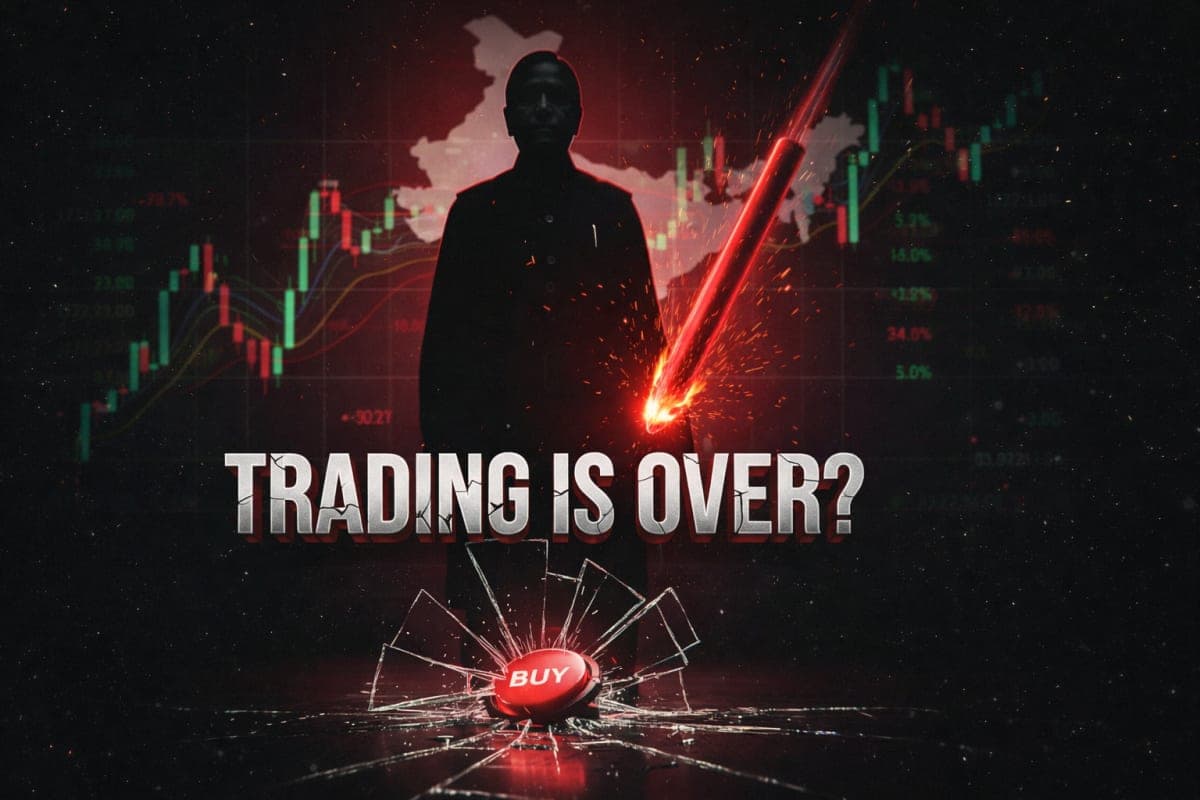
The message from Budget 2026 is loud and clear: The era of cheap speculation is over. If you want to survive as a trader in this new environment, you have to stop "churning" your account. You have to move away from 20 low-conviction trades a day and focus on 1-2 high-conviction setups.
For the long-term investor, nothing has changed. Your SIP is safe. Your 5-year portfolio is safe. But for the guy trying to "double his money" by Friday's expiry? The house just increased its edge.
Until then... check your contract notes and redo your math. ;-)