Imagine you’re the only person in town who knows how to fix a very specific, very old type of engine that powers every bank, every hospital, and every government office. Because you’re the only one with the tools and the "secret manual," you can charge whatever you want. You are a giant. You are "Big Blue" also known as IBM.
Now, imagine someone releases a free app that allows anyone to fix those engines instantly with their phone. Suddenly, your "secret manual" is worthless, and your business starts to crumble.
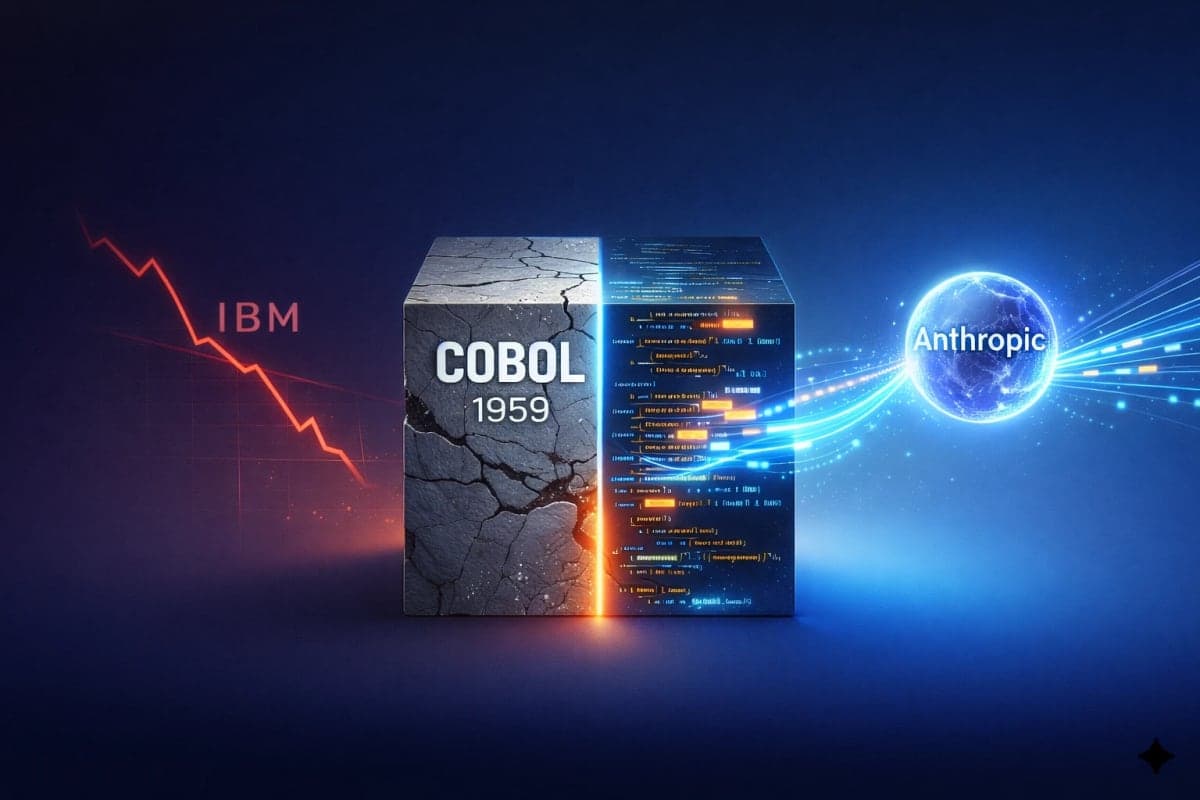
That is exactly what happened on February 23, 2026. This is the story of how a 60-year-old programming language called COBOL, an AI company called Anthropic, and a sudden stock market crash just changed the future of technology and potentially your future job.
Part 1: The "Zombie Code" Running the World
To understand why IBM’s stock just took a massive dive, you first have to understand COBOL.
COBOL (which stands for Common Business-Oriented Language) was created in 1959. To put that in perspective, that’s before the internet, before color TV was common, and before your parents were even born. It’s clunky, it’s wordy, and it looks nothing like the sleek code used to build TikTok or Fortnite.
But here’s the kicker: COBOL is the "invisible foundation" of the world.
- 95% of ATM swipes rely on COBOL code.
- 80% of in-person credit card transactions run on it.
- The US Social Security Administration uses it to send checks to millions of people.
For decades, big companies wanted to switch to modern code, but they were terrified. If you try to move a 60-year-old foundation, the whole building might fall down. So, they stayed with IBM, which specializes in keeping these ancient "mainframe" computers running. It was a multi-billion dollar "safety net" for IBM.
Part 2: The Anthropic "Bomb"
Enter Anthropic, one of the world’s leading Artificial Intelligence companies (the people who made the AI called Claude).
On February 23, Anthropic announced a massive breakthrough. They didn't just make a better chatbot; they created an AI tool specifically designed to "modernize" COBOL.
In the past, moving COBOL code to a modern language (like Java or Python) took years, cost hundreds of millions of dollars, and required thousands of human programmers. Anthropic’s new AI can do it in a fraction of the time with almost zero errors.
Why is this a "threat" to IBM? Because IBM’s business model was built on the idea that these old systems were impossible to leave. Anthropic just handed everyone an exit door.
As soon as the news hit, investors panicked. If companies don't need IBM to babysit their old COBOL code anymore, why would they keep paying IBM? IBM’s shares "tanked" (dropped in value) immediately, losing billions of dollars in market value in a single day.
Part 3: The "Butterfly Effect" – Why Researchers are Worried
While tech geeks are talking about code, financial researchers are looking at a much scarier picture. One prominent researcher issued a warning: This isn't just about one company; it’s about a potential unemployment crisis.
Here is the logic:
- The "AI Casualty" Effect: IBM is being called an "AI casualty." This means a giant, stable company is being hurt because AI can now do what thousands of their employees used to do.
- The Ripple Effect: If AI can replace the work of thousands of high-paid programmers who manage old code, what happens to those jobs?
- The Stock Market Bubble: Some experts believe the stock market has been "overheated" meaning prices are way higher than they should be because everyone is excited about AI. But now that we see AI can actually destroy big companies like IBM, investors are starting to get nervous.
The researcher warned that if more companies become "AI casualties," we could see a spike in unemployment and a massive crash in the stock market.
Part 4: Is it All Bad News?
If you’re 15, this might sound like a horror movie. "The AI is coming for the jobs! The stock market is crashing! The ancient code is dying!"
But there’s another way to look at it: Efficiency.
For the last 40 years, the world has been "stuck" using technology from the 1960s because it was too hard to change. This is like trying to run a modern city using horse-and-buggy paths. By using AI to finally upgrade the world’s banking and government systems, we could make things faster, cheaper, and more secure.
The "IBM crash" is a sign of Creative Destruction. It’s a fancy term for when a new, better invention destroys an old, outdated way of doing things.
- The car destroyed the horse-and-carriage business.
- The internet destroyed the video rental store (RIP Blockbuster).
- AI is now challenging the "old guard" of tech giants.
Part 5: What This Means for You
You’re likely going to enter the workforce in about 7 to 10 years. By then, the "COBOL War" will be over. So, what should you take away from this week’s news?
- Adaptability is the #1 Skill: IBM thought they were safe because they owned a "monopoly" on old tech. They weren't. In the AI era, no company (and no job) is 100% safe. You have to be willing to learn new things constantly.
- Don't Just Learn to Code Learn to Solve Problems: If you only learn how to write a specific type of code, an AI might replace you. But if you learn how systems work and how to use AI to solve big problems (like Anthropic did), you’ll be the one building the future.
- Watch the "Bubbles": When everyone is screaming that something is "guaranteed money," be careful. The stock market moves on hype, but it crashes on reality.
The Bottom Line
February 23, 2026, will be remembered as the day the "invisible foundation" of the financial world started to shift. IBM is struggling to figure out its next move, Anthropic is celebrating a technical victory, and the rest of us are realizing that AI isn't just for writing school essays it’s rewriting the rules of the global economy.
The world isn't ending; it’s just being updated. And like any major software update, there are going to be some bugs and crashes along the way.