In today's FirstScroll, we try to answer one of the most counterintuitive questions in markets right now: why is gold, the world's most famous safe haven, selling off in the middle of a war?
You have probably heard the advice at some point. From a parent, a grandparent, a well-meaning uncle at a family function. "Keep some gold. When everything goes wrong, gold always holds its value." It is one of the oldest pieces of financial wisdom in existence. And right now, in the middle of a live war, a global oil shock, and the worst market volatility in years, it is not working.
The Story
Let us set the scene with actual numbers, because the scale of this matters.
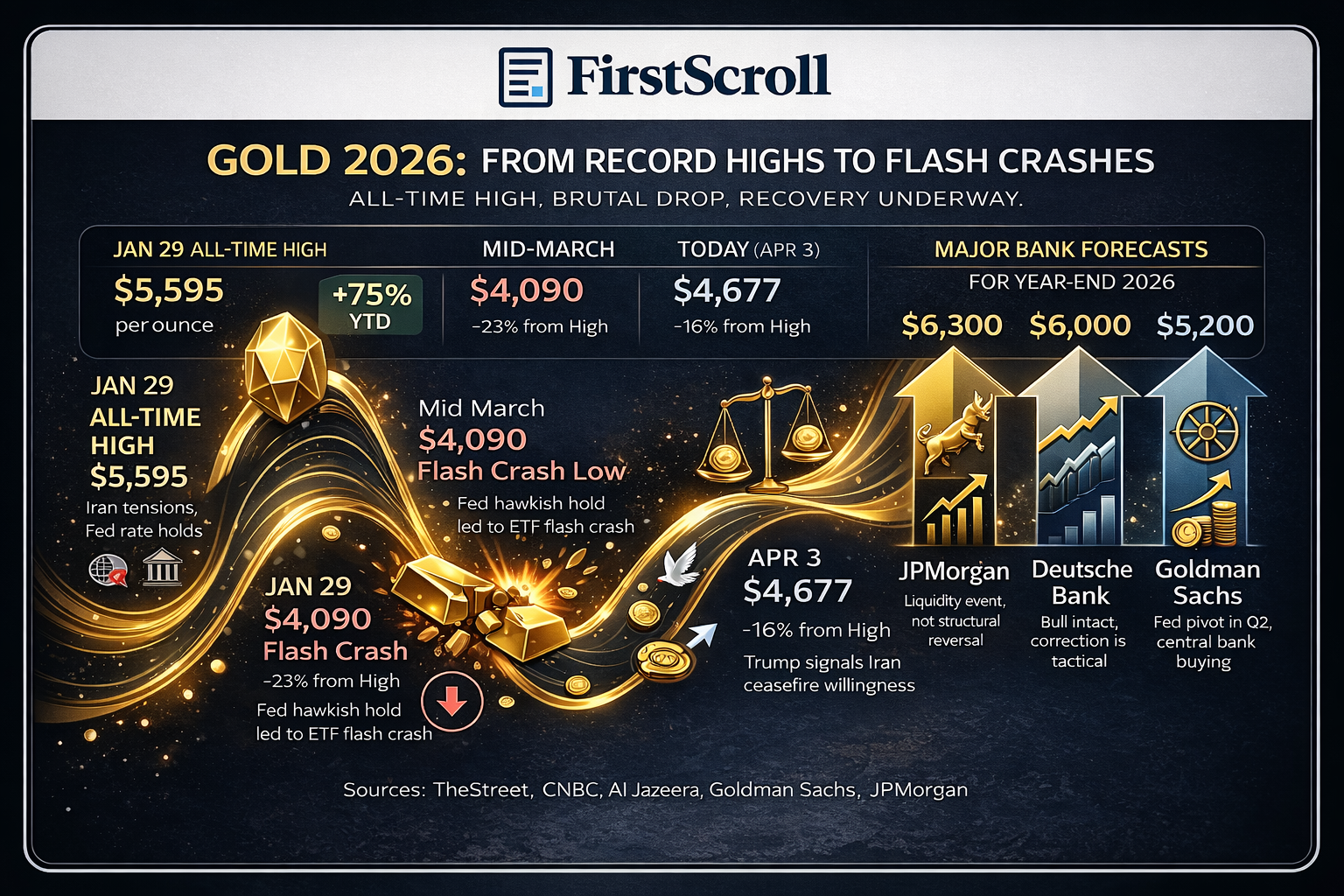
Here is the gold price journey from January to today: Gold reached a new all-time high of $5,595 on January 29, 2026. Central banks were buying. Retail investors had poured into gold ETFs. The setup for bullion looked perfect. Then war broke out in West Asia in late February. The Strait of Hormuz got disrupted. Oil crossed $100. And in the first days of the conflict, gold did exactly what every textbook said it would: spot prices briefly eclipsed $5,400 as panic gripped markets.
And then, over the following two weeks, the textbook caught fire.
So what happened? Three things went wrong simultaneously, and they reinforced each other in a way that overwhelmed gold's safe-haven logic entirely.
The first was liquidity. When equity markets started collapsing in March and hedge funds faced margin calls, they needed cash fast. The easiest thing to sell was the one asset that had actually gone up recently. That asset was gold. As institutional desks faced catastrophic losses in Asian equity markets and energy derivatives, they were forced to sell their most successful positions, gold ETFs, to stay solvent, inadvertently accelerating a downward price spiral. The SPDR Gold Shares ETF recorded a $2.91 billion single-day outflow, the largest such liquidation in over a decade.
Margin Call When you borrow money to invest and your investments fall in value, your broker asks you to put in more cash immediately to cover the gap. If you cannot, they sell your assets to recover the money. In a fast-moving market, this happens simultaneously across thousands of funds, creating a mechanical selling wave that has nothing to do with whether an asset is fundamentally valuable. Gold, being one of the most liquid assets in the world, gets sold first precisely because it can be sold instantly.
The second problem was the US Federal Reserve. At its mid-March 2026 meeting, the Fed held rates steady at 3.5% to 3.75% and issued a dot plot signalling only one rate cut for all of 2026, a hawkish shock that stunned markets. The US 10-year Treasury yield spiked to 4.38%. Gold pays no interest. When a government bond pays you 4.38% a year to simply exist, the opportunity cost of holding a metal that earns nothing becomes very hard to justify for large institutional portfolios.
The third was the dollar. The US Dollar Index climbed to 108.4 by March 24, near its highest level since late 2022. In a war driven by oil shocks, the dollar paradoxically strengthened because global energy trade is settled in dollars. A stronger dollar makes gold more expensive for every buyer outside the US, compressing demand from the exact buyers, Asian central banks, Indian households, Gulf sovereign funds, who had fuelled the record rally in the first place.
And yet. For Indian buyers of physical gold or gold ETFs, the rupee-term decline has been materially cushioned by currency depreciation. A weaker rupee means MCX gold prices have not fallen as sharply as the international dollar decline implies. So if you have been watching your gold fund in rupees and wondering why it does not look as bad as the headlines suggest, that is the reason.
The bull case has not disappeared either. JPMorgan analysts expect gold to reach $6,300 an ounce by end of 2026, describing it as a "dynamic, multi-faceted portfolio hedge" with investor demand coming in stronger than previous expectations. Goldman Sachs has maintained its year-end target of $5,200. Both banks frame the March crash as a tactical, liquidity-driven event inside a structural bull market, not a fundamental change in how the world values gold.
What to watch next:
Two things can bring gold back. First, a credible ceasefire signal from West Asia that eases oil prices and reduces pressure on central banks to stay hawkish. Second, any US economic data showing enough slowdown to push the Fed toward rate cuts, which would lower the opportunity cost of holding gold and weaken the dollar simultaneously. The $4,255 technical support level has held through three tests in March. A break below it would signal accelerated selling toward $3,900 to $4,000. Until one of those two catalysts arrives, gold is caught in the uncomfortable middle of a war it was supposed to benefit from.
Until next time, keep scrolling. 📜