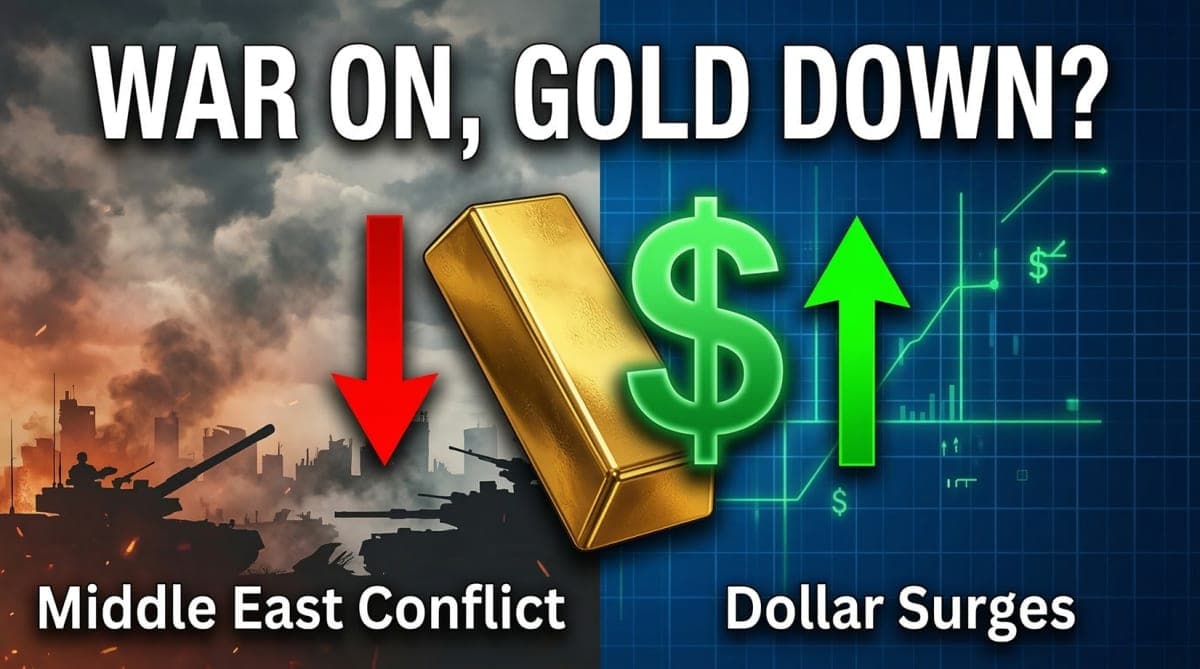
In today’s FirstScroll, we explain why gold, the world’s favourite safe-haven asset, is falling during the biggest military conflict in the Middle East in decades. The answer breaks one of investing’s oldest assumptions.
• • •
The Story
There’s a war raging in the Middle East. The Strait of Hormuz is shut. Oil has crossed $100 a barrel. Global stock markets have shed trillions. The entire world is in risk-off mode.
Gold should be soaring. It’s the textbook safe-haven play. War breaks out, investors panic, money floods into gold. That’s how it’s supposed to work. That’s how it’s always worked.
Except this time, it isn’t working.
Gold spiked briefly after the US-Israeli strikes on Iran on February 28, jumping from about $5,100 to over $5,400 per ounce in hours. Indian prices hit ₹1.64 lakh per 10 grams. Classic panic buying. But then something unusual happened. Gold reversed. Hard.
By March 3, gold had fallen over 6% to around $5,085. In India, 24-karat gold prices dropped by ₹1,09,800 per 100 grams over five consecutive days, according to Goodreturns data. Two weeks into the conflict, gold is trading near $5,000, roughly where it was before the war started.
A war. A genuine energy crisis. And gold is going down. What on earth is happening?
The Dollar Did It
The simplest explanation is also the most important one. When the Iran war broke out, the US dollar surged. The Dollar Index (DXY) jumped 1.1% in a single day on March 3, its sharpest gain since May 2025. It has stayed elevated since.
Why does this matter? Gold is priced in dollars. When the dollar strengthens, gold automatically becomes more expensive for everyone else. Indian buyers pay more rupees per gram. European buyers pay more euros. This dampens global demand even if the underlying fear is rising.
As BullionVault reported, traders were raising cash across the board. Stocks, bonds, base metals, even gold got sold as investors scrambled for dollar liquidity. When everything crashes simultaneously, it’s not because assets are worthless. It’s because cash is king. And in a crisis, cash means dollars.
The Inflation Trap
Here’s where it gets counterintuitive. You’d think rising oil prices would be good for gold, because oil drives inflation, and gold is an inflation hedge. Right?
Not quite. It depends on what central banks do about that inflation.
Oil crossing $100 a barrel has dramatically changed interest rate expectations. Before the war, markets were pricing in multiple Fed rate cuts in 2026. Now, traders see virtually no chance of a cut at next week’s Fed meeting, and only about 80% probability of even one cut this entire year.
This is the chain reaction that kills gold: war pushes up oil, oil pushes up inflation, inflation forces central banks to keep rates high (or even hike), higher rates strengthen the dollar, and a strong dollar plus high rates crush gold.
Commerzbank’s commodity analyst Barbara Lambrecht put it simply: "The gold price continues to fail to benefit from the geopolitical crisis. With oil and gas prices rising significantly, the risks of inflation are also increasing. This could force central banks to take countermeasures."
In plain English: the war is creating exactly the kind of inflation that makes central banks raise rates, which is the one thing that hurts gold the most.
The Profit-Taking Wave
There’s a simpler, more mechanical explanation too. Gold had an incredible run before the war even started.
The metal gained roughly 22% year-to-date before February 28, rising from around $4,200 to over $5,100 over twelve months. Central bank buying, dollar weakness expectations, and fiscal deficit fears had all fuelled the rally.
When the war triggered a spike to $5,400, a lot of investors who had been sitting on massive gains decided to book profits. In market language, this is called "selling the news." The war was the catalyst, but the selling was about locking in a year’s worth of gains, not about gold losing its safe-haven status.
The Arabic Trader reported that the decline "does not indicate a reduction in geopolitical risks but rather reflects a change in investor expectations and their shift towards the dollar as a temporary safe haven."
The Dubai Disruption
There’s a logistical angle too. According to Wikipedia’s economic impact tracker, flights to and from Dubai were grounded after Iranian strikes damaged airport infrastructure. Dubai is the world’s largest physical gold trading hub. When flights stop, gold shipments stop. This disrupted the physical supply chain, causing price swings in downstream markets like India, where gold went from a $50 premium to a discount against the London price in days.
When the physical market disconnects from the paper market, prices behave erratically. Indian gold prices were falling even as global spot prices were volatile, simply because supply chains were broken.
What About India Specifically?
Indian gold markets got hit from multiple directions. As Goodreturns reported, 24-karat gold fell by ₹7,700 per 10 grams on March 6 alone. The five-day cumulative drop of ₹1,09,800 per 100 grams is one of the sharpest corrections in recent memory.
IBJA Vice President Aksha Kamboj attributed it to "sustained profit-taking and reduced safe-haven demand, despite the presence of geopolitical risks." In short, Indian investors who had ridden gold’s year-long rally were cashing out.
The rupee’s weakness against the dollar also created a weird dynamic. Normally, a weaker rupee makes gold more expensive in India (since gold is imported in dollars). But the profit-taking pressure was so strong that it overwhelmed the currency effect.
So Is Gold Broken as a Safe Haven?
No. But the relationship is more nuanced than "war = gold goes up."
Here’s the framework that actually works: gold does well in crises where central banks are expected to ease monetary policy (cut rates, print money, weaken the currency). Think 2008, 2020, or any crisis where governments responded with stimulus.
Gold does poorly in crises that are inflationary and force central banks to tighten. That’s exactly what’s happening now. The Iran war is an oil shock, not a financial crisis. It creates inflation, not deflation. And inflation keeps rates high, which keeps the dollar strong, which keeps gold under pressure.
The long-term bulls haven’t changed their minds. J.P. Morgan’s 2026 gold target is $6,300 per ounce. Deutsche Bank sees $6,000. Both forecasts were set before the war. French bank Natixis estimates that the war added about $750 per ounce to gold’s price, and that "once the war ends, gold could drop back to around $4,600."
The structural case for gold (central bank buying, US fiscal deficits, de-dollarisation trends) hasn’t changed. But the short-term dynamics of this specific crisis are working against it.
The Bottom Line
Gold’s crash during a war isn’t a contradiction. It’s a lesson in how modern financial markets actually work. The old rule, war equals gold rally, assumed a world where war created uncertainty and uncertainty meant rate cuts. In 2026, war created an oil shock, the oil shock created inflation, inflation killed rate-cut hopes, and that killed gold’s momentum.
If you own gold as a long-term hedge, nothing has changed. The structural bull case is intact. If you bought gold expecting a quick war-time pop, the market just taught you an expensive lesson about the difference between geopolitical risk and interest rate risk.
Sometimes the safe haven isn’t the shiny metal. Sometimes it’s just the dollar. And in March 2026, it’s the dollar.
• • •
If this story made you rethink what you know about gold and safe havens, share it with a friend who’s been watching gold prices this week.
Sources: CNBC, Bloomberg, Yahoo Finance, BullionVault, Goodreturns, Arabic Trader, GoldSilver, Intellectia, Wikipedia