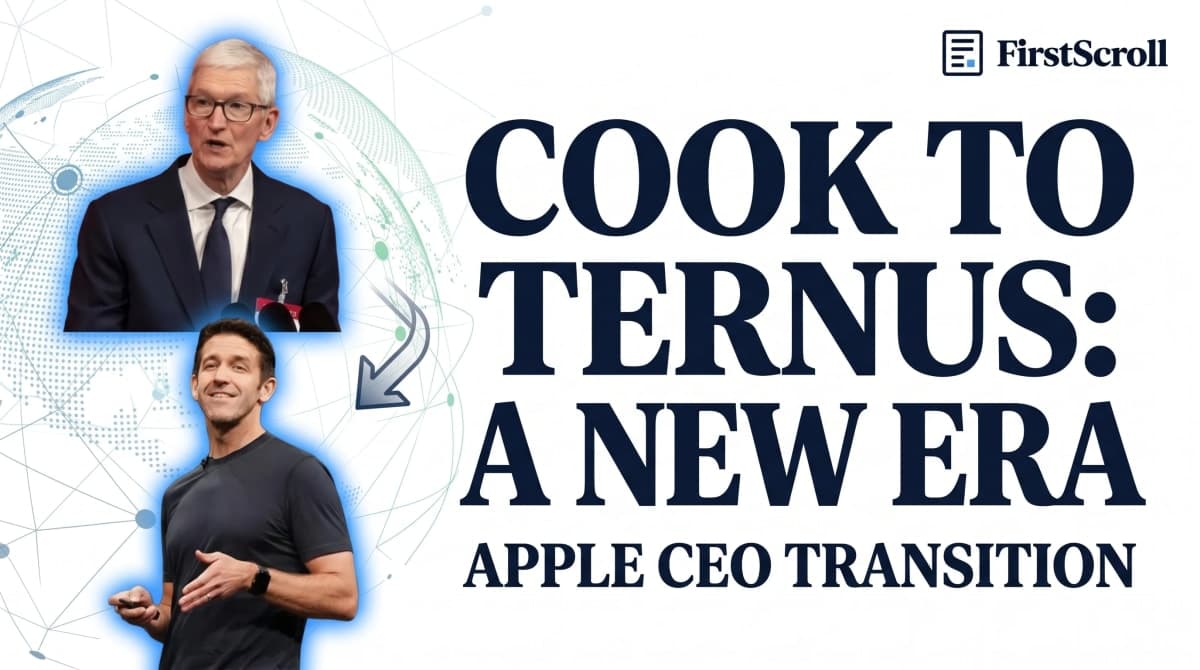
On April 20, 2026, Apple made an announcement that the tech world had been expecting for months but that still hit like a thunderclap when it arrived.
Tim Cook is stepping down as CEO.
The man who took Apple from a $350 billion company to a $4 trillion one. The man who turned Apple into the most profitable business in human history. The man who, for 15 years, kept the machine running flawlessly after the near-impossible task of succeeding Steve Jobs.
He's not disappearing Cook becomes Executive Chairman, staying involved in policy and strategy. But the corner office at Cupertino? That goes to someone most people outside the tech world have never heard of.
John Ternus. 51 years old. Mechanical engineer. 25-year Apple veteran. And the man most responsible for one of the greatest technical achievements in modern computing Apple Silicon.
He takes over on September 1, 2026.
And here's why every Indian should be paying attention.
First: Who Is Tim Cook, and What Did He Actually Do?
To understand why this transition matters, you need to understand what made Cook extraordinary because it wasn't what most people think.
Cook wasn't a product visionary. He wasn't the guy dreaming up the next iPhone in a design studio. Steve Jobs was that guy. After Jobs died in 2011, many people worried Apple would lose its creative soul.
What Cook brought was something different, and arguably just as important: operational genius.
He was Apple's supply chain mastermind. He figured out how to make hundreds of millions of iPhones, iPads, and Macs every year with pinpoint quality, at enormous scale, delivered on time, to customers in 180 countries.
A quick lesson on why supply chains matter:
A supply chain is the entire journey a product takes from raw material to your hands. For an iPhone, that means: mining lithium in Chile, manufacturing chips in Taiwan, assembling components in China, shipping to warehouses around the world, and delivering to your doorstep.
Coordinating all of that across dozens of countries, hundreds of suppliers, and billions of dollars of inventory is mind-bendingly complex. Cook built that machine. And it made Apple incredibly rich.
Under Cook, Apple's revenue grew from $108 billion to over $400 billion a year. Market cap went from $350 billion to $4 trillion. He turned Apple into the first company in history to reach a $3 trillion valuation.
Not bad for someone who was never the "creative" one.
Now: Who Is John Ternus?
John Ternus joined Apple in 2001 as a product design engineer. He worked his way up steadily VP of Hardware Engineering by 2013, Senior VP by 2021.
He is, by every account, an engineer's engineer. Quiet. Deeply technical. Well-liked inside Apple. Someone who spent 25 years actually building the products rather than selling them or managing their logistics.
His biggest achievement? The transition to Apple Silicon.
Here's why that matters in plain English.
For decades, Macs ran on Intel chips the same processors used by Windows PCs. Apple was dependent on Intel's timeline, Intel's performance improvements, and Intel's pricing. If Intel's chips were slow one year, Apple's Macs were slow that year. There was nothing Apple could do about it.
In 2020, Apple decided to break free. They started making their own chips the M-series designed specifically for Apple's products. The result was staggering. The MacBook Air became faster than most Windows laptops costing twice as much, while lasting longer on battery. The Mac went from a product people were giving up on to one of the most desirable computers in the world.
Ternus didn't design the chips that was chip architect Johny Srouji's job. But Ternus led the hardware teams that had to redesign every Mac around the new chip architecture. That's the harder job making theory work in reality, at scale, in products that millions of people use every day.
Cook was the supply-chain master. Ternus is the hardware builder the executive associated with the products themselves. That's the philosophical shift happening at Apple's top.
Cook Built the Factory. Ternus Has to Build the Future.
Here's the challenge Ternus walks into on September 1.
Apple is the world's most valuable company. But it's facing real headwinds.
AI is the biggest one. While Google, Microsoft, and a wave of new companies have been racing ahead with artificial intelligence chatbots, image generation, AI assistants Apple has been playing catch-up. Siri, Apple's voice assistant, has been a running joke for years compared to what competitors are doing. Apple Intelligence, the company's AI push launched in 2024, received mixed reviews.
Ternus, as a hardware engineer, actually has a unique angle on this. AI doesn't just live in the cloud it increasingly runs on the device itself. Apple's chips have dedicated AI processing units called Neural Engines. The better the chip, the better the on-device AI. This is Ternus's world. His instinct will be to solve AI through better hardware faster chips, smarter sensors, tighter integration between the device and the software running on it.
Whether that's the right strategy in a world where AI is moving at breakneck speed that's the question his tenure will answer.
The second challenge is geopolitics. And this is where India enters the story.
Apple's India Bet The Biggest Manufacturing Shift in a Generation
Tim Cook spent years building Apple's manufacturing empire in China. At its peak, China made over 75% of all iPhones in the world. That worked brilliantly until it didn't.
The US-China trade war, Trump's tariffs on Chinese goods, and growing geopolitical tensions made total dependence on China look reckless. Apple needed a Plan B. It chose India.
The scale of what's being built here is staggering.
Apple is planning to shift the production of over 60 million iPhones annually to India by the end of 2026 enough to cover all iPhones sold in the US.
Two manufacturing partners are leading this:
Tata Electronics has set up a new plant in Hosur, Tamil Nadu one of the first times the storied Tata Group has entered electronics manufacturing at this scale. They've already started assembling iPhones. They also acquired Wistron's iPhone assembly unit, making them a fully established Apple supplier almost overnight.
Foxconn Apple's largest global manufacturing partner is building a massive new facility in Bengaluru, Karnataka. The $2.6 billion plant, when fully operational, will employ 50,000 people and produce hundreds of iPhones per hour. It will be Foxconn's second-largest plant outside of China.
Together, Foxconn and Tata now operate five iPhone manufacturing plants in India.
Apple ramped up production urgently in early 2025, shipping approximately 600 tonnes of iPhones worth $2 billion to the United States in March a monthly record for both Tata and Foxconn.
India went from contributing around 18% of global iPhone production to being on track to become Apple's most critical manufacturing base outside China. In a matter of months.
What Does a Hardware CEO Mean for India?
This is the most important question and the most underreported angle of the Cook-Ternus transition.
Tim Cook built the India manufacturing strategy. He visited India multiple times, met the Prime Minister, opened Apple's first retail stores in Mumbai and Delhi, and personally championed the shift to India.
But Cook was fundamentally an operations man. His interest in India was supply-chain driven a rational response to geopolitical risk.
Ternus is different. He is a hardware man. For him, where something is made isn't just a logistics question it's a product quality question. Manufacturing decisions directly affect the product.
Here's what that means for India practically:
The India manufacturing bet now needs a product champion, not just an operations champion.
Moving 60 million iPhones of production to India isn't just about setting up assembly lines. It's about ensuring the quality is identical to what comes out of China. It's about building supplier ecosystems the hundreds of component makers that feed into final assembly. It's about training workers to build increasingly complex products like foldable iPhones and Apple Vision Pro.
A hardware-focused CEO will scrutinise Indian manufacturing quality more carefully and invest more seriously in making it world-class. That's good for India in the long run, even if the transition is bumpy.
India also becomes strategically more important under Ternus because of his AI focus. On-device AI requires chips. Chips require manufacturing. As Apple pushes more AI processing onto the device itself, the supply chain for Apple's custom chips and the products built around them becomes even more critical. India is already in that chain. Getting deeper into it is the opportunity.
A Lesson on Why This Matters Beyond Apple
Most people think of Apple as a phone company. It's much more than that.
Apple is now the anchor of an entire Indian manufacturing ecosystem. When Apple comes to a country, suppliers follow. Component makers, logistics companies, packaging firms, quality testing labs all of them set up operations near Apple's factories.
This is already happening in Tamil Nadu and Karnataka. Entire industrial parks are being built around Apple's manufacturing presence. Tens of thousands of jobs many of them for women from rural areas are being created.
Apple's India bet is also India's signal to the world. If the world's most demanding, quality-obsessed company can make its flagship product here, other companies will follow. It's a proof of concept for India as a serious global manufacturing hub not just cheap labour, but precision manufacturing.
The CEO of Apple isn't just running a tech company. He's making decisions that ripple through entire economies. India is now one of those economies.
The Bottom Line
Tim Cook's legacy is clear: he made Apple the most profitable company in history and built a supply chain that could deliver billions of devices to billions of people with extraordinary efficiency.
John Ternus's legacy is yet to be written. He takes over a company worth $4 trillion, facing real pressure on AI, navigating a geopolitical landscape that's reshaping global manufacturing, and carrying the weight of being only the third CEO in Apple's history.
Cook himself said it best when announcing the transition: "John Ternus has the mind of an engineer, the soul of an innovator, and the heart to lead with integrity and with honor."
For India, the transition from an operations CEO to a hardware CEO could actually be a good thing. The India manufacturing story isn't just about saving costs it's about building something real. A hardware leader understands that better than anyone.
The iPhone in your pocket was probably still made in China. The one in your child's pocket? It might be made in Hosur or Bengaluru by an Indian worker, in an Indian factory, under the watch of Apple's newest CEO.
That's not a small thing.