In today's FirstScroll, we slow down the most ordinary moment in modern Indian life, that tiny pause after you scan a QR code and tap pay. In those 3 seconds, a hidden relay race runs across five different computer systems. And at the end, we answer the question nobody asks: if it's free for you, who's actually paying for it?
The Story
You do it without thinking. Chai at a tapri. Scan. Tap. Ting. "Payment received." You've already walked away.
That little "ting" feels instant and effortless. But in the roughly 2 to 5 seconds between your tap and that sound, something genuinely wild happens. Your ₹20 sets off a high-speed relay race across the country, touching multiple banks, apps, and a giant national traffic controller, all racing to finish before you lose patience.
Let's hit pause and watch it happen in slow motion.
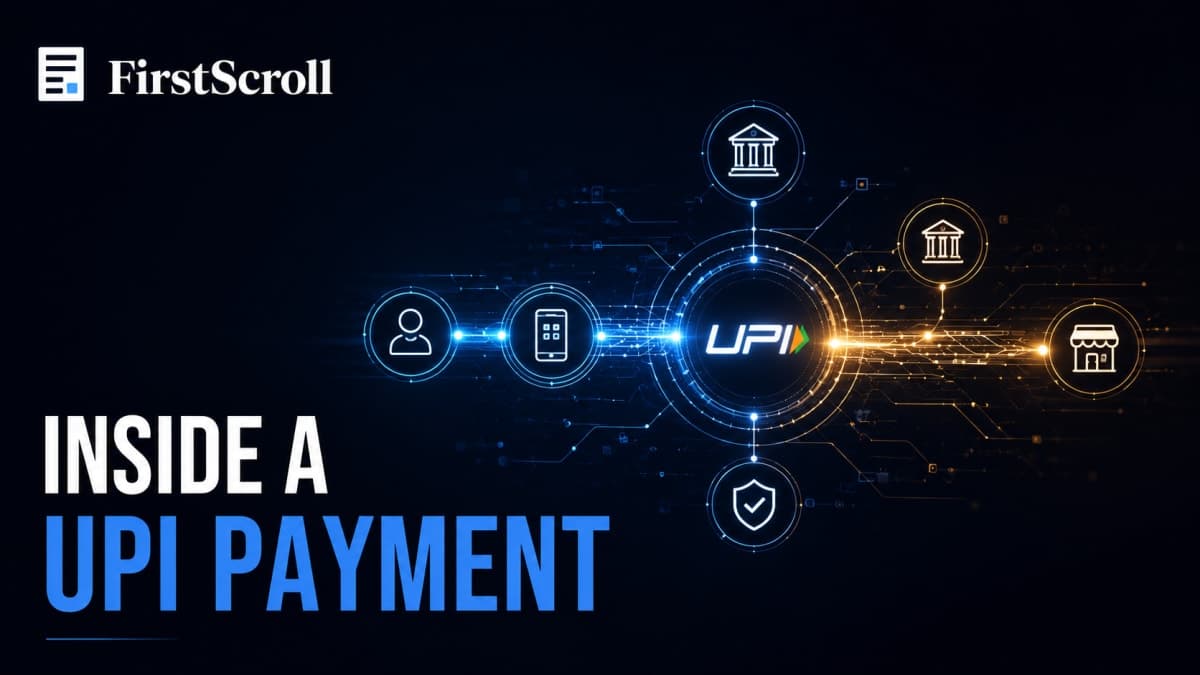
First, the cast of characters. Because "UPI" isn't one thing, it's a team of five different systems that all have to be online and talking at the exact same moment.
There's you and the shopkeeper. There's your UPI app (GPay, PhonePe, Paytm), known as a PSP, basically the friendly face that takes your request. There's your bank (where your money sits). There's the shopkeeper's bank (where it needs to go). And sitting in the middle, like an air-traffic controller for money, is NPCI, the National Payments Corporation of India, which runs the central "UPI switch" that connects everyone.
Now, the 3-second relay race.
Step 1: You tap, and the request takes off.
You scan the QR, type ₹20, and enter your UPI PIN. The moment you hit confirm, your app bundles this into a secure request and fires it off to NPCI, the central switch. Think of it as dropping a letter into the world's fastest postbox.
Step 2: NPCI figures out who's who.
NPCI looks at the shopkeeper's UPI ID and goes, "okay, which bank does this person belong to?" It quietly asks the shopkeeper's app for their real bank details behind the scenes. This is the genius of UPI, you never see the shopkeeper's actual account number. The UPI ID hides it. NPCI is the only one who connects the two.
Step 3: Your bank checks if you're good for it.
Now NPCI turns to your bank and says "this customer wants to send ₹20, verify them." Your bank does three lightning-fast checks: is the PIN correct, is there enough balance, and is this within UPI limits? If all yes, it debits ₹20 from your account and tells NPCI "done, money's left the building."
Step 4: The money lands.
NPCI immediately tells the shopkeeper's bank "credit ₹20 to this account." The bank adds the money and confirms back. And here's a subtle but huge detail: unlike credit cards, where the money actually moves hours or days later, UPI settles in real time. The money genuinely moves, then and there.
Step 5: The "ting."
NPCI sends the success signal back down the chain, to the shopkeeper's app, which fires off that satisfying "payment received" notification. Race complete.
All of that, the postbox, the identity lookup, the balance check, the debit, the credit, the confirmation, happens in about 2 to 5 seconds. Five systems, perfectly in sync, for a cup of chai. When you realise UPI does this over 2,200 crore times in a single month, it's honestly one of the most impressive things India has ever built.
Which brings us to the question that should be nagging you by now.
All those banks, all that technology, all those servers humming day and night. That costs serious money to run. And yet you paid exactly zero. The shopkeeper got the full ₹20. So... who's footing the bill?
The uncomfortable truth: UPI was never actually free.
Here's the thing. When you pay a merchant by credit or debit card, the shop pays a small fee called MDR (Merchant Discount Rate), usually 1 to 2% of the bill. That fee is what pays the banks and networks for running the system. It's the fuel that keeps card payments alive.
For UPI, the government made a bold call: it set that MDR to zero for regular UPI payments. No fee for you, no fee for the shopkeeper. This is exactly why UPI exploded across India, from giant malls to the vegetable cart. Free is irresistible. It's the single biggest reason a digitally young country leapfrogged the world in digital payments.
But "free for everyone" doesn't mean "free to run". Someone still has to pay for those humming servers. As the RBI Governor bluntly put it, there are real costs, and someone has to bear them. The fact that you don't see a charge doesn't make the cost disappear. It just moves it somewhere else.
So where did it go? Two places.
One, the government, meaning taxpayer money. To keep UPI free, the government hands out a yearly subsidy to banks and payment companies to partly cover their costs. For FY27 it set aside ₹2,000 crore for this. Which sounds like a lot, until you hear the second part.
Two, the payment companies themselves, who eat the rest of the loss. And the gap is enormous. The industry says that government subsidy covers only about 11% of the actual cost of running the system. The PhonePes and Google Pays of the world are quietly absorbing billions to keep your chai payment free, in the hope of making money some other way.
And that's the catch. This setup is starting to strain. Payment companies have been pleading for years that they can't do this for free forever. A parliamentary committee has now flagged that the zero-fee model may be unsustainable as volumes explode, and floated an idea: keep it free for street vendors and small shops, but charge a tiny MDR to large merchants, the big chains that can easily afford it.
Nothing's been decided. But the direction is clear. The free ride, at least for big businesses, may not last forever.
So, what happens in the 3 seconds after you tap "Pay"?
A breathtaking relay race runs across five systems and two banks, moving your money in real time, hidden behind a single satisfying "ting". It's a genuine engineering marvel that the whole world is now trying to copy.
And the reason it feels magically free is that someone, the government with your tax money, and payment companies with their own, is quietly paying the bill in the background so you never have to think about it.
UPI isn't free. It's just free for you. And the real question India is now wrestling with is a simple one: how long can someone keep paying for everyone's chai?
Until next time...