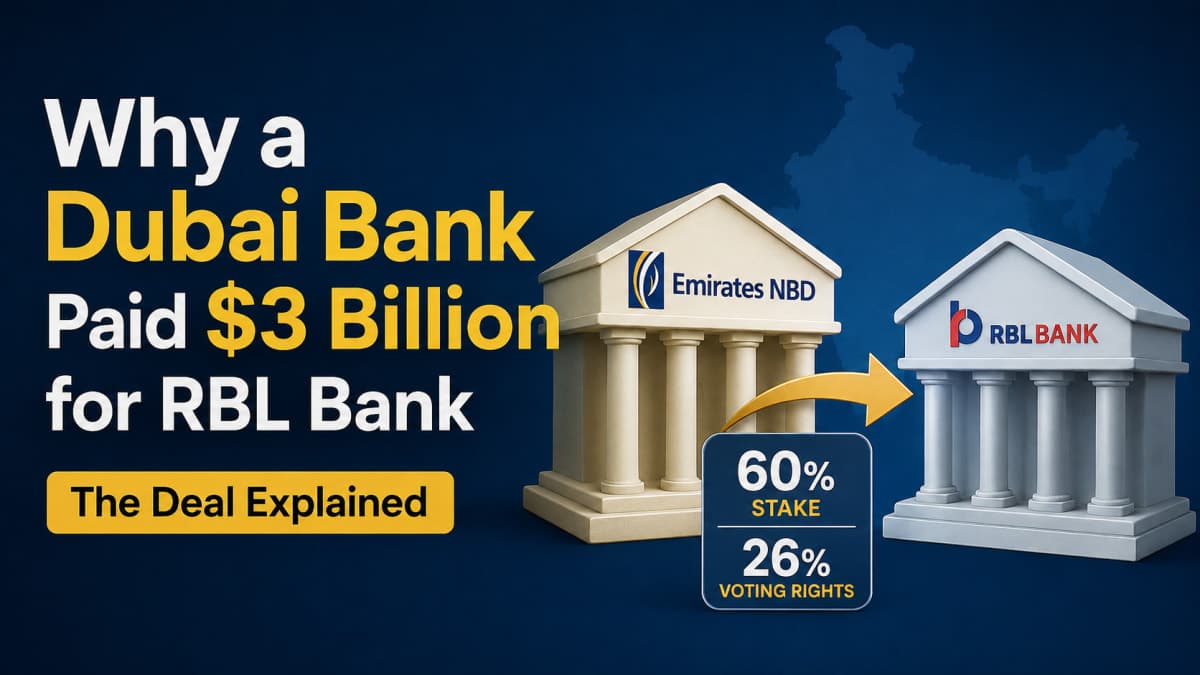
In today's FirstScroll, we break down Emirates NBD's $3 billion takeover of RBL Bank and explain why a Dubai bank paid a fortune for a majority stake it can't even fully vote with.
With that out of the way, let's dive into today's story.
The Story
If you've ever swiped an RBL credit card at a petrol pump, you've probably never wondered who owns the bank behind it. And honestly, until last year, the answer was "nobody in particular". RBL Bank was that rare thing in Indian banking: a bank with no promoter at all, its shares scattered across mutual funds, institutions and regular folks like you.
It wasn't a small operation either. The bank serves over 15 million customers through 603 branches spread across 28 states, with a solid credit card business and a lending franchise for small borrower groups.
Then, in October 2025, everything changed. Dubai's biggest bank, Emirates NBD, announced it would pump roughly ₹26,850 crore (about $3 billion) into RBL for a controlling stake of up to 60%. And on 18th June 2026, the deal was formally completed, making it the largest foreign direct investment Indian banking has ever seen.
But here's the strange part. Even after paying $3 billion for 60% of the bank, Emirates NBD's voting rights are capped at just 26%.
So here's the question: why would a Dubai bank pay $3 billion for a majority stake in an Indian bank when the rulebook says it can never vote like a majority owner?
To answer that, you need to understand two quirks of Indian banking law.
First, the ownership quirk. India technically allows foreigners to own up to 74% of a private bank. But the RBI caps any single foreign institution at 15% unless it grants a special exception. Which means for decades, no foreign bank could actually take charge of an Indian one. This deal is the first time a foreign bank has been allowed to buy majority control of a profitable Indian bank. The RBI didn't just approve this deal. It broke its own precedent for it.
Second, the money quirk. This wasn't a case of Emirates NBD writing cheques to existing shareholders. The stake came through something called a preferential issue, where a company creates brand new shares and sells them directly to one buyer. RBL issued about 959 million fresh shares at ₹280 apiece to Emirates NBD.
Why does that matter? Because in a preferential issue, the money doesn't leave through the back door into some seller's pocket. All ₹26,000 crore landed inside RBL Bank itself, instantly making it one of the best-capitalised mid-sized banks in the country. In fact, it was the largest equity fundraise in Indian banking history.
Once you see that, everyone's incentives snap into place.
For RBL, the logic is simple. A mid-sized bank fighting HDFC and ICICI for deposits just received a war chest bigger than its own market value at the time, plus a deep-pocketed parent with $331 billion in assets across 13 countries.
For Emirates NBD, India is the growth story its home market can't offer. Dubai is rich but small. India is the fastest-growing large economy on the planet, sitting at the other end of one of the world's busiest remittance corridors. Buying its way into 603 branches overnight beats spending twenty years building three. Which, incidentally, is exactly what it had: just three branches in Mumbai, Gurugram and Chennai, now being folded into RBL.
And the RBI? It has quietly been rolling out the red carpet for exactly these deals, like Japan's SMBC buying about a quarter of Yes Bank. The regulator sees foreign capital as a way to strengthen governance at mid-sized banks, the segment that has historically produced India's messiest banking accidents.
But here's the twist. That 26% voting cap isn't an oversight. It's the whole design. The government and the RBI recently discussed raising the cap and decided to keep it exactly where it is, precisely so that no single shareholder, however large, can steamroll an Indian bank.
So how does Emirates NBD actually control RBL? Through the board, not the ballot. RBL has already approved five Emirates NBD nominees as directors, including the group CEO and CFO. In Indian banking, control flows through board seats, RBI approvals and promoter status, not raw voting power. Emirates NBD is betting $3 billion that this is enough.
Now to be clear, it probably is. A 60% economic stake means Emirates NBD eats 60% of every rupee of profit RBL makes, and no rival can ever outvote a shareholder that large in practice. But it also means the fate of a 15-million-customer Indian bank now runs through a boardroom answerable to Dubai, where the UAE government owns 56% of the parent.
So, is this the beginning of foreign giants shopping for Indian banks? Well, the RBI has now shown it will bend its most sacred ownership rule when the buyer is credible and the target needs muscle. Every mid-sized private bank in India just became a potential bride. Whether the regulator treats this deal as a template or a one-off is something only time will tell.
Until then…
If this story helped you make sense of the Emirates NBD and RBL Bank deal, share it with a friend on WhatsApp, LinkedIn or X.