In today's FirstScroll, we break down why a celebrated fintech spent years as a slick app on your phone, then turned itself into the slow, heavily regulated bank it was built to disrupt, and why that "step backwards" may be the smartest move in Indian finance.
With that out of the way, let's dive into today's story.
The Story
A few years ago, Slice was the poster child for how Indian fintech was supposed to work. It handed young people, students, fresh graduates, gig workers, a sleek card and a smooth app when no traditional bank would give them the time of day. At its peak it was issuing over 400,000 cards a month, more than any bank or fintech in the country. It was fast, it was loved, and its roughly $1.5 billion valuation put it well inside unicorn territory, the club of startups worth over a billion dollars. It was, in the language of the industry, a disruptor.
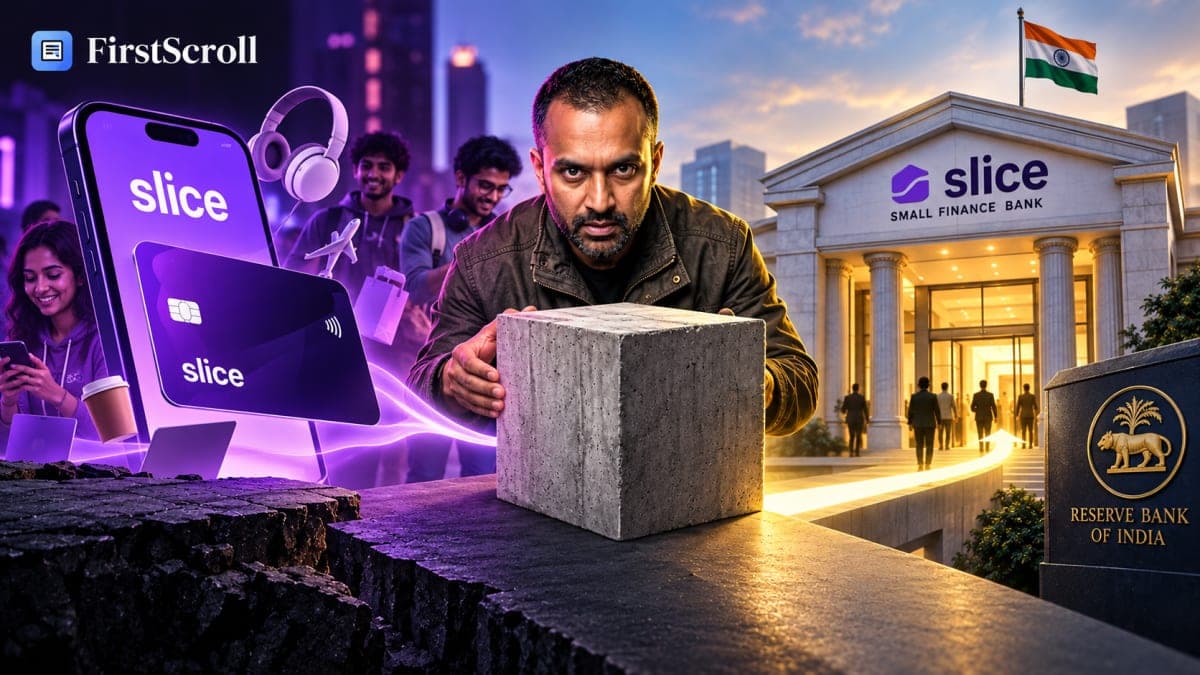
Then it did something that looked, on the surface, like a surrender. It merged into a small, loss-making bank in the northeast and turned itself into a licensed bank. And last week, it raised $100 million to keep building out that bank.
The company that made its name as an app on your phone chose to become the thing that app was supposed to replace.
So the question is, why would a beloved, high-flying fintech voluntarily bury itself inside a slow, boring, tightly regulated bank?
To understand it, you have to understand what most fintechs actually are, because it is not what the glossy apps suggest.
You see, in India, you cannot simply decide to lend money or hold people's deposits. Those are regulated activities, and they require a licence from the [Reserve Bank of India](INTERNAL: repo rate home loan emi), a licence that is famously, deliberately, almost impossible to get. So most fintechs never had one.
Instead, they built a beautiful app and rented the actual banking underneath from a licensed partner bank. The fintech owned the customer, the experience, the brand. The partner bank owned the thing that was actually legal: the licence. Think of it as running a gorgeous restaurant in a building you do not own, on a lease the landlord can change at any time.
For years, that arrangement looked like genius. Why deal with the heavy, capital-hungry burden of being a bank when you could just build the fun part on top?
And then, in 2022, the landlord changed the terms.
The RBI issued a set of rules that quietly detonated the whole model. It clarified that these fintechs could not load credit lines onto their cards the way they had been doing, a practice that sat at the heart of Slice's business. Overnight, the regulator reminded an entire industry of an uncomfortable truth: if your business depends on a licence you do not hold, you do not really control your business.
Slice, Uni and others were hit at once. The app was never the moat. The licence was. And they had been renting it.
This is the hidden lesson underneath Slice's strange journey. The most valuable thing in finance is not the slick interface everyone can see. It is the boring, hard-won permission to hold money, the thing the RBI hands out to almost no one. Fintechs spent a decade competing on design while quietly depending on partners who held the one asset that actually mattered.
So Slice made its choice. Rather than keep renting, it would own. It spent over a year working with North East Small Finance Bank, first buying a stake, then merging with it entirely in a deal the RBI signed off on, an approval so rare it has eluded some of India's biggest corporate names for decades. The disruptor became the incumbent, on purpose.
But here's the twist, and it is the part even seasoned finance people found surprising. There was a clever, cautious way to do this and a hard, all-in way, and Slice chose the hard one.
The cautious move, the one analysts say most founders would have picked, was to grab the banking licence and then keep the messy bank at arm's length, layering fintech on top and quarantining the ugly, risky banking operations to one side. Keep the glamour, ring-fence the grind.
Slice's founder did the opposite. He merged everything, the operations, the capital, the technology, the people, and the liability, and set about rebuilding the whole thing from the core. The bank he took on was not a healthy one either: North East had run up a ₹441 crore loss before the merger, against which Slice's own pre-merger losses looked modest. Fixing that hole became his actual job.
And here is why that matters, and why the "boring" choice was the strong one. When you own the licence, the rules that once threatened you become your moat. The same regulatory wall that the RBI used to hammer fintechs in 2022 now stands in front of Slice, protecting it from the next wave of app-only challengers who still have to rent what Slice now owns. A bank grows differently from an app, too. It cannot grow on downloads and marketing alone. It grows on a strong balance sheet and deposits, which is exactly why that fresh $100 million matters more than any ad campaign. Capital is the fuel a bank runs on. By early reports, the once-loss-making entity has since turned profitable.
Now, why should you care about one company's corporate restructuring? Because it marks a turning point you will see ripple across everything you use. The first era of Indian fintech was about the interface, who had the nicest app, the smoothest signup, the best cashback. The next era is about who owns the pipes. A string of fintechs, in lending and beyond, are now chasing licences, banking permissions, [the regulated core](INTERNAL: itc demerger sum of parts), rather than renting them. When you next hear that a familiar app is "becoming a bank" or "acquiring an NBFC," you will know it is not a step backwards. It is a company deciding to own the one thing that was always the real prize.
So Slice did not surrender by becoming a bank. It stopped renting the most valuable asset in finance and bought it outright, then did the harder job of rebuilding it from the inside rather than hiding from it. The app was always the easy part. The licence was the whole game.
Whether it can now turn a fixed-up small bank into the pan-India digital bank it is promising is the next chapter, and this time, at least, it owns the building.
Until then…
If this reframed how you see the apps in your pocket, share it with a friend on WhatsApp, LinkedIn or X.