In today's FirstScroll, we investigate the ₹100 water bottle. You've felt the sting: you clear security, you're thirsty, and suddenly a bottle of water costs three times what it does outside. It feels like daylight robbery. It isn't random greed. It's one of the most deliberate business setups in the world, and once you see how it works, you'll understand why it's almost impossible to escape.
The Story
You know the exact moment.
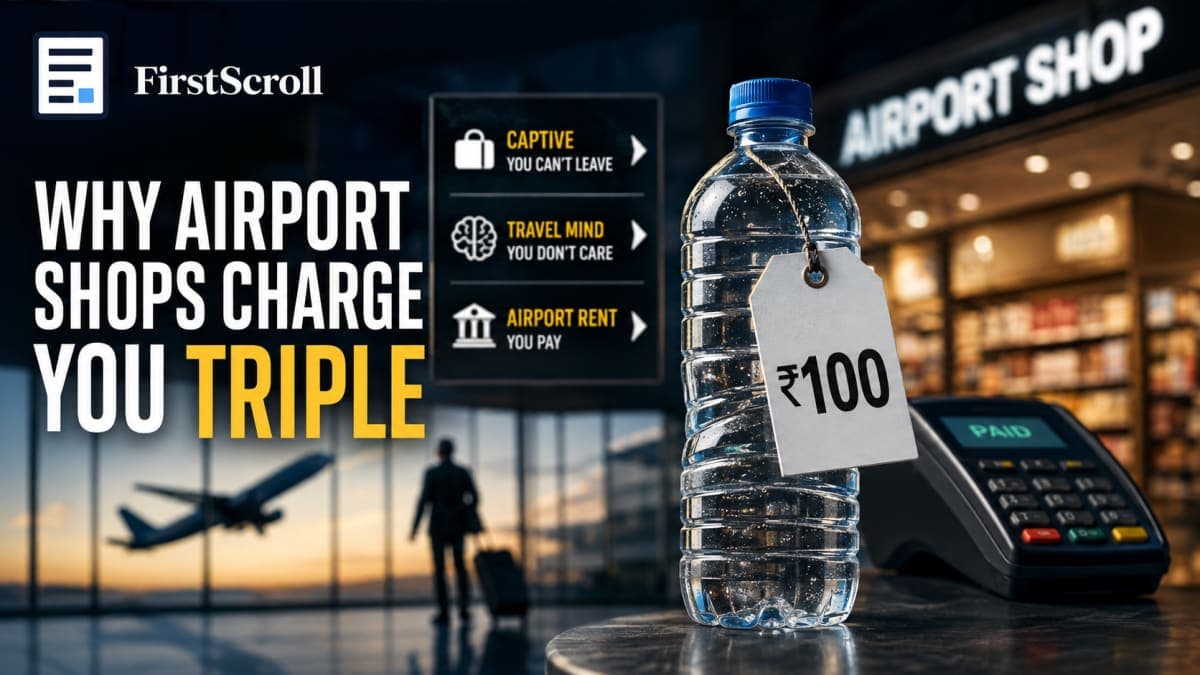
You've cleared security. Your flight is in an hour. You're thirsty, or hungry, or you forgot your earphones. You walk up to a shop, pick up a bottle of water, and the number on the tag makes you flinch. A hundred rupees. For water that costs ₹20 at the shop outside your house.
You pay it anyway. You always do. And that reaction, that little sigh of "fine, whatever", is not an accident. It is the entire business model, working exactly as designed.
So let's answer the real question. Why can an airport shop charge you triple and get away with it, again and again, to millions of people who all know they're being overcharged?
The answer has two halves. One is a clever trap. The other is a psychology trick. Together, they make one of the most reliable money machines in retail.
Half one: you are a captive.
Here is the single most important idea in this whole story.
The moment you walk through airport security, you enter a sealed box. Inside that box, there is no competition. You cannot leave to buy water cheaper elsewhere, because leaving means going back through security and possibly missing your flight. You cannot order online. You cannot wait for a better deal.
Economists have a name for this. You have become a captive market, a customer who literally cannot go anywhere else.
Think about what that does to pricing power. In a normal market, if a shop charges ₹100 for water, you walk ten steps to the shop next door that sells it for ₹20. That competition is what keeps prices honest. Inside the airport, that escape route is gone. The shops know it. And when a seller knows you have nowhere else to go, the price stops being set by competition and starts being set by how much you'll tolerate.
That's why the markup is so bold. A bottle of water can carry a 100%-plus markup, and food often costs 2 to 3 times the normal rate. Not because the water is special. Because you're trapped, and everyone in the box knows it.
But being trapped only explains why you can't run. It doesn't fully explain why you pay so willingly. That's the second half.
Half two: your brain is on "travel money".
Something strange happens to people at airports. They spend differently.
When you're travelling, a mental switch flips. The normal, careful part of your brain that says "₹100 for water? absolutely not" goes quiet. Instead, a looser voice takes over: it's just travel money. I'm on a trip. Who cares.
Airports are designed to lean on this exact feeling. You're a little stressed, a little tired, maybe anxious about the flight. You have time to kill and money in your pocket. In that state, spending feels temporary and painless, like it doesn't quite count.
Retailers know this mood intimately. So they place food outlets right where you'll drift past them, pump out the smell of fresh coffee, and light up the displays. They're not just selling you a sandwich. They're catching you in a moment where your guard is down and your wallet is open.
Captivity means you can't leave. Travel-mind means you don't really want to fight the price. Put those together, and you have a customer who is both trapped and willing. That is a retailer's dream.
But here's the twist: the shopkeeper isn't the villain.
Now, it's tempting to picture a greedy shop owner cackling as he charges you ₹100 for water. The reality is more interesting, and it flips the story.
The shop is often barely keeping the money. Because the real price you're paying isn't for the water. It's for the rent.
To operate inside an airport, a shop, called a "concessionaire", has to win the space in an auction and then pay the airport eye-watering amounts. Typically it's the higher of a big fixed rent or a percentage of its sales, often 10 to 18%, handed straight to the airport. On top of that, the per-square-foot rent inside a terminal can far exceed what the same brand pays at a prime shop in the city.
So the shop's costs are genuinely, structurally higher than a normal store's. It's paying a fortune just to stand there. And it passes that fortune straight on to you, in the price of your coffee.
Which means the ₹100 water isn't really a water business. It's a rent business, and you're the one ultimately paying the airport's rent.
Why the airport wants it this way.
Now step back and ask: why would an airport charge its shops so much that they have to gouge passengers? Isn't that bad for the airport?
Not at all. Because this is exactly how modern airports make their money.
You'd assume an airport earns mostly from planes, landing fees, and airlines. But that "aeronautical" income is only about half the story. The other half, sometimes more, comes from non-aeronautical revenue: parking, and above all, the shops and food courts.
At many airports, concessions, the retail and food, make up as much as 60% of total revenue and a huge chunk of the profit. Globally, non-aeronautical income is around 37% of airport revenues, and at the profit level it matters even more.
So the airport has every reason to squeeze the highest possible rent from shops. That rent is a core part of how it pays for those shiny terminals and long runways. Your ₹100 water is quietly helping fund the airport itself.
It's a beautiful, self-reinforcing loop. The airport charges shops brutal rent. The shops pass it to trapped, relaxed-spending passengers. The airport pockets a cut of every sale on top. Everyone in the chain profits, except the person holding the water bottle.
And here's the proof it's a choice, not a necessity.
If airport prices were purely about high costs, you'd never be able to sell anything cheaply inside a terminal. But you can, and some do, which proves the high prices are a decision, not an unavoidable fact.
In India, after a flood of passenger complaints, the Airports Authority of India pushed government-run airports to open low-cost counters selling water at MRP and tea at ₹10. The "UDAN Yatri Cafe" in Kolkata and Chennai now sells tea at ₹20 and water at ₹10, and it pulled in thousands of passengers within weeks. Some US airports cap concession prices at around 10% above street rates.
That's the tell. When someone forces the price down, the shops still function. Which means the ₹100 water was never about survival. It was about how much they could get from a captive, distracted customer, until someone made them stop.
So, why do airport shops charge you triple?
Because they've built the perfect pricing environment. They trap you in a zone with no competition, catch you in a mindset where money feels like play money, and load their prices with the enormous rent the airport demands, rent the airport wants high because those shops are how it makes its profit.
The lesson runs far beyond airports, and you can spot it everywhere once you know it: cinema popcorn, stadium drinks, the minibar in your hotel room. Whenever a seller controls a space you can't easily leave, the price stops reflecting the cost of the thing and starts reflecting the value of your being trapped.
The water was never worth ₹100. Your inability to walk away was.
Until next time...