In today's FirstScroll, we expose the best-kept secret in the world's most famous company. You think of Apple as the iPhone company. But the real money machine isn't the shiny phone in your hand, it's the invisible stuff running on it. Apple is quietly turning into a subscriptions empire, and the numbers are genuinely jaw-dropping.
The Story
Ask anyone what Apple sells, and they'll say one word: iPhones.
And fair enough. The iPhone is the most successful product in history. It's still Apple's single biggest revenue line by a mile, pulling in over $200 billion a year. When people picture Apple, they picture that glass-and-metal rectangle.
But here's a secret hiding in plain sight. The iPhone might be what Apple is famous for. It's increasingly not where Apple makes its profit.
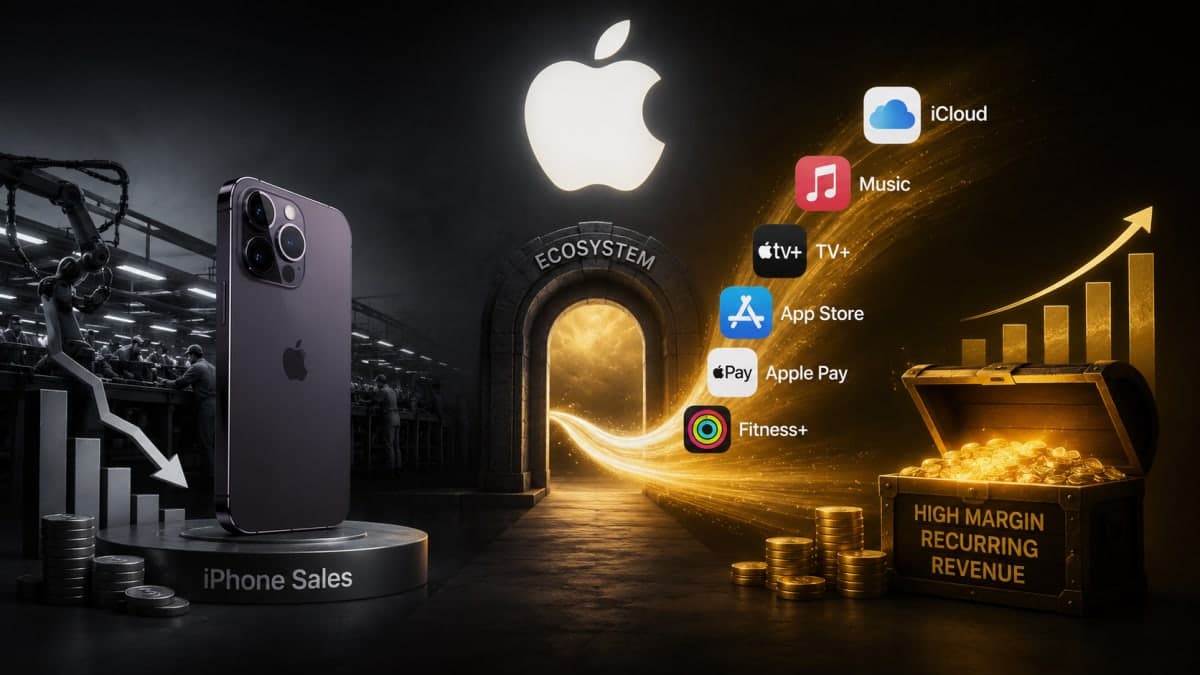
That quiet, almost invisible part of Apple, the App Store, iCloud, Apple Music, Apple TV+, Apple Pay, AppleCare, all the digital stuff, is now closing in on something staggering: it's about to out-earn every single Apple device combined. Every iPhone, iPad, Mac, and Watch on the planet, on one side. And on the other, just the services. And services are about to win.
How is that even possible, when the iPhone brings in five times more revenue? The answer is one of the most important ideas in all of business. So let's break it down.
The trick isn't how much you sell. It's how much you keep.
Imagine two shops.
Shop A sells smartphones. For every ₹100 phone it sells, it spends about ₹60 building it, screens, chips, batteries, assembly. So it keeps ₹40.
Shop B sells a music subscription. For every ₹100 it earns, it spends barely ₹25 to deliver it, because there's no physical product, just code and servers. So it keeps ₹75.
Same ₹100 of sales. But Shop B keeps nearly twice as much profit. That, in a nutshell, is the entire Apple story.
In real numbers, it's exactly this dramatic. Apple's products (the hardware) run at a gross margin of around 40.7%. Its services run at a stunning 76.5%. As one analysis put it, every dollar of services brings in nearly twice the profit of every dollar of hardware.
So even though services are a smaller slice of revenue, each rupee of that slice is worth almost double. And that changes everything.
Just how big has this "invisible" business become?
Brace yourself. In fiscal 2025, Apple's services division crossed $109 billion in revenue for the first time. To give you a sense of that scale: Apple's services arm alone is now bigger than the entire annual sales of Disney, Tesla, or Tencent.
Read that again. The "side business" most people don't even think about is larger than some of the most famous companies on Earth.
And it's not just big, it's the profit engine. In a recent quarter, services delivered a remarkable 45% of gross profit, despite being only about a quarter of its revenue. The profitability is so lopsided that analysts now expect services to soon surpass the profit of all of Apple's devices put together.
The iPhone is the body. Services have quietly become the heart.
So how did the iPhone company morph into a subscriptions empire? Through a beautifully simple strategy.
Step 1: Sell the device. Step 2: Rent them everything forever.
Here's the genius. Apple sells you an iPhone once. That's a one-time payment. Nice, but it ends there.
But that iPhone isn't really a product. It's a doorway. Once you own it, you walk through that door into Apple's world, and you keep paying, month after month, year after year:
You buy apps and games (Apple takes a cut of up to 30% from the App Store). You run out of storage, so you pay for iCloud. You stream Apple Music. You watch Apple TV+. You tap to pay with Apple Pay. You protect your phone with AppleCare. Each one a small, recurring payment, flowing to Apple automatically, forever.
This is the magic shift: from a one-time sale to a forever subscription. As one report described it, each device sale becomes a multi-year recurring revenue addition rather than a one-time transaction. You don't just buy an iPhone. You start paying rent on Apple's ecosystem.
And the scale of this is wild. Apple now has over 1 billion paid subscriptions running across its platform, and the App Store alone has over 850 million weekly users. Every new iPhone sold doesn't just earn Apple a one-time profit, it adds another paying member to a club that keeps paying for the next 5 to 7 years.
Step 3: The army that keeps growing.
This is why Apple keeps selling iPhones even when it can't really make them dramatically better each year. Because every device sold is another recruit into the services army.
There are now over 2.5 billion active devices in the world. That's 2.5 billion little money-doors, each one a person who might pay for storage, music, or an app subscription. As Apple sells more devices in growing markets like India, the services revenue automatically grows behind it, like a shadow.
That's why this model is so powerful. Hardware sales bounce up and down with each product cycle, a great iPhone year, then a slow one. But services just keep climbing steadily as the installed base grows, smoothing out the bumps. It's a predictable, high-margin river of cash that the volatile hardware business could never provide on its own. This shift has pushed Apple's overall profit margin from about 38% in 2020 to around 47% recently, a massive jump.
The catch, because there's always one.
This goldmine has a target painted on it. Because so much of the services profit comes from that App Store commission of up to 30%, regulators around the world are circling. Governments in the US and Europe are challenging Apple's fees and rules, arguing the cut is unfairly high. A big chunk of services profit also quietly comes from Google paying Apple billions just to be the default search engine on the iPhone, another deal under legal threat.
So the empire is dazzling, but not bulletproof. If regulators force Apple to cut its App Store fees or kill the Google deal, the most profitable part of the machine takes a hit. Apple knows this, which is why it keeps expanding into new services to spread the bet.
So, why does Apple quietly make more money from services than from the iPhone?
Because Apple figured out the deepest truth in business: selling a product once is good, but getting paid forever is far better. It spent years turning the world's most desirable gadget into a doorway, and then built a high-margin empire of subscriptions and fees on the other side of that door. The iPhone gets the glory and the headlines. The invisible services running on it quietly bring home an ever-bigger share of the actual profit.
The world still calls Apple a hardware company. The numbers say it's becoming a subscriptions company that happens to sell really nice hardware.
The phone was never the real product. It was the key to a door, and Apple has been collecting rent ever since.
Until next time...