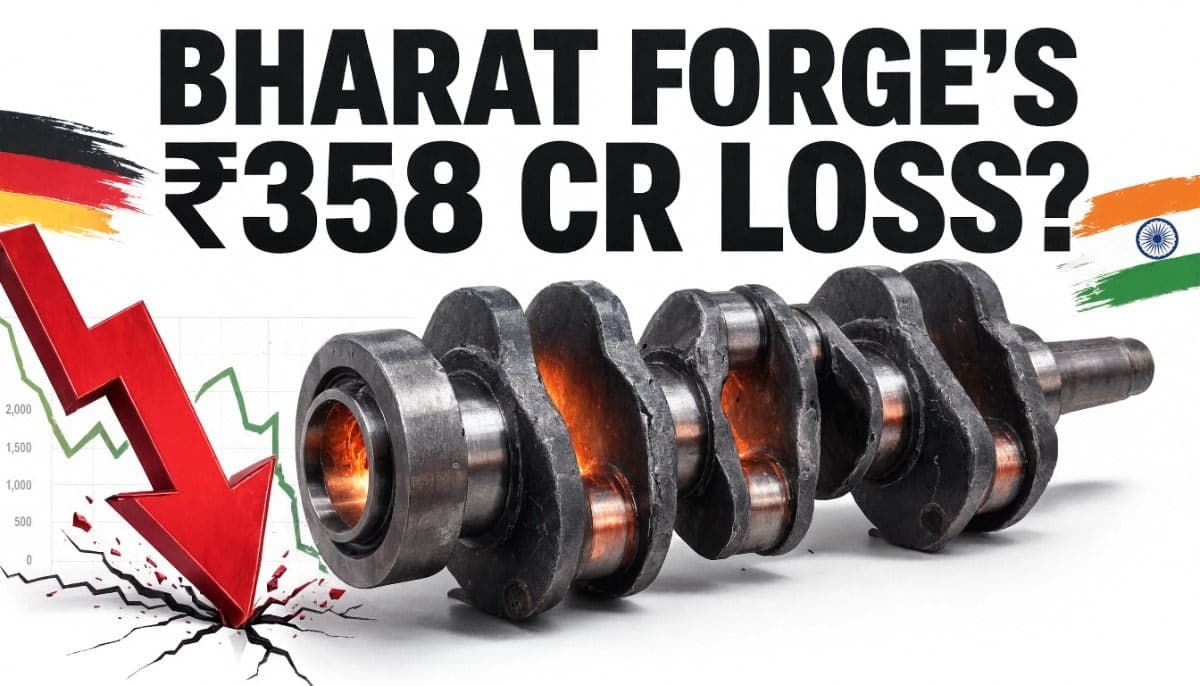
In today's FirstScroll, we break down Bharat Forge's surprise Q1 loss and explain why the company is paying ₹358 crore to shrink in Germany while betting billions on India.
With that out of the way, let's dive into today's story.
The Story
If you've ever ridden in a truck, flown in a plane, or watched an artillery gun roll past on Republic Day, there's a decent chance a piece of it was hammered into shape in Pune.
That's Bharat Forge for you. The Kalyani family built it into one of the world's largest forging companies, the folks who take raw metal and press it into crankshafts, axle beams, and gun barrels. For decades, its growth story ran through the West. It bought factories in Germany, supplied American truck makers, and became the textbook example of an Indian manufacturer conquering global markets.
Germany, in particular, was the crown jewel. The home of precision engineering. The market that gave an Indian forging company its global credibility.
Then, on Monday, the company dropped a surprise. Bharat Forge reported a net loss of ₹90 crore for the June quarter, against a ₹284 crore profit a year ago. The stock cracked 9% in a single session.
Here's what makes this weird. This wasn't a company running out of steam. Revenue actually grew 18.7% to ₹4,640 crore. Its defence business, the segment everyone's excited about, jumped 87%. And its defence order book stands at a chunky ₹11,196 crore, roughly two and a half years of a full quarter's revenue, already locked in.
So here's the question: how does a company grow nearly 19%, watch its hottest business almost double, and still end the quarter in the red?
The answer sits in one line of the results: a ₹358 crore exceptional loss. And behind that line sits a factory in Germany.
You see, when a company decides to shut down or shrink an operation, accounting rules force it to book the expected cost of that decision today, even if the actual cheques go out over the next year or two. That upfront charge is called a restructuring provision. It's not cash walking out the door this quarter. It's the company admitting, on paper, that a painful bill is coming.
Bharat Forge's bill comes from its German subsidiary, Bharat Forge CDP GmbH, which has been squeezed by weak European demand and stubbornly high costs. Spiralling energy prices didn't help either. Making things in Germany has quietly become one of the more expensive hobbies in global manufacturing.
But here's the part most Indian readers won't know. In Germany, a company can't simply hand out pink slips and lock the gates. German law requires it to negotiate with the Works Council, an elected body of employees with real legal teeth, and agree on something called a social plan: a compensation package covering severance, retraining, and transition support for affected workers.
That's exactly what happened. BF CDP reached an in-principle understanding with its Works Council, and Bharat Forge booked a ₹330 crore provision for the social plan, plus ₹27 crore in incidental costs. In plain words: the company is paying hundreds of crores for the right to become smaller in Germany.
Now, why would anyone pay to shrink? For Bharat Forge, the logic is simple: every crore sunk into propping up a structurally unprofitable German plant is a crore not spent on the businesses that are actually growing. Management has said it will keep re-evaluating its global footprint wherever profitability looks challenging. This isn't a one-off. It's a slow, deliberate retreat from expensive geographies.
And for the German workers? The social plan is their insurance. They lose jobs either way if the plant bleeds out; the negotiated exit at least guarantees compensation. Both sides prefer an expensive, orderly goodbye over a messy collapse.
Where does the money go instead? Home. Bharat Forge plans to invest around ₹1,800 crore over 12 to 18 months in capacity for what it calls sunrise sectors: defence, aerospace, semiconductors and data centres, including an energetics plant in Andhra Pradesh. To fund the pivot, the board has approved raising up to ₹2,500 crore through fresh equity or other instruments.
But here's the twist. Strip out the German write-off and the quarter still isn't spotless. The consolidated EBITDA margin, the share of revenue left after day-to-day running costs, slipped to 15.3% from 17.2% a year ago. Even the standalone Indian business saw its margin narrow to 24.9% from 27.1%. The one-off explains the loss. It doesn't explain the squeeze.
Now to be clear, management is unfazed. It has maintained a 20 to 25% growth outlook for the Indian manufacturing business this year, weighted towards the second half. And the Indian operations did win new orders worth ₹1,352 crore during the quarter, half of it from defence.
So, is this quarter a disaster? Not quite. It's better read as the price tag of a pivot. Bharat Forge spent thirty years buying its way into Western manufacturing. It's now spending real money to unwind parts of that bet, so it can go all-in on Indian defence and chips.
The irony is hard to miss: the company that once proved Indian engineering could win in Germany is now proving that even German engineering can't beat German costs. Whether the ₹358 crore goodbye turns out to be the cheapest cheque Bharat Forge ever wrote is something only time will tell.
Until then…
If this story helped you make sense of Bharat Forge's Q1 loss, share it with a friend on WhatsApp, LinkedIn or X.