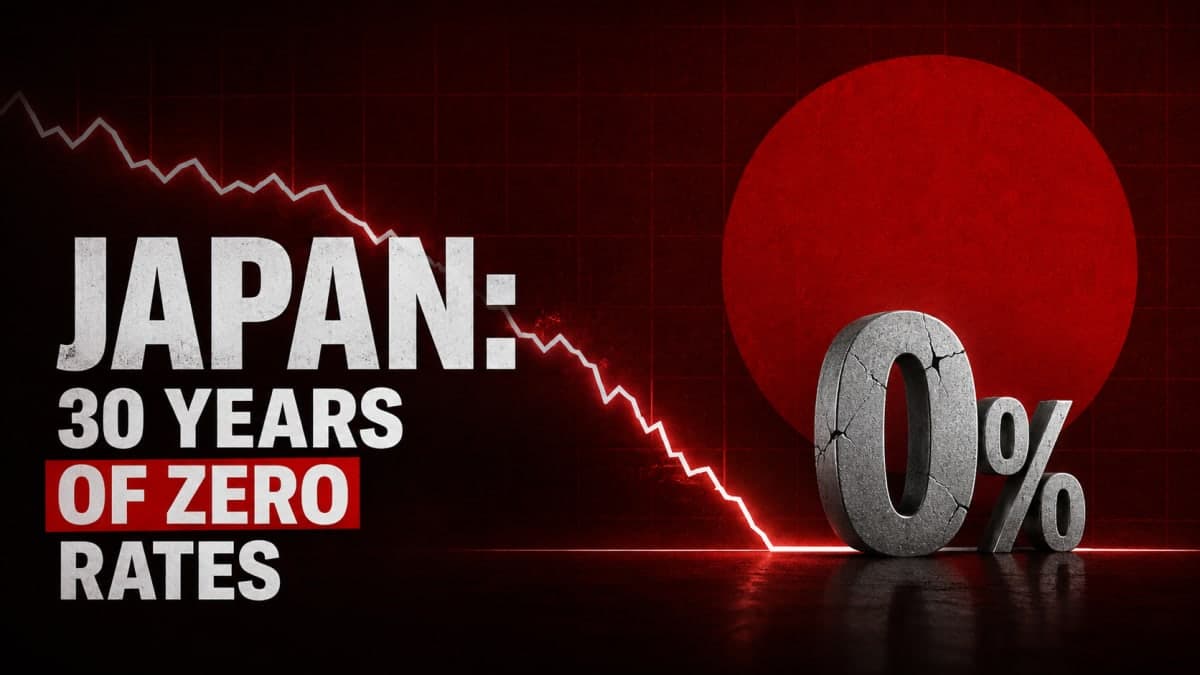
In today's FirstScroll, we break down why Japan spent 30 years stuck at zero interest rates, and why it's now climbing out slower and more nervously than any economy on earth.
Fair warning, this one bends the premise a little, because the answer is more interesting than the question. With that out of the way, let's dive into today's story.
The Story
Picture Japan in the late 1980s. Tokyo real estate was so valuable that, on paper, the land under the Imperial Palace was said to be worth more than the entire state of California. Stock prices were vertical. It was the richest bubble the modern world had seen.
Then, in 1989, the Bank of Japan tried to let the air out gently. It sharply raised interbank lending rates to cool the speculation. The bubble didn't deflate. It exploded.
What followed wasn't a recession. It was an era. Land prices and the stock market collapsed, banks were buried under bad loans, and Japan slid into something economists now call the "lost decades," a run of stagnation so long that the Nikkei spent more than 20 years far below its peak.
And here's the part that puzzles people. Japan's problem wasn't rising prices. It was the opposite. Prices kept falling, year after year, in a condition called deflation.
So here's the question. If everyone else raises interest rates to fight inflation, why did Japan spend three decades doing the reverse, holding rates at zero to try and create some?
You see, deflation sounds harmless, even nice. Cheaper stuff every year, who complains? But for an economy it's quietly poisonous. If you know a fridge will be cheaper next year, you wait. If everyone waits, companies sell less, cut wages, and prices fall further. Households and firms spend the decade paying down old debt instead of spending, which starves demand even more. It becomes a loop that feeds on itself.
A central bank's normal escape hatch is to cut interest rates, making borrowing cheap enough that people spend again. So Japan cut. And cut. Until in 1999 it did something no major economy had done before: it introduced a zero interest rate policy, making it virtually free for banks to borrow.
But it didn't work, and that's where the mechanism gets strange.
Once rates hit zero, the central bank runs out of room to cut further. Economists call this the zero lower bound, and it comes with a nasty trick: when prices are falling, a rate of 0% isn't really free money. If cash itself gains value each year because everything gets cheaper, then holding cash earns a positive real return, so people hoard it rather than spend. The BoJ was pushing on a string.
So it went further than anyone. It pioneered quantitative easing, buying huge quantities of government bonds to flood the system with money. In 2016 it even pushed its policy rate to minus 0.1%, charging banks to park cash. For years, still, inflation barely stirred.
Now to the twist, because the thing that finally broke the spell wasn't Japanese policy at all.
It was the global inflation wave of 2021 to 2023. Imported energy and food costs surged worldwide, and that external shock did what decades of domestic experiments couldn't: it dragged Japan's inflation above the 2% target. The escape, in other words, came from outside.
Which brings us to why Japan is still the odd one out. While the US Fed and others hiked aggressively to crush inflation, Japan wants the opposite. It wants to make sure this inflation sticks before it kills it. So it has moved with painful slowness: off negative rates in 2024, then a careful climb to 1% by June 2026, its highest in 30 years, but a level most economies would consider rock bottom.
And it has two very good reasons to tread lightly. First, Japan's government debt sits around 236% of GDP, the heaviest in the developed world, so every rate rise makes servicing that mountain more expensive. Second, higher rates strengthen the yen and can unwind the "carry trade," where global investors borrow cheap yen to buy higher-yielding assets abroad. Move too fast, and you risk jolting markets far beyond Tokyo.
So, why does Japan look like it's still near zero when everyone else raised rates? Partly because it was, for longer than any modern economy, fighting a deflation the rest of us only read about in textbooks. And partly because even now, having finally started to climb, it's the one central bank that fears killing inflation more than feeding it. Whether Japan can normalise without triggering the debt and currency shocks it's so afraid of is something only time will tell.
Until then…
If this story helped you make sense of Japan's zero-rate era, share it with a friend on WhatsApp, LinkedIn, or X.