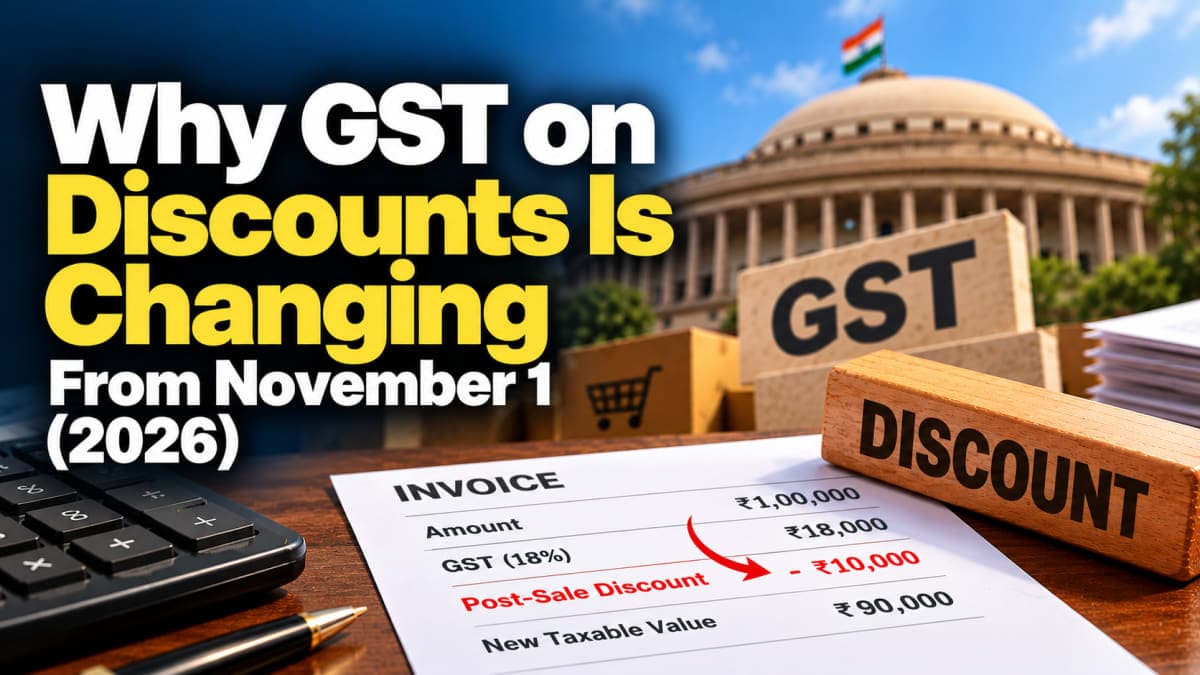
Indian businesses have been paying tax on money they gave back to customers for eight years. From Sunday, November 1, that ends. Here is why a small change in GST law could free up cash for lakhs of dealers and distributors.
What happened?
On October 26, the government notified that new GST rules on post-sale discounts will start on November 1, 2026.
The change itself isn't new. It was announced in Budget 2026-27 and passed in March. But the government hadn't said when it would kick in. Now we know: November 1, 2026.
First, what is a post-sale discount?
It's a discount given after a sale is already done.
Say a biscuit company sells stock to a dealer in April. In March, it looks back and says: "You sold a lot this year. Here's 3% back." That rebate is a post-sale discount.
This happens all the time in India. Year-end rebates, festive schemes, sales-target bonuses, compensation when prices drop. FMCG, pharma and auto dealers live on them.
So what was the problem?
GST is a tax on the price you sell at. If the price later falls because of a discount, the tax should fall too. Simple, right?
Not under the old rules. The tax could only be reduced if two things were true:
The discount was written into a contract before the sale.
It was linked to specific invoices.
Real business doesn't work like that. Nobody knows in April which dealer will hit a target in March. And a lump-sum rebate on a year of sales can't easily be tied to hundreds of separate bills.
So most companies took the safe route. They gave the money back but left the GST untouched. The result? The seller kept paying tax on money it no longer had.
And when paperwork wasn't perfect, tax officers often rejected the discount entirely, leading to years of disputes.
What changes from November 1?
Both old conditions are gone. Now a discount reduces the tax if just two things happen:
The seller issues a GST credit note (a formal document reducing the bill).
The buyer cancels the matching tax credit it had claimed.
That's it. No advance contract. No invoice matching.
The law has also been tweaked so credit notes officially cover post-sale discounts. Earlier, one part of the law allowed the tax cut, but another part didn't clearly allow the document needed to make it.
How does it work? Let's do the math
A manufacturer sells goods worth ₹1,00,000 to a dealer. GST at 18% is ₹18,000.
Later, it gives the dealer a ₹10,000 rebate that wasn't in any contract.
Old rules: The manufacturer still pays GST on the full ₹1,00,000, even though it only earned ₹90,000. The dealer keeps the full ₹18,000 tax credit.
New rules: The manufacturer's GST drops by ₹1,800. The dealer gives up ₹1,800 of its tax credit.
Notice something? The government collects the same total tax either way. The only difference is that the tax now matches the real price. The seller stops paying tax on money it handed back.
Wait, what's a "tax credit"?
Quick refresher. When a dealer buys goods, it pays GST. When it sells them, it collects GST. The government lets it subtract what it paid from what it owes, so the same goods aren't taxed twice. That subtraction is called input tax credit, or ITC.
If the dealer's purchase price drops because of a discount, its credit has to drop too.
Why does it matter?
More cash for businesses. Companies that give big rebates will stop paying tax on them. That money stays in the business.
Fewer fights with the taxman. Fewer conditions means fewer things for officers to object to.
Less paperwork. No need to draft contracts upfront for every possible scheme.
What's the catch?
The seller's relief now depends on the buyer. If a dealer doesn't cancel its tax credit, the seller's claim can fall apart. Experts say sellers should track this through return matching, not just hope the dealer does it.
Also, not every "discount" counts. If a dealer is being paid to run ads or promotions under a contract, CBIC has already said that's a taxable service, not a price cut.
Anything else changing on November 1?
Yes, two refund fixes. Businesses whose raw materials are taxed more than their final products can now get faster provisional refunds. And small exporters shipping by courier or post no longer face a ₹1,000 minimum refund limit.
The bottom line
Prices often change after a sale. For eight years, GST pretended they didn't. From November 1, the tax will finally follow the price that was actually paid.
For sellers, that means less tax on rebates. For dealers, it means one new habit: when a GST credit note arrives, cancel the matching credit on time.
FirstScroll explains, we don't advise. Businesses should check the details with their chartered accountant.