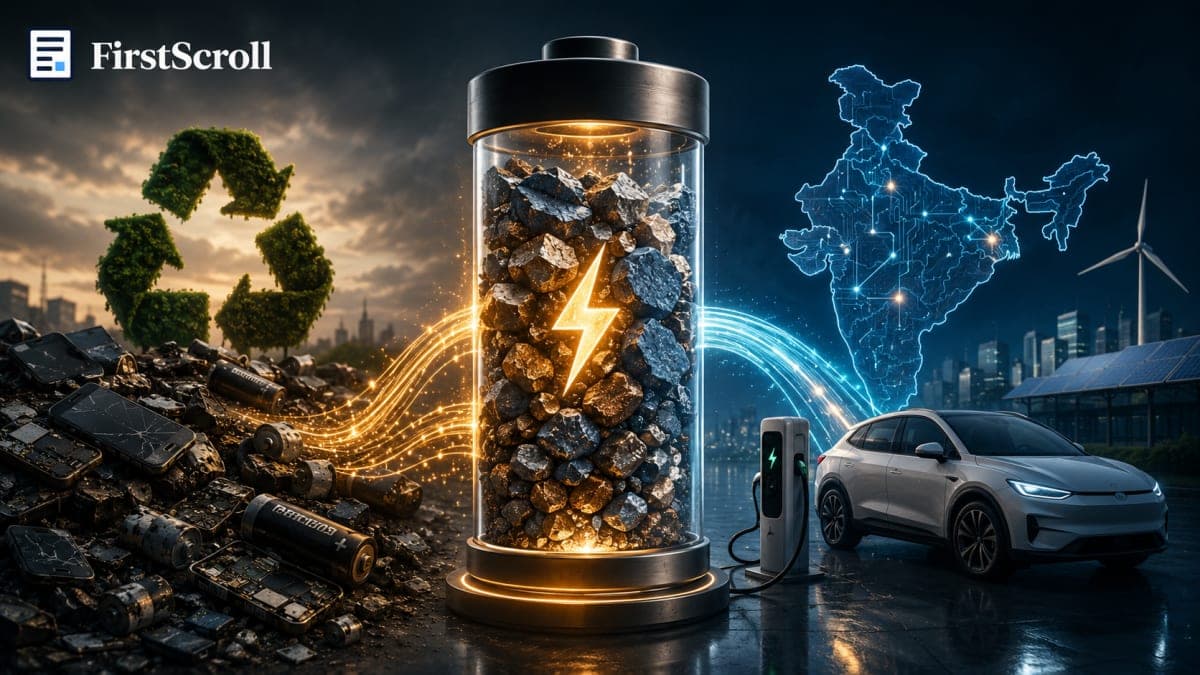
In today's FirstScroll, we explain why the Indian government suddenly cares a lot about your dead phone batteries, scrapped EV packs, and broken laptops. It just cleared 58 companies to start mining gold from garbage. And the real reason has less to do with the environment and more to do with a quiet war over the metals that power the future.
The Story
Here's a sentence that sounds made up: India is about to start "mining" without digging a single new hole in the ground.
In April 2026, the Ministry of Mines approved 58 companies under a ₹1,500 crore incentive scheme to recover critical minerals from waste, old lithium-ion batteries, dead electronics, and industrial scrap. Those companies have together pledged to invest nearly ₹5,000 crore and build a huge recycling capacity.
On the surface, this looks like a feel-good environmental story. Recycling, green economy, less waste, lovely. But that's not really why the government is throwing money at it.
The real reason is far more strategic, and a little scary. To understand it, you have to know about the metals hiding inside everything you own.
The problem: the future runs on a handful of metals India doesn't have.
Look around. Your phone, your laptop, your earbuds, and increasingly your scooter and car, all run on batteries. And those batteries need specific metals: lithium, cobalt, nickel, and a few others. They're called "critical minerals", because modern life literally cannot function without them.
Here's India's painful problem. It barely has any of these in the ground. So it has to import almost all of them. And the country it mostly depends on for processing these minerals? China.
This is the trap. India wants to build a massive electric vehicle future, crores of EVs, huge battery factories, clean energy everywhere. But you can't build batteries without these metals. And right now, India's EV dream is sitting on a foundation it has to buy from a rival that could choke the supply anytime.
We've actually already seen this movie. When China restricted rare-earth exports, it hit India's EV sector hard, because those magnets go into EV motors. One decision in Beijing, and Indian carmakers started sweating. That's the kind of dependence that keeps a government up at night.
So India needs its own supply of these metals, badly. But here's the catch: digging new mines takes forever.
Why digging won't save India fast enough.
Finding a new mineral deposit, getting clearances, building a mine, and actually pulling metal out of the earth can take 10 to 15 years. India doesn't have that kind of time, the EV wave is happening now.
So the government got clever. If you can't dig the metals out of the ground fast enough, why not pull them out of the mountains of waste you already have lying around?
Think about it. Every dead phone, every scrapped laptop, every end-of-life EV battery is stuffed with lithium, cobalt, and nickel. It's a metal mine, just in a different shape. Experts call this "urban mining", treating cities and their garbage as the new ore deposits.
And India has a LOT of this raw material. The country generates about 1.75 million tonnes of e-waste every year, the third highest in the world, plus a fast-growing pile of dead batteries. The problem? Most of it is currently wasted.
The leak the scheme is trying to plug.
Here's the frustrating part. Right now, nearly 90% of India's e-waste is handled by the informal sector, the kabaadiwala networks. They do crude, often dangerous extraction, recover a bit of value, and frequently the most valuable material, called "black mass" (the metal-rich powder from crushed batteries), gets exported abroad cheaply.
So India was doing something absurd: throwing away its old batteries, watching the precious metals inside them get shipped overseas, and then importing those same metals back at a premium to build new batteries. A leaky bucket of value, flowing straight out of the country.
This ₹5,000 crore push is designed to plug that leak. The government is paying companies, through a 20% subsidy on plant and machinery, plus rewards for actually producing minerals, to build proper, large-scale recycling plants inside India. The goal is to capture that value at home: take India's own waste, extract the critical metals here, and feed them straight back into Indian battery and EV factories.
The response stunned the government. It had targeted 270 kilotonnes of recycling capacity, but companies pledged 850 kilotonnes, more than three times the target. The industry clearly smells a huge opportunity.
Why this matters for EVs, and for you.
Connect the dots and the strategy is beautiful. A robust local recycling industry means India slowly builds its own homegrown supply of lithium, cobalt, and nickel, without depending on China or waiting 15 years for mines.
That feeds directly into cheaper, more secure EV batteries made in India. And since the battery is the single most expensive part of an electric vehicle, a steady local supply of recycled metals could, over time, help bring down EV prices and protect the industry from sudden foreign supply shocks. The Mines Secretary is openly betting that India could become a major global recycling hub by 2030.
It also creates a circular loop, the dream of a "circular economy". The battery in your scooter today could be melted down to make the battery in someone's car tomorrow. Less mining, less import dependence, less waste, more self-reliance. India isn't alone here either, the EU and US have similar recycling laws and incentives, so India is racing to keep up in a global scramble for these metals.
But let's stay honest about the challenges. A scheme on paper is not a factory on the ground. Building large refining plants needs serious money, technical skill, and time. And the biggest hurdle is that 90% informal sector, if the formal recyclers can't actually get their hands on enough old batteries because the kabaadiwalas still control the flow, these shiny new plants could sit half-empty. Plus, recycling still can't solve India's deeper gaps in high-end stuff like rare-earth magnets and semiconductors.
So, why is India betting ₹5,000 crore on your old batteries?
Because the future is electric, the future runs on a few critical metals, and India doesn't want to be at the mercy of other countries for them. Unable to dig new mines fast enough, it's turning to the next best thing: mining the mountain of electronic waste it already produces. It's a clever attempt to turn a weakness, being import-dependent and waste-heavy, into a strength.
Your dead phone battery, it turns out, isn't junk. In a world fighting over the metals that power everything, it's a tiny piece of national strategy. And India has finally decided to stop throwing it away.
Until next time...