In today's FirstScroll, we talk about the one number in India's trade data that keeps breaking records every single year, no matter who's in power, no matter how many "boycott China" campaigns we run, and ask why it simply refuses to come down.
The Story
Every few years, the same story plays out.
Tensions flare at the border. Hashtags trend. People film themselves smashing Chinese TVs. Politicians give speeches about atmanirbharta, self-reliance. The government slaps duties on Chinese goods and launches schemes to build factories at home.
And then, almost like clockwork, the annual trade data comes out. And the deficit with China has broken yet another record.
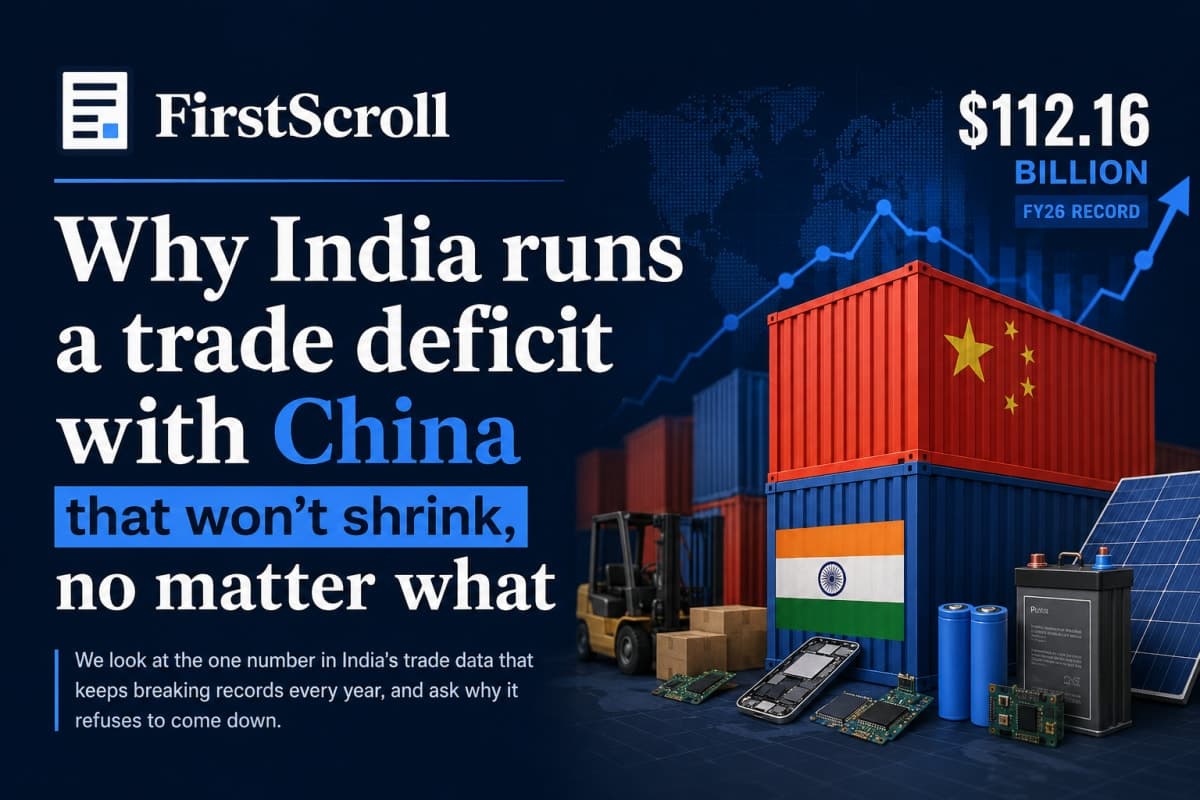
In FY26, it hit a record $112.16 billion, up from $99.2 billion the year before. To put that in perspective, that single number is larger than India's entire annual defence budget. China even quietly overtook the US to become India's largest trading partner again, with bilateral trade crossing $151 billion.
So here's the question that should bother all of us. We've been trying to fix this for over a decade. Why does it keep getting worse?
The easy answer is "cheap Chinese goods flooding our market". And that's not wrong. But it's not the real story either.
To understand the real story, you have to stop looking at what India buys from China, and start looking at why India can't stop.
Let's rewind.
In 1990, India and China were almost economic equals. India's GDP per capita was around $370. China's was about $350. We were, if anything, marginally richer per person.
Then the two countries took very different roads. China poured everything into becoming the world's factory, building an industrial base brick by brick, from raw chemicals all the way up to finished electronics. India, on the other hand, leapfrogged manufacturing and became a services powerhouse, exporting software and IT talent to the world.
That choice made India rich in a certain way. But it left a hole. And that hole is exactly what shows up on our import bills today.
Because here's the catch. When you look at what India actually buys from China, it isn't a pile of cheap toys and plastic decorations. It's electronics, machinery, EV battery cells, solar panels, chemicals, and active pharmaceutical ingredients, the inputs that Indian factories then use to make their own products.
In other words, India buys from China the outputs of the manufacturing base it never fully built.
This is the part most people miss. The deficit isn't a shopping problem. It's an industrial problem.
Think about your smartphone. India now "makes" a huge number of phones. We even export them. Make in India is working, on the surface. But crack one open, and the screen, the chip, the camera module, the battery cell, a huge chunk of those components were made in China and shipped here to be assembled.
So the more phones India assembles and sells, the more components it has to import from China to build them. Our success in manufacturing is literally driving up our imports from China. The export engine and the import engine are bolted together.
And it gets more uncomfortable.
Remember those government schemes meant to reduce dependence? The big one is the Production-Linked Incentive scheme, or PLI, where the government pays companies to manufacture in India. Sounds like the perfect cure.
Except, as trade expert Ajay Srivastava of GTRI pointed out, the PLI scheme may actually be boosting imports, because the companies cashing in on it still rely heavily on imported Chinese components to do the manufacturing. We're subsidising assembly, and assembly needs Chinese parts. The cure feeds the disease.
Now, the same logic runs through one of India's proudest industries: pharma.
India is called the "pharmacy of the world". We export generic medicines everywhere. But the active pharmaceutical ingredients, the actual chemical compounds that make a medicine work, are overwhelmingly imported from China. We package and brand the world's medicines, but the core chemistry often starts in a Chinese factory. The private sector here never wanted to make APIs, because it's capital-heavy, low-margin, and risky. So China filled the gap, and we let it.
You're probably seeing the pattern by now.
Electronics. Solar. Pharma. Batteries. In each case, India does the visible, glamorous final step, assembling, branding, exporting, while China quietly supplies the unglamorous foundation underneath. One analysis summed it up perfectly: "assembled in India, built in China".
So why won't the deficit shrink, no matter what?
Because the deficit isn't really about trade policy. You can raise tariffs, run boycotts, and announce a hundred schemes, but none of that builds a 30-year-deep industrial supply chain overnight. China spent three decades and trillions of dollars building factories that make the components that make the components. India is, by most industrial measures, 25 to 30 years behind on exactly those capabilities.
You can't tariff your way out of a gap like that. If anything, slapping duties on Chinese components just makes Indian-made goods more expensive, which hurts our own manufacturers and exporters. The dependency is baked into the supply chain itself.
And there's a cruel twist on the export side too. India's exports to China are mostly low-value raw materials, iron ore, naphtha, chemicals, and the like, while China sends back high-value finished and intermediate goods. So even when our exports to China grow, the value gap keeps widening, because we sell cheap stuff and buy expensive stuff. We ship out the ingredients; they ship back the cake.
To be fair, it's not all doom. India's exports to China actually jumped nearly 37% in FY26. The government is pushing API parks, semiconductor fabs, and component manufacturing to slowly build the missing layers. These things matter. But they're 10- and 20-year projects, not quick fixes. The deficit will keep setting records for a while yet, because the hole took 30 years to dig.
So here's the uncomfortable truth.
India's trade deficit with China isn't a sign that we buy too much. It's a mirror, reflecting an industrial base we never finished building. Every record-breaking number is really a measurement of one thing: the distance between assembling things and actually making them.
And until India builds the boring, invisible foundation, the chemicals, the chips, the cells, the components beneath the components, that gap won't close. No boycott, no tariff, no hashtag can shrink it.
You can only build your way out. And building takes decades.
Until next time…