If you own a classic long term Indian portfolio, there is a good chance it includes HDFC Bank.
It is the vanilla ice cream of investing. Reliable. Everywhere. Comforting.
And lately, frustratingly boring.
You buy it, you hold it, and you wait. Meanwhile, riskier stocks sprint ahead while HDFC Bank keeps moving sideways.
On January 5, the bank finally gave investors something to look at. Its Q 3 business update dropped, packed with growth numbers that would normally excite the market.
But the stock fell.
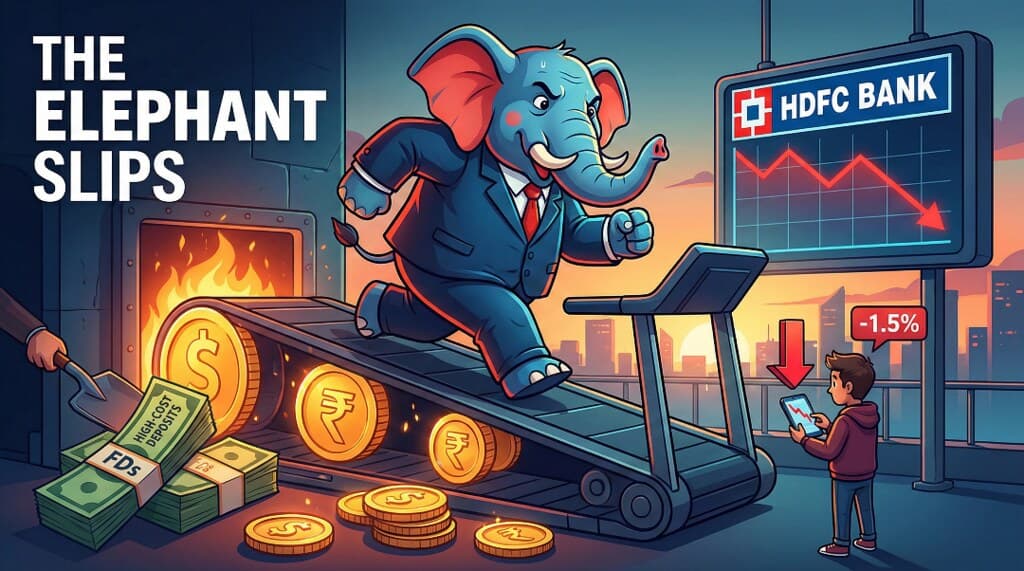
Shares slipped 1.5 percent in early trade and dragged banking stocks with it.
So what went wrong?
The problem was not growth.
The problem was the cost of that growth.
For the quarter ending December 31, 2025, HDFC Bank reported strong headline numbers.
Total loans rose 11.9 percent year on year to
₹28.45 lakh crore.
Deposits increased 11.5 percent to
₹28.60 lakh crore.
In a year when banks are aggressively competing for household savings, double digit deposit growth is not easy. In simple terms, the bank is lending almost as fast as it is collecting money.
On paper, everything looks solid.
But markets always read beyond the headline.
Imagine you run a pizza shop.
You buy cheese from two suppliers.
The first supplier sells cheaply. This is like savings and current accounts, where banks pay roughly 3 to 4 percent.
The second supplier is expensive. These are fixed deposits, where banks pay around 7 to 8 percent.
This quarter, cheap deposits grew only 10.1 percent, while expensive fixed deposits grew 13.4 percent. That means every pizza you sell now earns slightly less profit.
1. The deposit war is not over
HDFC Bank is the bellwether of Indian banking. If even the largest private lender is leaning more on expensive deposits, it signals that savers are demanding higher returns. This makes it harder for banks to cut lending rates anytime soon.
2. Borrowing appetite is still strong
Despite high interest rates, Indians are still taking loans. Nearly 12 percent loan growth for a bank this large shows housing, personal, and corporate credit remain resilient. Fears of a sharp consumer slowdown have not fully reached the credit system yet.
That is HDFC Bank’s loan book today.
Roughly ₹3 lakh crore was added in just one year.
More than the entire loan book of many mid sized Indian banks.
Growth is not the concern.
Profitability is.
When a bank raises money at around 7.5 percent and lends it at about 9 percent, margins start shrinking.
That margin is called Net Interest Margin.
The market is betting that when HDFC Bank reports full earnings later this month, margins could come under pressure.
The uncomfortable question is simple.
Is this growth coming at the cost of profits?
Attention now shifts to the earnings call.
One number will matter more than all others.
Net Interest Margin.
If HDFC Bank manages to protect margins despite higher deposit costs, the stock could recover.
If not, the long phase of time correction may continue.
In the near term, expect volatility in other banking stocks like ICICI Bank and Axis Bank, as investors assume the same expensive money problem applies across the sector.
HDFC Bank is getting bigger.
But it is also getting more expensive to run.
Until low cost deposits start growing faster, investor patience will be tested.
Fun fact: At its peak, nearly half of HDFC Bank’s deposits came from low cost savings and current accounts. Today, that share has fallen closer to 30 to 33 percent as Indians chase higher fixed deposit returns.
That is why we built First Scroll. A five minute daily finance read that explains what happened, why it matters, and what to remember.
No hype. No panic. Just clarity.