In today's FirstScroll, we break down India's ballooning crude bill and explain why buying less oil somehow ended up costing a whole lot more.
With that out of the way, let's dive into today's story.
The Story
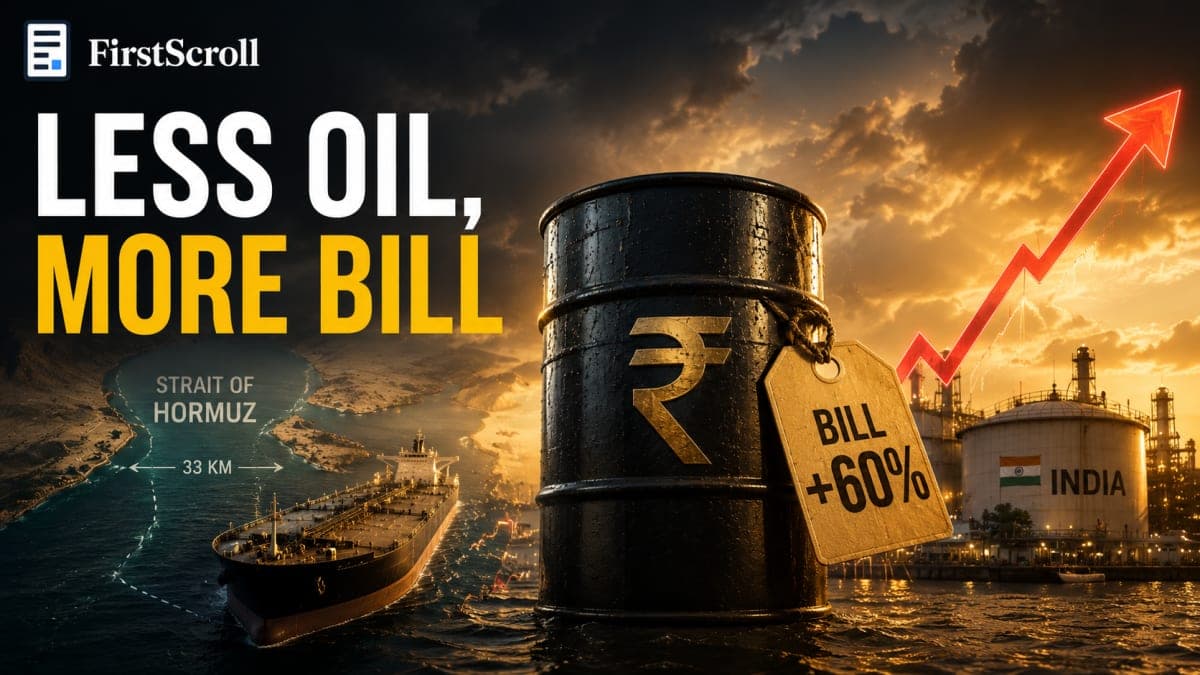
Picture a supertanker the length of three football fields, loaded with two million barrels of crude, slowing down in the Arabian Sea. Ahead of it lies a strip of water just 33 kilometres wide at its narrowest point, the Strait of Hormuz. On a normal day, a fifth of the world's oil sails through it without anyone noticing.
This was not a normal day. The captain checked his insurance premium, checked the war risk advisory, and turned the ship around.
For most of us, that U-turn happened somewhere far away, on someone else's ocean. But it showed up right here, in India's import bill.
Then the June quarter numbers landed. India's crude oil imports actually fell by about 4.5% to 59.8 million tonnes. We bought less oil than we did a year ago. And yet the bill for that oil crossed $49 billion, while net oil and gas imports jumped roughly 45% to $44.9 billion.
So the question is, how does a country buy less of something and still end up paying 60% more for it?
The answer starts with a simple idea: an import bill has two moving parts, price and volume. Volume is how much you buy. Price is what each unit costs you by the time it lands at your port. And when price moves violently enough, volume stops mattering.
Here's what happened to price. A year ago, India's landed cost of crude was around $67 a barrel. By the June quarter, it was closer to $113 a barrel. That is not oil getting more expensive to pump out of the ground. That is what traders call a chokepoint premium.
You see, the sticker price of crude is only the beginning. To get a barrel from a Gulf port to an Indian refinery, someone has to insure the ship. When missiles start flying near a strait, insurers reprice that risk overnight, and war risk premiums can multiply within days. Then there's freight. If tankers refuse to enter the strait, cargo has to be rerouted over longer, slower paths, and every extra day at sea is money. Stack war insurance and rerouted freight on top of a crude price that's already spiking on fear, and you get $113 a barrel landed in India.
Now multiply that by 59.8 million tonnes. Suddenly the maths makes sense. We bought less. We paid far more. The strait did the rest.
And this is where every player's incentive comes into view. Shipowners want to sail only if the premium covers the risk. Insurers want to price panic while it lasts. Refiners want crude at any workable cost because a shut refinery is worse than an expensive one. And the government wants pump prices stable, because petrol is politics.
But there's a twist here. The part of this story nobody checks is the thing that was supposed to protect us: the strategic petroleum reserve.
India's SPR holds roughly 5.33 million tonnes of crude. That sounds enormous until you convert it into time. It works out to about nine to ten days of import cover. Japan, which imports almost all of its oil just like we do, holds reserves measured in months. The buffer we built for a rainy day was never sized for a storm that parks itself over a strait for a full quarter.
Now to be clear, India didn't just sit there. Over the past few years, the country has quietly diversified its suppliers, and today around 70% of our crude arrives through routes that avoid the Strait of Hormuz entirely. That is genuine strategy, not luck. And when landed costs spiked, an excise duty cut absorbed part of the shock before it reached your fuel pump. The system bent. It did not break.
But bending has a cost, and someone always pays it. A wider import bill leans on the current account. A weaker current account leans on the rupee. A weaker rupee makes the next barrel of oil more expensive in rupee terms, even if the dollar price never moves again. It's a loop, and India sits inside it as the world's third-largest oil importer.
The uncomfortable truth is that India's energy security was tested this quarter, and the report card is mixed. The rerouting worked. The reserve did not, because it couldn't. Whether the next crisis meets a bigger buffer or the same nine days of cover is something only time will tell.
Until then…
If this story helped you make sense of India's oil bill, share it with a friend on WhatsApp, LinkedIn or X.