In today's FirstScroll, we break down the Dhoot Transmission IPO and explain why the humble wire quietly became the biggest winner of India's electric vehicle shift.
With that out of the way, let's dive into today's story.
The Story
Walk into a wiring harness factory in Chhatrapati Sambhajinagar and you'll see something odd. Rows of workers standing at pegboards, routing wires by hand, taping bundles together, clipping connectors into place.
In an industry where robots weld chassis and paint bodies, the harness is the one part machines still can't make well. Every vehicle model needs its own design. Every design needs human fingers.
For decades, this made wiring the least glamorous corner of the auto business. The engine got the glory. The wire got tucked under the seat.
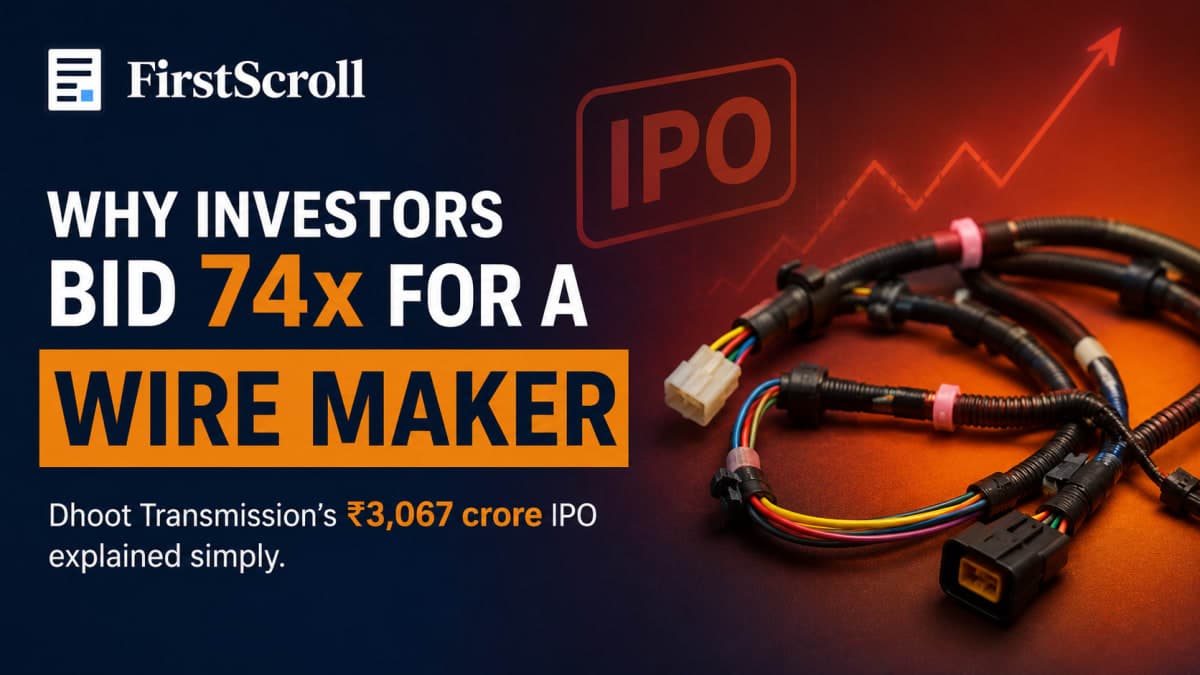
Then, last week, something strange happened. Investors placed bids worth 74 times the shares on offer in the IPO of Dhoot Transmission, a company that earns [77% of its revenue](RHP: replace with SEBI filing link) from exactly these bundles.
So the question is, why would investors fight this hard over a company whose main product is copper wire wrapped in tape?
The answer starts with what a harness actually does. Think of it as the vehicle's nervous system: a bundle of wires, connectors and terminals that lets the headlights, sensors, battery and brakes talk to each other. No harness, no communication. No communication, no vehicle.
Now here's the part most people miss. When a scooter goes electric, the engine disappears, but the wiring doesn't. It multiplies.
An electric two-wheeler needs high-voltage cables, battery interconnects and charger links that a petrol scooter never carried. So an EV harness is worth [1.5 to 2.5 times](RHP: CRISIL section of the SEBI filing) a petrol one. Same scooter sold, bigger cheque for the wire maker.
This is the oldest trade in the book: sell shovels in a gold rush. You don't need to guess whether Ola, Ather, Bajaj or TVS wins the EV race, because every single one of them buys wire.
And Dhoot sells more of it than almost anyone. It holds a [41% market share](RHP: CRISIL section of the SEBI filing) in India's two-wheeler and three-wheeler harness market, and close to 70% in the electric segment. Its EV-linked revenue has climbed from [16% of sales](RHP: replace with SEBI filing link) in FY24 to 24% in FY26.
The growth shows too. Revenue rose 31% to [₹4,525 crore in FY26](RHP: replace with SEBI filing link), while the electric two-wheeler shift is only getting started at under 7% penetration.
You can see why everyone at the table wanted this listing. Bain Capital, which owns [49% of the company](RHP: replace with SEBI filing link), gets to sell part of its stake at scale. The founder gets money for [new plants](RHP: objects of the issue section) in Haryana and Tamil Nadu. And retail investors get a bet on electrification without having to pick the winning scooter brand.
But here's the twist.
Of the ₹3,067 crore this IPO raised, only ₹1,400 crore is fresh money entering the company. The remaining ₹1,667 crore is an OFS, an [Offer for Sale](INTERNAL: OFS pillar or OYO IPO breakdown), essentially an escape hatch for early investors to cash out. More than half of what the public paid last week goes to exiting shareholders, not the factory floor.
Then there's the customer list, a strength until you read it twice. The top 10 customers account for [80.93% of revenue](RHP: risk factors section), and Bajaj, TVS and Hero alone contribute roughly 60%.
One lost platform, and the whole model wobbles. Remember, in this business you don't win customers gradually. You win entire vehicle programmes, or you don't.
And the profit line is running slower than the top line. Revenue grew 31% in FY26, but profit grew just 12% to [₹397 crore](RHP: replace with SEBI filing link), because rising copper and input costs get passed on to automakers with a lag.
Now, to be clear, this isn't a cash-burning startup dressed up for listing day. Dhoot held [₹1,084 crore of cash](RHP: replace with SEBI filing link) at the end of FY26, more than all its borrowings put together.
Its grip on customers is also physical, not contractual. Each harness is built to the automaker's own design, on tooling the customer owns but parks inside Dhoot's plants, and its top five customers have [stayed 13 years](RHP: replace with SEBI filing link) on average. Switching suppliers means requalifying every single part, and nobody volunteers for that.
Which brings us to the price. At ₹871 a share, investors are paying about 45 times earnings, roughly what listed peer Motherson Sumi Wiring trades at, for a company currently growing profit at 12%.
The stock lists on 17 August, and the grey market expects a pop. Whether the wire stays this valuable once the EV story is fully priced in is something only time will tell.
Until then…
If this story helped you make sense of the Dhoot Transmission IPO, share it with a friend on WhatsApp, LinkedIn or X. You might also enjoy our story on shiprocket.