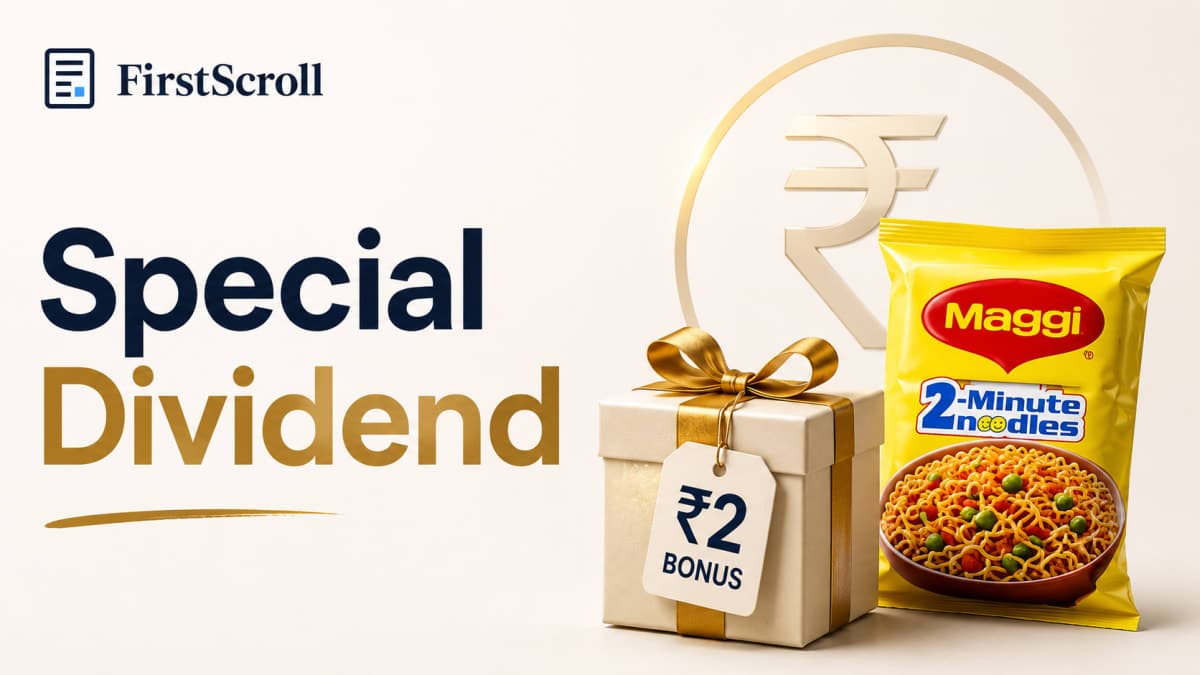
In today's FinScroll, we break down Nestlé India's ₹2 special dividend and explain why this "gift" is less about generosity and more about some very clever bookkeeping.
Before we dive in, if you're someone who loves keeping tabs on the world of business and finance, hit subscribe if you haven't already. One story a day. No jargon. Promise.
Now onto today's story.
The Story
There's a decent chance that something made by Nestlé is sitting in your kitchen right now. A packet of Maggi for the 2-minute hunger emergencies. A jar of Nescafé for the 7 am survival ritual. Maybe a KitKat hiding in the fridge that you're pretending you forgot about.
That's the thing about Nestlé India. It's not really a stock. It's a pantry.
And this week, the pantry decided to hand its shareholders a little something extra.
On 3rd July, Nestlé India's board declared a special dividend of ₹2 per share, to be paid out from 30th July, on top of the regular final dividend for FY26. The board meeting that approved it, by the way, lasted all of 12 minutes. It began at 9:30 am and wrapped up by 9:42.
Twelve minutes to give away roughly ₹386 crore. That's what ₹2 multiplied by Nestlé India's 192.8 crore outstanding shares works out to.
Which brings us to the obvious question:
What exactly makes a dividend "special"? And why is Nestlé handing one out now?
You see, a regular dividend is like your salary. It arrives on a schedule, and you build your expectations around it. Nestlé India is famous for this. It has paid dividends with clockwork regularity for decades, often multiple times a year.
A special dividend, on the other hand, is like a surprise bonus. It's a one-time payout, separate from the regular cycle, and the company makes no promise of ever repeating it. Companies typically announce one when they're sitting on more cash than they know what to do with. Maybe after selling a business, winning a lawsuit, or having an unusually good year.
And at first glance, Nestlé seems to fit that last description. Its most recent quarterly results showed a 27% jump in profit and 23% revenue growth. The stock has climbed about 22% in just three months. Business is good.
So this is just a company sharing the spoils of a great year, right?
Well, not quite. And this is where the story gets interesting.
Because this ₹386 crore isn't coming from this year's profits at all.
To understand where it is coming from, we need to peek inside a company's piggy bank. When a company earns profits, whatever it doesn't pay out as dividends gets parked in an account called retained earnings. Think of it as the company's accumulated savings over the years. Some of those savings, however, get moved into a separate locked drawer called the General Reserve. Money in this drawer was traditionally meant to be kept aside, not handed back to shareholders.
Now here's what Nestlé did. Back in 2023, it went to the NCLT (the National Company Law Tribunal, the court that approves corporate restructurings in India) and got permission for a "Scheme of Arrangement". Sounds fancy, but in plain English, it simply asked: "Can we unlock that drawer and move ₹837 crore from the General Reserve back into retained earnings, where it can actually be used?"
The court said yes.
And Nestlé has been slowly spending down that unlocked money ever since. In August 2025, it used about ₹96 crore of it to issue 1:1 bonus shares. That's when a company gives you one free share for every share you own. And now, it's using another chunk of the remaining ₹741 crore balance to fund this special dividend.
So this isn't a windfall. It's housekeeping. Money that was always sitting inside the company, in a drawer nobody could open, is finally being handed back to its owners.
Now, before you rush to buy the stock for this "free money", let's talk about the downsides.
For starters, look at the actual size of the gift. ₹2 per share sounds nice until you remember that one Nestlé India share costs about ₹1,454. That's a yield of roughly 0.14% on the special dividend. To put things in perspective, that's like a supermarket handing you a single KitKat finger for filling an entire shopping cart. Pleasant. Not life-changing.
Then there's the classic dividend trap. To receive the payout, your name must be on the shareholder list as of the record date, which is 10th July in this case. But markets are not naive. Stock prices typically adjust downward by roughly the dividend amount once it's paid out. Buying a stock just to pocket a dividend is usually a zero-sum game, minus taxes. And yes, dividends are added to your income and taxed at your slab rate.
And finally, there's a more philosophical question lurking underneath. When a company returns cash to shareholders, it's also quietly saying something: "We don't have a better use for this money right now." For a capital-light FMCG giant that doesn't need to build expensive factories every year, that's perfectly normal. But it's worth noting that the truly explosive returns in markets usually come from companies reinvesting their cash, not returning it.
So that leaves us with the ultimate question: Is this special dividend a signal of confidence from a company firing on all cylinders? Or is it simply tidy accounting, a company clearing out an old drawer because the court finally let it?
Honestly, it's a bit of both. And how you read it probably says more about your investing style than about Nestlé.
But here's the zoomed-out takeaway. In a market obsessed with the next hot IPO and the next 10x story, Nestlé India just reminded everyone of a quieter kind of wealth creation: a company so consistently profitable that its biggest problem is figuring out how to give money back. The stock, for what it's worth, is up 364% over ten years.
Sometimes, boring is the flex.
Until then…
Liked this story? Share it with a friend, family member, or even a stranger on WhatsApp, LinkedIn and X.
Disclaimer: FinScroll is for education, not investment advice. Please talk to a qualified financial advisor before making investment decisions.