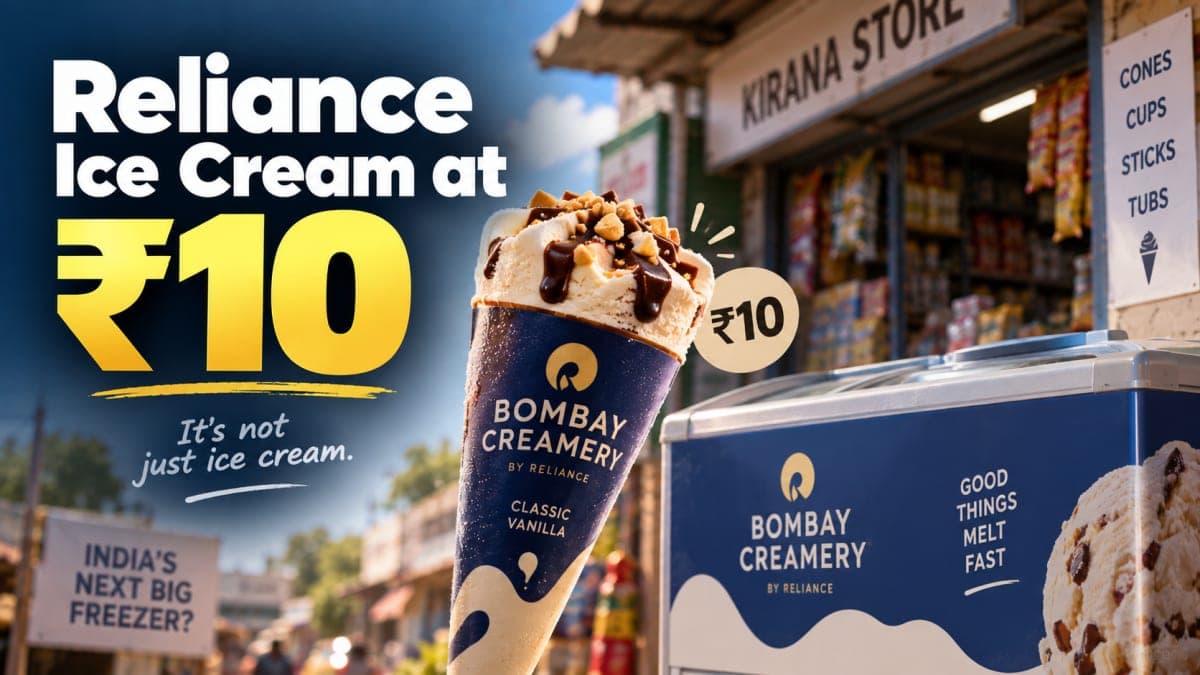
In today's FirstScroll, we break down Reliance's Bombay Creamery launch and explain why a ₹10 cone is really a bid for your kirana's freezer.
Quick housekeeping: this one is a little shorter than usual. With that out of the way, let's dive into today's story.
The Story
Picture the deep freezer at your neighbourhood kirana. It sits by the door, hums all day, and there is a good chance it does not belong to the shopkeeper. A brand put it there, painted it in its colours, and in return the shop mostly stocks that brand.
For years that freezer has belonged to a short list of names. Amul at the top, then Kwality Wall's, Mother Dairy and Vadilal, and behind them a long tail of regional dairies like Dinshaw's, Arun and Havmor.
Then, on 1 September, Reliance walked in. Its FMCG arm launched Bombay Creamery, a dairy ice cream sold as cones, cups, tubs, bars and sticks, rolling out in western India first and priced from ₹10.
To see how aggressive that is, look at the market leader. Amul's cheapest ice cream on quick commerce apps sells for around ₹20, so Reliance is entering at half the incumbent's entry price.
So here's the question: how does anyone make money selling real-dairy ice cream for ten rupees, when milk, sugar, packaging, freezing, trucking and the shopkeeper's cut all have to fit inside one coin?
The honest answer is that they probably don't, at least not on that cone. And that is the point.
You see, there is something called a loss leader: a product sold at or below cost, not to earn on the product itself, but to earn on whatever it drags along with it. A supermarket sells milk cheap so you walk in and fill a basket with everything else.
In ice cream, what the ₹10 cone drags along is the freezer. A kirana has floor space for one deep freezer, maybe two, and whoever fills it owns the shelf. Think of it as Reliance's real estate business: the cone is the rent it pays to get a box on the floor.
Reliance has run this play before, as we saw in [Campa Cola's ₹10 comeback](INTERNAL: campa cola pricing strategy). It relaunched Campa in 2023 with a ₹10 bottle of 200ml aimed at the price-sensitive buyer that Coke and Pepsi had no product for. By FY26, Campa had crossed ₹4,700 crore in gross sales and become India's fourth-largest cola brand.
That machine now reaches more than 3 million outlets, built for cola and now handed a cone. Ice cream is a new product going into an old pipe.
Now, there is a second thing that makes ₹10 possible, and Reliance did not do it. Last September, the GST Council cut the tax on ice cream from 18% to 5%. On a ₹10 price tag, that is roughly a rupee that used to go to the government and now stays inside the product. Before that cut, a ₹10 real-dairy cone was arithmetic nobody wanted to attempt.
This is where the incentives line up. For Reliance, ice cream is another brick in a plan to take its consumer arm from ₹22,000 crore to ₹1 lakh crore by FY30, and it can lose money on cones for years while it builds that.
And for the kirana? A free freezer and a ₹10 impulse buy are pure footfall. For you, it is a coin instead of a note.
But here's the twist. The company that gets hurt by a ₹10 cone is usually not the company the headline names. When Campa launched, Pepsi's bottler wobbled on the stock market, but analysts found the real damage landed on local and regional brands, not on Coke or Pepsi. The ₹10 slot was theirs to lose.
Ice cream is the same story, only more so. The unorganised end of the market, the local dairies and kulfi makers, still holds 35% to 40% of sales. Amul can match ₹10 for a summer and shrug. The dairy two districts over cannot.
There is a second catch, and it is physics. A cola sits in a chiller and survives a power cut; ice cream does not. So Reliance has to build or borrow a cold chain freezer by freezer, which is why the rollout starts in the west: Maharashtra alone is 15.9% of India's ice cream sales, the biggest single state market and the easiest place to keep a cone frozen.
Now to be clear, Reliance does not need to win ice cream. Amul is a farmers' cooperative with no share price to punish and a long record of outlasting multinationals, and it is not going anywhere. What Reliance needs is a freezer in a few million doorways with its name on the lid. Everything else it can put inside later.
So, is the ₹10 ice cream a bargain or a bait? Both. Most Indian ice cream is bought on impulse, at the door, in the two seconds between a hot afternoon and a coin, and that is a market you win with reach, not recipes. Whether the kirana hands Reliance the freezer, or Amul makes ₹10 the new floor first, is something only time will tell.
Until then…
If this story helped you make sense of Reliance's ice cream play, share it with a friend on WhatsApp, LinkedIn or X.