In today's FirstScroll, we unwrap the most quietly clever product in India. For nearly thirty years, the small pack of Parle-G has cost ₹5. Petrol tripled, gold soared, your chai went from ₹5 to ₹20, but this biscuit refused to move. That's not sentiment. It's one of the smartest pricing strategies in the country, and once you understand it, you'll never look at a ₹5 pack the same way.
The Story
Try to think of one thing you buy today for the same price you paid in the 1990s.
Your morning chai has gone up four or five times. A bus ticket, a movie, a plate of pav bhaji, all multiplied. Even a phone call, once precious, is now basically free but your phone bill isn't.
And yet, there sits Parle-G. That little yellow-and-white pack with the girl on it, still asking for ₹5, the same coin your parents handed over decades ago.
Here's the puzzle. Everything Parle-G is made of, wheat, sugar, palm oil, fuel, packaging, wages, has become far more expensive over those years. Palm oil alone has jumped almost 50% in a single recent year. So if costs went up and the price stayed frozen, how on earth did Parle keep making money?
The answer is a magic trick performed in plain sight. And the secret is not the price. It's the weight.
The trick: don't change the price, change the pack.
Here is what actually happened, quietly, over the years.
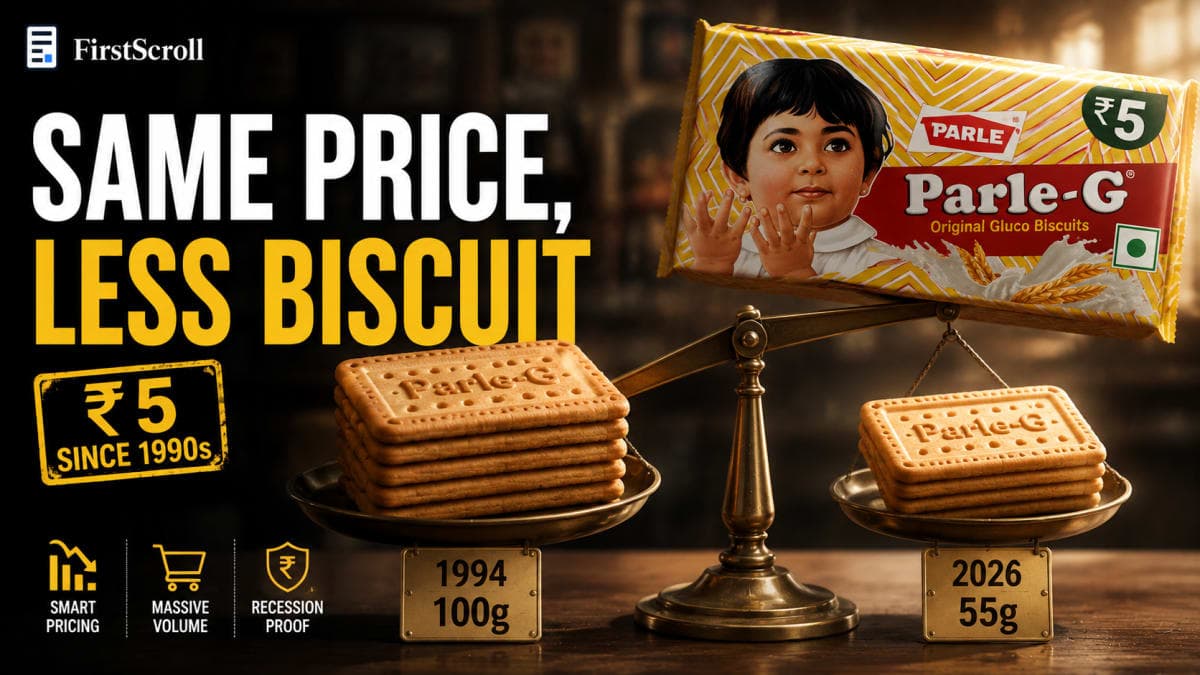
In 1994, a ₹5 pack of Parle-G gave you around 100 grams of biscuits. A good, satisfying handful.
Then, slowly, it shrank. 100 grams became 92.5. Then 88. Then less. Today, that same ₹5 pack holds roughly 55 grams. That's about a 45% reduction from where it started, while the price on the front never budged.
This is a technique called shrinkflation. Instead of raising the price and upsetting the customer, you quietly give them a little less for the same money. The price tag lies still. The pack gets lighter.
And the genius is in the pace. The shrinking happens so gradually, a few grams at a time, across years, that no one ever notices. Nobody wakes up feeling cheated, because on any given day the pack looks exactly like it did yesterday. You only see it if you line up a 1994 pack against a 2026 pack side by side.
So Parle never actually froze its prices. It raised them constantly. It just did it by the gram instead of by the rupee.
But this raises a bigger question. Why go to all this trouble? Why not simply charge ₹10 and give people a proper 100-gram pack?
Why ₹5 is sacred.
To understand this, you have to understand who buys Parle-G, and how.
A huge share of Parle-G is bought in small towns and villages, often by people who earn daily wages. For them, ₹5 is not a random number. It's a mental price point. It's the coin in your pocket. It's what a child is given for a snack. It's an easy, thoughtless purchase, no change to count, no decision to agonise over.
The moment you push that to ₹6 or ₹7, something breaks in the buyer's head. Suddenly it's not a casual grab anymore. It needs exact change. It needs a second's thought. And in that second of thought, the customer might just put it back, or buy a rival's ₹5 pack instead.
Parle understands this deeply. Its own executives have said that price points like ₹5 and ₹10 are "sacrosanct", sacred, untouchable. As one put it, they may reduce the grammage, but they will not abandon these price points.
Why so protective? Because those tiny packs are the entire business. For Parle, packs priced at ₹10 and below bring in around 70% of revenue. The ₹5 pack isn't a token cheap option sitting in the corner. It is Parle-G. Break that price, and you don't dent the business, you break it.
So the ₹5 tag is not nostalgia. It's a carefully guarded psychological doorway, and Parle will bend the biscuit itself before it lets that doorway close.
The second engine: doing everything cheaply.
Shrinkflation explains how Parle protects its price. But there's a second half to the story, how it keeps the biscuit cheap to make in the first place.
Parle plays the cost game relentlessly. It sources locally, which cuts transport and import costs. It buys in enormous bulk, squeezing the best possible price out of every supplier. And it runs one of the widest distribution networks in the country, reaching over 6 million shops, from big-city supermarkets to the tiniest village shop at the end of a dirt road.
That scale is the real weapon. When you sell biscuits to almost every shop in a country of 1.4 billion people, you make your money not on fat margins per pack, but on staggering volume. A few paise of profit on one pack means nothing. A few paise across billions of packs is an empire.
This is the classic low-margin, high-volume machine. Each Parle-G pack earns almost nothing on its own. But sold in the billions, day after day, year after year, those slivers stack into one of India's most valuable food brands, worth over ₹2,000 crore and making up more than half of Parle Products' entire revenue.
The quiet superpower: it wins when times are bad.
Here's the part that makes Parle-G genuinely special as a business.
Most products suffer when the economy slows and people tighten their belts. Parle-G does the opposite. When money is tight, families trade down, they cut the expensive snacks and reach for the cheapest thing that still fills a stomach. And nothing is cheaper or more trusted than a ₹5 Parle-G.
That's why Parle-G tends to outsell every rival precisely during hard times, like the pandemic lockdowns, when it became a cheap, reliable source of calories for millions. It's a rare business that is almost recession-proof, because its whole design is built around the moment when people have the least to spend.
To be fair, the strategy has limits. You cannot shrink a pack forever, at some point 55 grams becomes 40 and customers finally feel robbed. That's why Parle is slowly nudging shoppers toward the ₹10 pack, and openly says "₹20 is becoming the new ₹10". The company is also now heading toward its own stock market listing, which means these quiet margins are about to face very public scrutiny.
So, why did Parle-G stay ₹5 for decades and still make money?
Because it was never really about keeping the price the same. It was about protecting a magic number in the customer's mind, ₹5, the price of a thoughtless, joyful, everyday purchase, while quietly raising the real price through the back door by shrinking the pack, gram by gram, so gently that nobody ever felt it.
Pair that with ruthless cost control, gigantic volumes, and a product that sells best when times are worst, and you get one of the most quietly brilliant businesses in India.
The lesson goes far beyond biscuits: sometimes the smartest move isn't to raise your price. It's to understand exactly which number your customer refuses to let go of, and to defend that number with everything you have, even if it means changing the product itself.
The price stayed ₹5. Almost everything else about the biscuit changed. And that, precisely, was the plan.
Until next time...