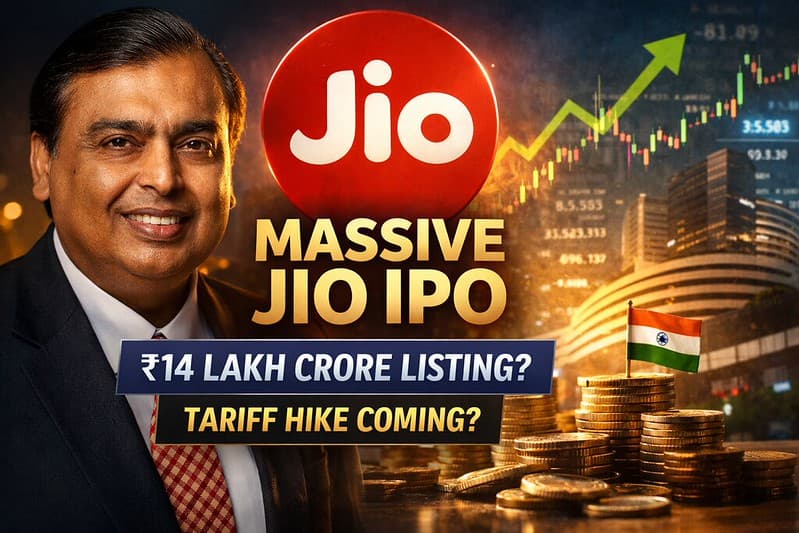
Remember 2016? The year when people across India stood in long queues not for cash, but for free SIM cards. Reliance Jio didn’t just launch a telecom network; it opened the doors to a new digital India. Fast forward to January 2026, and the same company that gave us free data is now gearing up to create massive wealth.
The excitement on Dalal Street isn’t random. Global brokerage Jefferies has increased its target price for Reliance Industries to ₹1,830, calling the upcoming Jio listing the biggest market trigger for 2026. Mukesh Ambani had already confirmed at the last AGM that the IPO would happen in the first half of 2026. After years of waiting, the process has officially begun.
But this move is bigger than just an IPO. It signals Reliance’s transformation from a traditional energy giant to a global tech powerhouse. Even though recent geopolitical issues have hit RIL’s crude supplies for January, the company seems laser-focused on unlocking the value of India’s largest digital network.
Jio is no longer just a mobile operator. It includes fiber broadband, 5 G, OTT platforms, and deep integration with retail. Analysts now estimate Jio’s standalone equity value at around $170 billion (roughly ₹14.2 lakh crore). That places it ahead of Airtel and just behind Reliance Industries itself.
Think of Reliance as a giant supermarket that also runs a secret tech lab inside. Most people only notice the supermarket, so its value stays average. Listing Jio separately is like giving the tech lab its own shining entrance. Suddenly, everyone realizes the lab is worth more than the supermarket.
And the numbers back it up. Jio reported an ARPU of ₹208.8 in Q 1 FY 26, along with nearly 25% growth in net profit year-on-year. Meanwhile, Reliance is cleaning up its group structure, with RIIL set to review Q 3 results on January 14, 2026 another signal that the IPO machinery is in motion.
And it already has a massive user base of over 500 million subscribers.
For everyday investors, the Jio IPO could be the biggest market event of the decade. Jefferies expects Jio’s EBITDA to grow by nearly 28% in FY 27. Global investors like Meta and Google who are already minority shareholders are expected to double down during the public issue.
For consumers, there’s a flip side. To keep these high valuations justified, Jio will need to increase revenues. Analysts expect a mobile tariff hike of about 15% around June 2026. With the company soon answerable to public shareholders, growth will matter more than ever.
Here’s the tough question: Are we paying a premium for something that might soon become a commodity? Jio holds a 42.3% revenue market share, but the real value lies in services built on top of the network AI apps, digital payments, cloud tools, and more.
If Jio fails to launch breakthrough digital products, the IPO could end up valuing a utility business like a tech company dangerous territory.
The Draft Red Herring Prospectus (DRHP) is expected shortly, with a planned listing in the first half of 2026. Investors should watch RIL’s January 19, 2026 results closely. Any hint about Jio’s dilution percentage expected between 2.5% to 10% could send the stock soaring.
The Bottom Line: The Jio IPO is more than a stock market event. It’s India’s digital story entering its final, global chapter. Reliance is betting that people will want to own a piece of the network they use every day.
Fun Fact: Jio now leads India’s home broadband market with over 20 million subscribers a segment it barely touched a few years ago.
If markets stress you out, you are not alone.
That is exactly why we built First Scroll. It is a daily, five minute, mobile first finance read that explains what happened, why it matters, and what to remember without hype or panic.
Subscribe to First ScrollSources: NDTV Profit | Upstox | Zerodha