In today's FirstScroll, we break down Swiggy's new "Indian-owned" tag and explain why a company celebrated foreigners owning less of it.
With that out of the way, let's dive into today's story.
The Story
Picture a dark store in Bengaluru at midnight. You order a pack of atta, a phone charger, and ice cream on Instamart. Fifteen minutes later, it's at your door.
Here's the strange part. For most of Instamart's life, Swiggy didn't actually own the atta sitting on those shelves. It merely ran the shelf, a middleman connecting you to sellers, taking a cut on the way.
Not because owning inventory is a bad business. Because, legally, Swiggy wasn't allowed to.
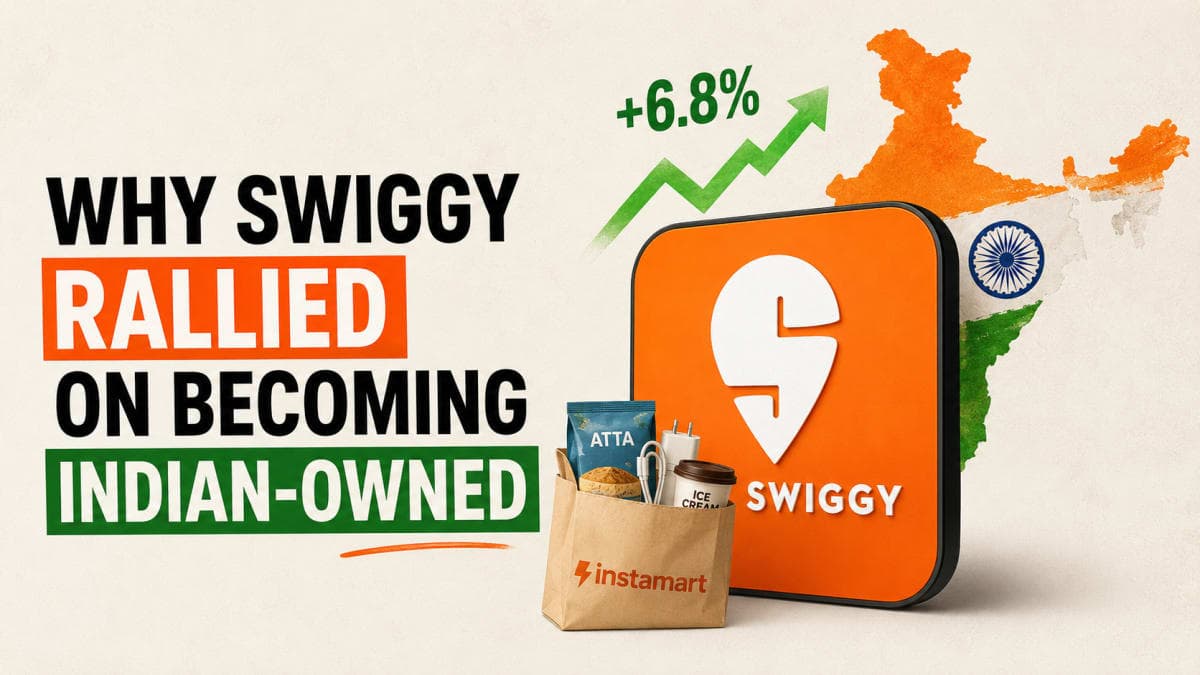
Then, on Tuesday, something changed. Swiggy informed the stock exchanges that foreign investment in the company had slipped to 49.76%, pushing domestic ownership to 50.24% for the first time. And the market loved it. The stock closed 6.8% higher at ₹266 on a day when nothing else about the business changed.
So here's the question: why would a stock rally because foreign investors own less of it? Isn't foreign money supposed to be the good stuff?
You see, India's e-commerce rules draw a hard line between two business models. In a marketplace model, the platform is a mall: it rents out space, sellers stock the goods, and the platform earns a commission. In an inventory model, the platform is the shop itself: it buys the goods, owns them, prices them, and sells them to you.
Foreign-funded companies are allowed to run the mall. They are not allowed to run the shop. That restriction was designed to shield India's kirana stores from a wall of foreign capital selling directly to consumers.
Which is why quick commerce companies with foreign money, and Swiggy raised plenty of it from Prosus, SoftBank and others over the years, have had to operate Instamart as a marketplace. Swiggy earns a commission on that atta instead of the full sale.
Now flip the model, and the economics transform. Own the inventory and you control procurement, negotiate directly with manufacturers, run your own warehousing, and book the entire sale as revenue instead of a sliver of it.
Don't take our word for it. Eternal, the parent of Zomato and Blinkit, capped its foreign ownership at 49.5% last year precisely so Blinkit could go inventory-led. The switch helped Eternal report ₹17,292 crore in revenue in the March quarter, since it moved from booking commissions to recognising the full value of every sale. We covered that mechanic in [our Blinkit inventory model breakdown](INTERNAL: eternal blinkit inventory led model).
For Swiggy, the incentive is obvious. Instamart is its fastest-growing bet, and the company needs every margin lever it can find. Swiggy's revenue jumped from ₹15,227 crore in FY25 to ₹23,053 crore in FY26, but it's still losing money, ₹800 crore in the March quarter alone, even if that's better than the ₹1,081 crore loss a year earlier.
And for the government? The rulebook stays intact. Nobody rewrote the FDI policy for Swiggy. The company simply crossed to the Indian side of the line the rules had drawn all along. If you want the full rulebook, we've explained it in [our FDI in e-commerce explainer](INTERNAL: fdi rules indian ecommerce marketplace vs inventory).
But here's the twist. Swiggy didn't engineer this milestone. Its shareholders actually voted against it.
Back in May, Swiggy proposed amendments to its Articles of Association, a key legal step in its plan to become an Indian Owned and Controlled Company, or IOCC. The resolution won 72.35% of the vote and still failed, because such changes need 75%. What happened this week wasn't a boardroom victory. Foreign investors simply sold enough shares in the open market that the ownership needle drifted below 50% on its own.
And that drift only gets Swiggy halfway. The magic acronym, IOCC, has two tests: Indian owned and Indian controlled. Control means things like the right to appoint a majority of the board. Swiggy has cleared the ownership test but not the control test, and the company itself told exchanges that Tuesday's change does not, by itself, alter its ownership and control status under the law.
There's one more catch. What drifts down can drift back up. If foreign portfolio investors turn buyers again, Swiggy could slip back across the 50% line unless it does what Eternal did and formally caps foreign ownership. Until then, this milestone rests on the daily whims of the market.
Now to be clear, the direction of travel matters. Domestic mutual funds and retail investors have been steadily raising their stake in Indian internet companies, and Swiggy is closer to the IOCC finish line than it has ever been. Tuesday's 6% pop is the market pricing in a future where Instamart owns its shelves.
But a stock rallying on a milestone the company didn't engineer, toward a status it hasn't yet secured, tells you something about quick commerce in India. In this market, the biggest competitive advantage isn't an algorithm or a discount. It's a passport.
Whether Swiggy can clear the control hurdle and lock in what the market has already celebrated is something only time will tell.
Until then…
If this story helped you make sense of Swiggy's Indian-owned milestone, share it with a friend on WhatsApp, LinkedIn or X.