Yotta Data Services wants a $4 billion valuation ahead of its IPO. Most people have never heard of it. But if India is serious about AI, companies like Yotta are the reason it will or won’t get there.
Here’s a question nobody asks when they’re using ChatGPT or Gemini or any AI tool: where is this actually running?
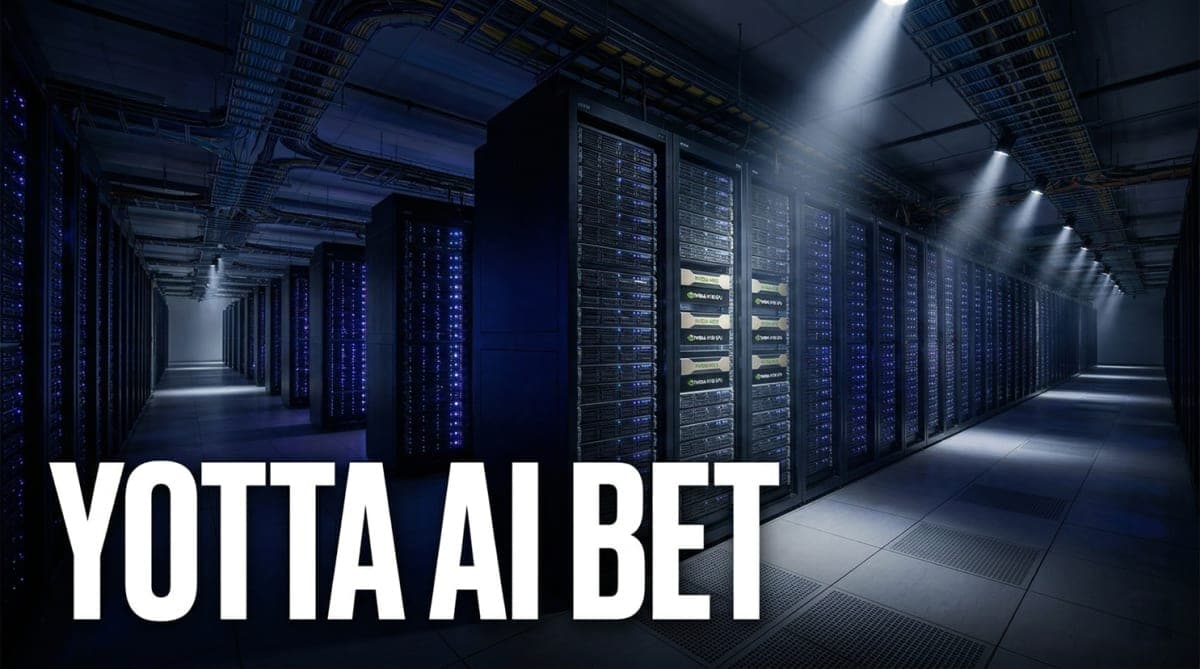
The answer is a data centre. A massive, warehouse-sized building, usually on the outskirts of a city, packed floor to ceiling with specialised computer chips called GPUs. These chips don’t browse the internet or run Excel. They do one thing: process the enormous mathematical calculations that AI models need to function.
Every AI response you get every image generated, every document summarised requires thousands of these chips working together in real time. And right now, most of that computing power sits in the US, in facilities owned by Amazon, Google, and Microsoft.
India has almost none of it.
That’s exactly the gap a Mumbai-based company called Yotta Data Services is trying to fill. And this week, it announced it wants to go public at a valuation of $4 billion roughly ₹33,000 crore.

So who is Yotta, and why does it matter?
Yotta is backed by the Hiranandani Group the same family behind many of Mumbai’s large township projects. It runs data centres in Navi Mumbai and Greater Noida, and has built something it calls the Shakti Cloud a platform where Indian businesses, startups, and even government agencies can rent AI computing power by the hour, without depending on Amazon or Google.
Think of it like electricity. You don’t build your own power plant to run your house. You plug into the grid. Yotta is trying to become India’s AI grid.
Here’s the scale of what it’s building. Yotta currently runs about 10,000 of Nvidia’s H100 chips. By May, it will add thousands of newer B200 units. By August, more than 20,000 of the most advanced B300 chips part of a $2 billion commitment go live. If that happens on schedule, Yotta will operate one of the largest AI computing clusters in all of Asia.
Now here’s where it gets interesting for the IPO story.
Yotta had earlier planned to list in the US via a SPAC merger. It dropped that idea and pivoted to India instead. The reason CEO Sunil Gupta gave was strategic most of Yotta’s customers, assets, and growth are in India, so Indian investors should get to participate first.
But there’s also a more practical angle. Indian investors are hungry for AI infrastructure stories right now, and Yotta has a genuinely compelling one. Sovereign wealth funds, including Abu Dhabi’s Mubadala, and several Indian billionaire family offices have already committed to the pre-IPO round. Goldman Sachs and ICICI Securities are in the running to manage the listing.
The catch? The competition isn’t small.
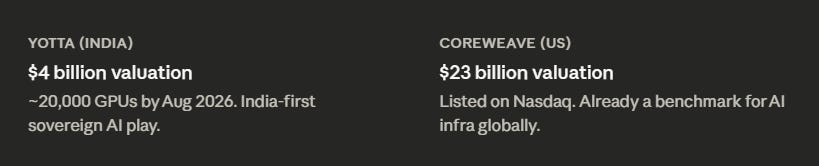
Yotta is valued at less than a fifth of CoreWeave, its closest global peer. Analysts say that gap reflects the reality that India’s AI spending while growing fast is still a fraction of the US market. Amazon and Alphabet have each committed over $100 billion in global AI infrastructure spending this year. Yotta’s entire fundraise is $1.2 billion.
But that comparison might be missing the point.
India isn’t trying to out-invest Amazon. It’s trying to make sure that when Indian businesses, hospitals, railways, or government departments want to use AI, the data stays in India, on Indian infrastructure, under Indian control. That’s what Yotta means when it says “sovereign AI cloud.” And that pitch data sovereignty, cost efficiency, India-first has a very real audience in a country that has passed strict data localisation laws and is increasingly wary of depending on foreign tech for critical services.
Whether the IPO succeeds at $4 billion will depend on how much Indian public markets are willing to pay for that vision right now. SEBI’s final clearance is still pending. The listing is expected sometime in FY2027.
In the meantime, every time someone in India uses an AI tool hosted locally and that number is growing fast there’s a small chance it’s running on a Yotta chip in Navi Mumbai.
Until next time…