This is the story of a quiet day in Mumbai that actually matters for every kitchen table in India.
On April 8, 2026, the Reserve Bank of India (RBI) met to decide the future of your money. They looked at the world, looked at our markets, and decided to do... nothing. They kept the "Repo Rate" at 5.25%.
But in the world of finance, "doing nothing" is often the hardest and most important decision of all. It’s like a pilot flying through a storm and deciding to keep the plane level instead of climbing or diving.
Let’s break down why this happened, what it means for your pocket, and why a war thousands of miles away is currently deciding how much you pay for your home.
1. What is this "Repo Rate" Anyway?
Before we talk about wars and oil, let’s explain the main character of this story: The Repo Rate.
Think of the RBI as the "Big Boss" of all banks. Banks like SBI, ICICI, or HDFC sometimes need to borrow money for a short time. When they go to the Big Boss to borrow that money, the RBI charges them interest. This interest rate is called the Repo Rate.
Why does this matter to you?
The Domino Effect: If the RBI charges your bank 5.25%, the bank has to charge you more (maybe 8% or 9%) when you take a home loan so they can make a profit.
The Brake and the Gas Pedal: If the economy is slow, the RBI lowers the rate (hits the gas pedal) so people borrow and spend money. If prices are rising too fast (inflation), the RBI raises the rate (hits the brakes) to cool things down.
Right now, the RBI has decided to keep its foot off both pedals. The rate is frozen at 5.25%.
2. The "Goldilocks" Year That Almost Was
To understand why the RBI stood still today, we have to look at how we got here.
At the start of 2025, India was in a fantastic spot. We call this a "Goldilocks Economy" not too hot, not too cold, but just right. Inflation (the rising cost of things like milk, petrol, and clothes) was falling. Because things were getting cheaper, the RBI felt brave. They cut interest rates five times between February 2025 and early 2026.
Those cuts were like a gift to the Indian middle class. If you had a home loan, your EMI (Monthly Installment) likely dropped. If you were a business owner, you could borrow money to open a new shop for less.
Everyone was happy. We expected 2026 to be the year of even lower rates. Then, the world changed.
3. The February 28 Disaster: War and Oil
On February 28, 2026, a massive geopolitical conflict broke out. The US and Israel launched strikes on Iran. In response, the Strait of Hormuz was effectively blocked.
You might not have heard of the Strait of Hormuz, but your car has. It is a tiny strip of water in the Middle East that acts as the world’s most important "oil pipe." Almost 20% of the world’s oil travels through this one narrow gap.
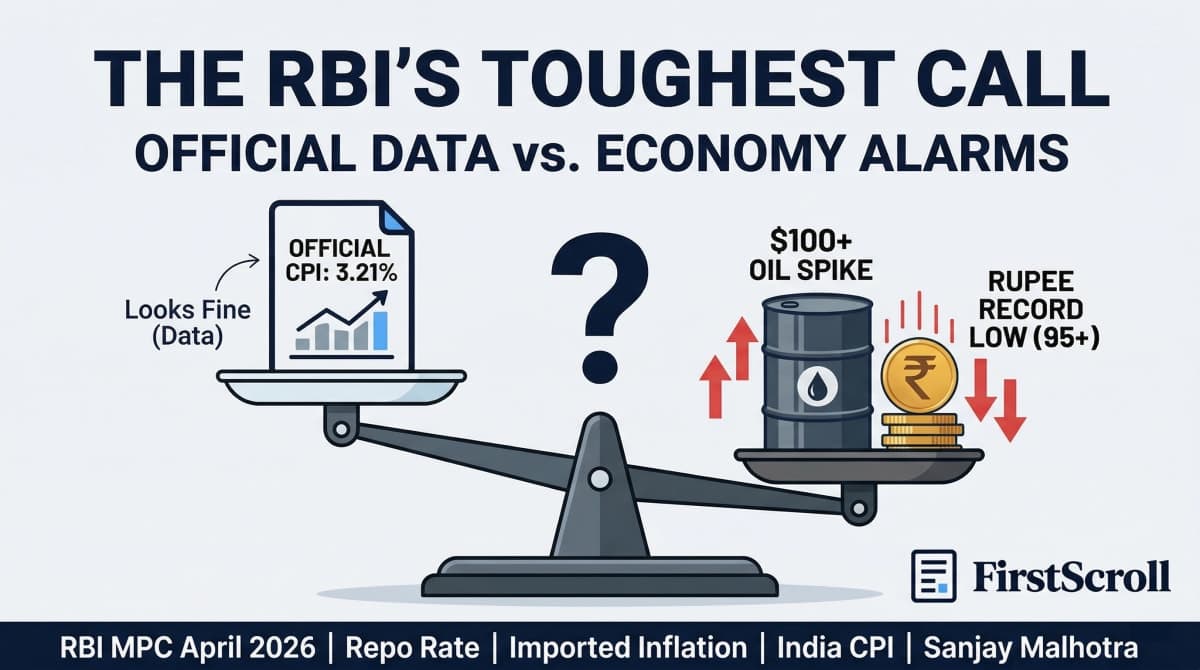
When the gates were shut, the price of oil didn't just go up it exploded. It shot past $100 a barrel.
Why India Cares About Global Oil
India is a growing giant, but we have one big weakness: we don't have enough of our own oil. We have to buy about 85% of our oil from other countries.
When global oil prices double, India has to pay double. This creates "Imported Inflation." Even if our farmers grow plenty of food, the trucks that bring that food to the city use diesel. If diesel is expensive, your tomatoes become expensive. This one event ruined the RBI’s plan to keep cutting interest rates. They had to stop and wait.
4. The Three Worries Keeping the RBI Awake
RBI Governor Sanjay Malhotra told the country today that the RBI is staying "Neutral." That’s a fancy way of saying, "We are waiting to see if things get better or worse." Here are the three things he is worried about:
I. The 6% Danger Zone
The RBI’s most important job is to keep inflation around 4%. They are allowed to let it go up to 6% in an emergency, but they hate doing it. Right now, because of the oil crisis, they expect inflation to hit 5.2% later this year. If they cut interest rates now, people would spend more, which would drive prices even higher.
II. The Weakening Rupee
When there is trouble, investors get scared. They sell their Indian Rupees and buy US Dollars because the Dollar is seen as a "safe" place to hide. When everyone sells Rupees, the value of the Rupee drops. Earlier this month, people were scared the Rupee would fall to 95 against the Dollar. A weak Rupee makes everything we buy from outside (like electronics or machinery) much more expensive.
III. The El Niño Mystery
While everyone is looking at the war, the RBI is also looking at the clouds. There are signs of El Niño this year a weather pattern that often brings less rain to India. In India, if the monsoon is bad, the harvest is bad. If the harvest is bad, the price of pulses, rice, and sugar goes through the roof.
5. India’s "Secret Weapons"
It’s not all bad news. India has "Secret Weapons" protecting us from the global chaos:
The $697 Billion Shield: India has saved up a massive amount of US Dollars and Gold. This is our insurance policy. If the Rupee starts falling too fast, the RBI can use this money to stabilize it.
The Russian Oil Deal: Even though global oil prices are high, India has a special deal to buy oil from Russia at a discount. This keeps our petrol pumps running without the prices becoming unbearable.
The Ceasefire Hope: The best news of the week came just before the RBI meeting: The US and Iran are talking about a ceasefire. The moment this news hit, oil prices started falling.
6. What Does This Mean for You?
For Your Loans (EMI)
If you already have a loan, your EMI is staying the same. You aren't getting a "discount" today, but you aren't getting a "penalty" either. If you need a home, don't wait rates are unlikely to drop significantly in the next 2–3 months, but they aren't likely to go up either.
For Your Savings (FD)
This is decent news. Since the RBI didn't cut rates, banks won't rush to lower the interest they pay you on Fixed Deposits. You can still get around 6.5% to 7% on your savings.
For the Stock Market
The stock market hates surprises. By doing nothing, the RBI has given the market a "Sigh of Relief." It shows the RBI is in control and not panicking.
7. The Road Ahead: When will rates fall?
If the ceasefire holds and the monsoon rains are good, the RBI will have a very easy job. Most experts think the next rate cut could come in June or August 2026. If that happens, we go back to the "Goldilocks" period. Your loans get cheaper, and the Indian economy continues to be the fastest-growing major economy in the world.
Summary: The "Take Home" Message
Stability: Your bank balance and your loan payments are safe for now.
Global Connection: What happens in the Middle East affects the price of your groceries in Delhi.
Preparation: India is better prepared for this crisis than almost any other country.
The RBI meeting today was a "Status Report." The report says: "The weather is a bit rough, but the ship is solid. We aren't changing direction yet." In a world full of chaos, "No Change" is actually pretty good news.