Five years ago, two Stanford dropouts started a 10-minute grocery delivery app from a Mumbai apartment. Last week, India's market regulator gave them the green light to take it public at roughly $6 billion.
In today's FirstScroll, we unpack why Zepto's IPO is the most consequential listing of 2026 and the uncomfortable question lurking inside its prospectus.
The Story
On May 8, SEBI quietly issued what's called an observation letter to Zepto. In market parlance, that's the regulator's way of saying: "You've done your homework, you can proceed."
For the uninitiated, when a company wants to list its shares on the stock exchange, it can't just announce a date and start selling. It first files a thick document called a Draft Red Herring Prospectus the DRHP that lays out everything an investor would want to know. Financials, risks, founder backgrounds, lawsuits, related-party transactions. SEBI reads it, asks questions, demands clarifications, and only then issues that observation letter. Think of it like a learner's licence being upgraded to a permanent one you can now actually drive on the road.
Zepto's DRHP was filed confidentially in December last year, and the IPO size is now pegged at ₹11,000 to ₹12,000 crore, or roughly $1.2 billion. That would make it one of the largest startup listings India has ever seen.
The conventional wisdom around this IPO is bullish, and it's not hard to see why.
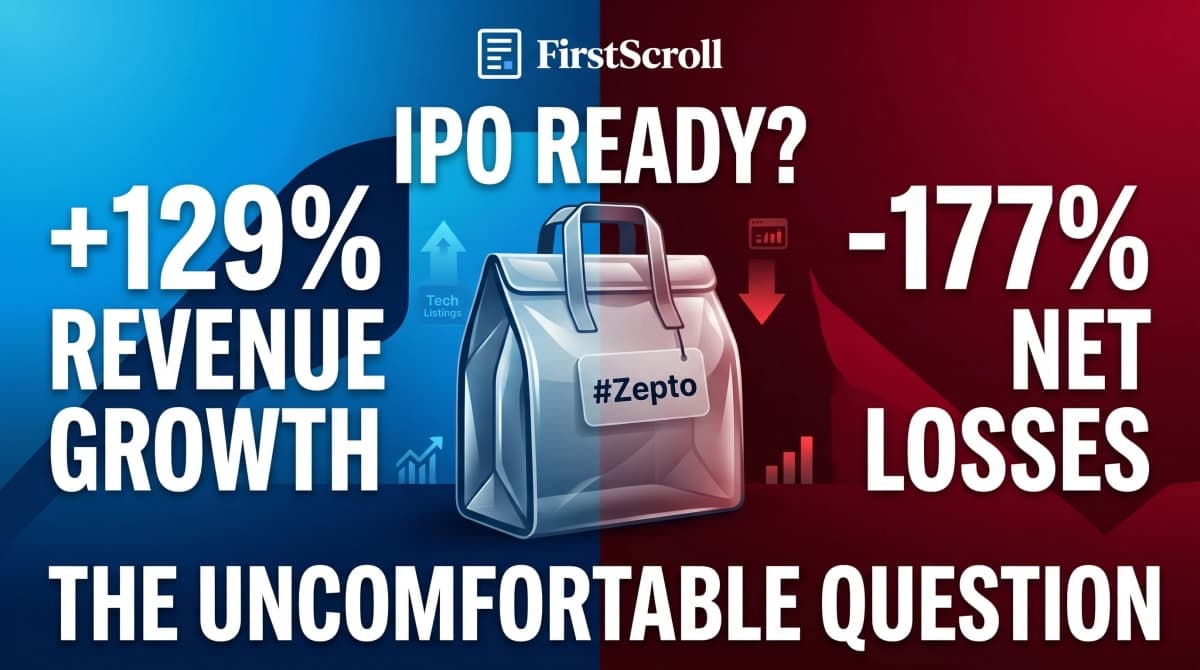
Zepto's revenue grew at a pace that almost no Indian consumer company has managed in living memory. In FY25, total sales jumped 129% to ₹9,668.8 crore, from ₹4,223.9 crore the year before. The company is now processing over 2 million orders a day across 1,000-plus dark stores in 70-plus cities, and holds roughly a 26-30% share of India's quick commerce market.
But here's what makes the prospectus harder to read with a straight face. In the same year that revenue more than doubled, net losses widened 177% to ₹3,367.3 crore up from ₹1,214.7 crore in FY24. In simpler terms: for every additional rupee of sales Zepto added, it burnt more than a rupee of capital. Growth came fast. Profitability didn't.
So what is SEBI actually approving here?
Three things are worth understanding before you decide what to make of this listing.
The first is what Zepto's "revenue" actually means. The ₹9,668.8 crore figure is total sales closer to what's called Gross Merchandise Value, or GMV. It includes the full value of everything sold across the platform, before Zepto's actual take. Quick commerce platforms typically book 15-20% of GMV as real operating revenue. By that math, Zepto's operational revenue is closer to ₹1,495-1,994 crore. For context, Blinkit (now under Eternal, formerly Zomato) reported ₹5,206 crore in revenue for the same year, while Swiggy Instamart's revenue stood at ₹2,252 crore. The reported topline can flatter the picture.
The second is the competitive landscape. Indian quick commerce is no longer a three-horse race. Blinkit's parent Eternal turned profitable in FY26. Swiggy narrowed its Q4 FY26 loss to ₹800 crore, with revenue jumping 44.7%. Amazon Now and Flipkart Minutes have entered the fray with bottomless funding behind them. Big Basket is still pushing. Reliance's quick commerce arm is in the wings. So Zepto isn't going public as a category winner it's going public as one of several well-funded players in an increasingly crowded room.
The third is the burn problem. A Moneycontrol analysis found that Blinkit, Swiggy, and Zepto together burnt close to ₹9,000 crore in just the past 9-11 months. Yet none of them are slowing down. Why? Because they can afford not to. Eternal and Swiggy each raised over $1 billion via QIPs after listing, and the top three now collectively sit on more than ₹40,000 crore in cash. The arms race is not ending; it's intensifying.
Think of it like a marathon where every runner is also lighting their own clothes on fire. The first one to either finish or extinguish themselves wins. Zepto's IPO is essentially a fresh tank of fuel.
So why is the company going public now?
Three reasons.
One, the existing investors need an exit. Zepto has raised roughly $2.45 billion across multiple rounds from Nexus, Glade Brook, StepStone, Y Combinator, General Catalyst, Lightspeed, and most recently CalPERS the pension fund of California's state employees. Some of these investors are now 5-6 years deep into their position. An IPO gives them a public market in which to gradually offload shares.
Two, the company itself needs the capital. Zepto's planned primary raise of around ₹11,000 crore will fund more dark stores, deeper inventory, electronics expansion, and customer acquisition costs in cities like Lucknow, Indore, and Coimbatore where it isn't yet dominant.
Three, the founders need a price discovery. Zepto's last private round in October 2025 valued it at $7 billion. The IPO is now being pitched at $5.6-5.95 billion, a 15-20% cut from that private round. That down-round-by-IPO is a story in itself. Either private markets had been overpricing the company, or public market investors are demanding a discount for the privilege of bearing the losses on their balance sheet. Most likely, it's both.
So why does this matter to you?
If you're a retail investor reading the IPO prospectus, the dilemma is this: do you bet on growth that's still burning cash, or do you wait for profitability that may or may not arrive? Eternal's listing is the optimistic template here it listed at ₹76 in 2021 amid much skepticism, fell briefly below that, and now trades well above ₹250 with a profitable business underneath. Paytm is the cautionary one listed at ₹2,150, currently trading around ₹990, still struggling for sustained profitability.
If you're an Indian startup founder watching this, the lesson is sharper. Zepto's SEBI nod is a signal that India's public markets are now genuinely open to high-growth, loss-making consumer tech businesses. That wasn't true even three years ago. Twenty-four startups have already filed DRHPs with SEBI this year, and another 26 are in advanced preparation. Founders looking 24-36 months out should be cleaning up cap tables, audited financials, FEMA disclosures, and ESOP structures right now.
If you're an Indian household paying for Zepto's groceries, the truth is uncomfortable. The 10-minute delivery you've been enjoying for ₹150 less than the supermarket has been subsidised by venture capital. That subsidy continues. But sometime in the next 18-24 months, the quick commerce sector will need to demonstrate it can stand on its own feet which means either prices go up, or the assortment narrows, or smaller cities get culled, or all three.
But let's be clear about what this IPO isn't.
It isn't a verdict on Zepto's business model. SEBI's role is to ensure the disclosures are complete and the procedural boxes are ticked. It does not pass judgment on whether the company will make money. That decision sits squarely with you, the investor.
It also isn't the end of Zepto's funding journey. The company is sitting on about $900 million in net cash after the CalPERS round. The IPO will add another $1.2 billion. If you assume a burn rate roughly in line with FY25's ₹3,367 crore loss, that's enough capital to keep running aggressively for another 3-4 years. The IPO doesn't force a profitability deadline; it just funds the next chapter of the same story.
Zoom out, and there's a broader signal here. India's public markets in 2026 are no longer hostile to internet-first, consumer-tech, growth-at-any-cost stories provided the growth is real and the path to profitability is at least visible. That's a fundamental shift from the post-Paytm caution of 2022-23. Eternal's turnaround helped. So did Swiggy's smoother-than-expected listing. So did India's massive retail investor base, which now has 11 crore-plus demat accounts and an appetite for tech listings that simply didn't exist a decade ago.
For Aadit Palicha and Kaivalya Vohra, the two Stanford dropouts who started this in a small Mumbai apartment in 2021, listing day will be a personal milestone. The much harder test begins the morning after when every quarterly result will be a referendum on whether 10-minute delivery was a fad subsidised into existence, or the next genuine retail revolution.
The market will decide, one earnings call at a time.
Until next time…