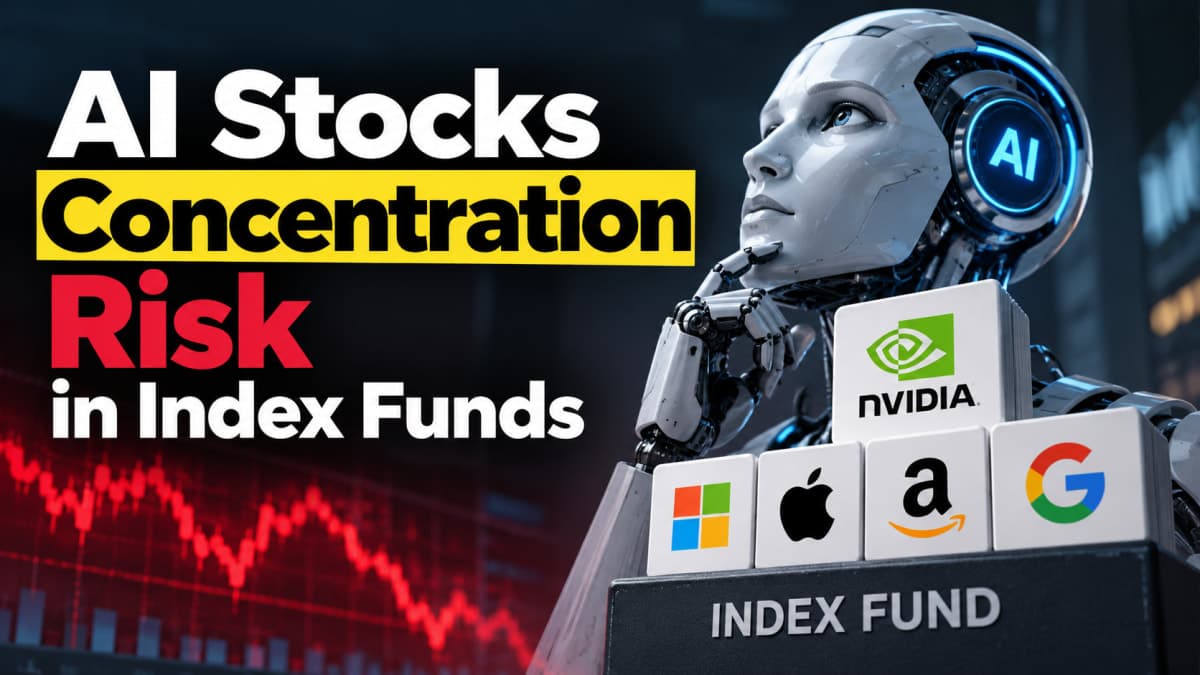
Global index funds are losing their balance as the AI boom creates a single point of failure for international portfolios.
The short answer: Concentration risk in index funds is rising as a few tech giants now dominate global benchmarks. With the US accounting for more than 60% of global stock market value, any fatigue in the artificial intelligence trade could hit Indian investors who thought they were buying safety through diversification.
The Story
A saver reviews a portfolio of Indian mutual funds alongside a small slice of a US index fund held for safety.
The logic is simple: if the Indian market takes a breather, the global giants will carry the load. They feel protected because they own the S&P 500, which holds 500 of the world's biggest companies.
But when they look closer at the holdings, they see the same names over and over. Microsoft, Nvidia, Apple and Google are not just part of the index: they are increasingly becoming the index.
Then, the headlines started to shift. While an Anthropic IPO filing revived optimism around AI this week, a sense of nervousness is creeping in.
Morningstar CEO Kunal Kapoor recently warned that this rising concentration in AI stocks poses a risk. It turns out the safety net of "diversification" is looking a bit frayed.
And here is the strange part. Even as US indices hit fresh highs, major global brokerages are slashing targets for other tech-heavy markets, citing doubts about the very AI trade that pushed them there.
So here's the question: if these index funds cover the most successful companies on Earth, why are experts worried they have become too risky for the average investor?
You see, the problem is not that these companies are failing. It is that the index has stopped acting like a diverse basket and started acting like a tech-themed bet.
Think of a global index fund as a fruit salad. A decade ago, you had a mix of apples, oranges, grapes and bananas. Today, the salad is mostly just giant apples, with a few other fruits hidden at the bottom.
If you enjoy the taste of apples, that is great. But if the apple harvest fails, your entire breakfast is ruined.
For context, the companies in the S&P 500 alone cover over 40% of global stock market value. This makes it the default choice for Indians looking to go global.
But investing internationally does not automatically mean you are diversified. If you already work in Indian IT and then buy a US tech index, you might be doubling down on the same risks, a situation we have explored in what is the AI Rotation Paradox?
Now, you might wonder why an Indian investor should care about US concentration. Because domestic markets and global markets do not always dance to the same tune.
Data shows that the correlation between the Indian NSE 500 and world indices has generally remained below 0.7 over the last 25 years. This gap is what gives you the "diversification benefit".
So who wants what here? The investor wants growth without the fear of a single sector crash. The fund managers want to follow the index, which forces them to keep buying the winners, making them even larger.
This is where the concentration trap snaps shut. As AI stocks grew, they took up more space in the indices. Now, the Nasdaq 100 is almost entirely a bet on technology and innovation volatility.
But here's the twist. The cracks are already showing in other parts of the world that rely on the same AI hunger.
Goldman Sachs recently cut its 12-month KOSPI target by 25%, citing doubts about the sustainability of the AI trade. They lowered the target from 12,000 to 9,000 points.
The brokerage is worried that the massive rally in chip stocks like Samsung and SK Hynix has lost its momentum. If the hardware makers are feeling the pinch, the software giants in your US index fund might not be far behind.
Now to be clear, global exposure is still a smart move for many. Experts suggest that beginners can consider allocating around 10% of their equity portfolio to overseas stocks to understand how they interact with Indian holdings.
This is particularly useful when foreign investors are moving their money around, as we discussed in Why Are FPIs Selling Indian Stocks 2026?
The fix for concentration is to look broader. Indices like the MSCI All Country World Index cover roughly 85% of global value across 2,600 companies, offering a much wider net than the tech-heavy Nasdaq.
So, is the index fund risk about the US economy failing? Not really. It is about a handful of AI companies becoming so large that they have become the market themselves.
Future growth rates among these corporate giants will determine if their heavy weight in a portfolio remains justified.
Until then…
If this story helped you make sense of AI stock concentration risk, share it with a friend on WhatsApp, LinkedIn, or X.