In today's FirstScroll, we break down how buy now pay later makes money when it charges no interest, and why "free" credit is never really free.
The Story
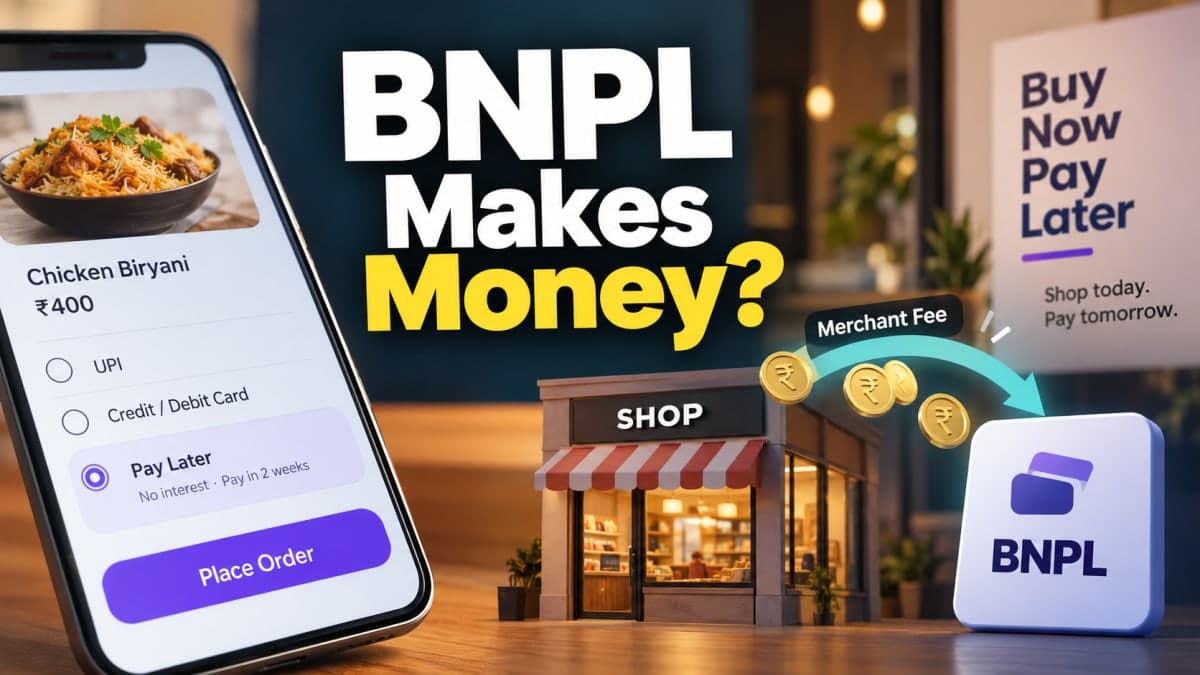
It is 11 pm on a Friday. You are ordering biryani, the wallet is somewhere in the other room, and a small button at checkout says "Pay later".
One tap and the food is on its way. No card, no OTP, no interest. You settle up in a couple of weeks.
If this feels familiar, it should. It is the old kirana khata, the neighbourhood shopkeeper's notebook where your family's dues sat until the end of the month, rebuilt as an app.
Then, the khata met the regulator. In September 2025, the RBI ordered BNPL startup Simpl to halt its payment operations, saying it was running a payment system without authorisation.
Meanwhile, the world's best-known pay later company went public in New York. Klarna says 97% of its transactions were interest-free in 2025.
So here's the question: if you pay no interest and often no fee, how does buy now pay later make money at all?
You see, the trick is that you are not the main customer. The shop is.
Every time you tap "Pay later", the merchant pays the BNPL company a cut of the sale, a bit like the fee a shop pays when you swipe a card. This is called the merchant discount. You never see it, because it comes out of the shop's side of the bill.
Simpl's own team described this model plainly. The company said it earned through merchant fees and a flat late fee, rather than charging interest.
The global numbers show how big that cut can be. Klarna processed $127.9 billion of purchases in 2025 and earned $3.5 billion in revenue. That works out to roughly 2.7 cents on every dollar that flowed through it.
Now, why would a shop hand over that much? Because an abandoned cart earns it nothing. If a pay later button turns "maybe next month" into "yes, tonight", a small fee on a sale beats a full price on a sale that never happens.
The second engine is speed. These loans are tiny and short, and Klarna says its loans last about 40 days on average. The same rupee can be lent, repaid and lent again several times a year, and the merchant pays a fee every single time.
The third engine is you, when you slip. Miss the due date and a late fee kicks in, which is why "no interest" and "no cost" are not the same promise.
So here is how the three players line up. The shop gets more sales, and the shopper gets a few weeks of free float.
And the BNPL company? It gets a fee on every order, plus a fee from everyone who pays late.
Now, a ₹400 food order sounds too small to matter, so why should you care? Because in India this is formal credit, not a favour. Pay later firms typically need an NBFC licence or a lending partner, and how you repay small loans can shape the [credit score](INTERNAL: what is a credit score) a bank checks later.
But here's the twist. Free money only works if almost everyone pays it back.
Every default wipes out the fee from dozens of good orders. Klarna set aside 0.63% of its purchase volume for credit losses in 2025, which is roughly a quarter of the 2.7% it earned.
Add funding, staff and technology, and very little is left. Klarna's adjusted operating profit was just $65 million on $3.5 billion of revenue, a margin of 1.9%, and it still reported a loss per share for the year.
That is why the business is quietly shifting. Klarna's interest-bearing loans, which it calls Fair Financing, grew 165% year on year in the last quarter of 2025. The free product brings you in, and the paid products are where the money is.
It is a familiar playbook. As we saw with [quick commerce unit economics](INTERNAL: quick commerce unit economics), a habit that looks cheap to the user is often being paid for by someone else.
Now to be clear, none of this means pay later is a trap. If you pay on time, it really does cost you nothing, because the merchant has already paid for your convenience.
And the losses are not spiralling either. In the same quarter, Klarna's credit loss provisions fell to 0.65% of purchase volume from 0.72% the quarter before.
So, is buy now pay later free? For the disciplined user, mostly yes. For the late payer and for the shop, it never was.
The bigger question is what the button becomes. It can stay a quiet checkout convenience, or it can turn into a doorway to bigger, interest-bearing loans. Which way India's pay later market goes is something only time will tell.
Until then…
If this story helped you make sense of how buy now pay later makes money, share it with a friend on WhatsApp, LinkedIn, or X.