In today's FirstScroll, we break down why your next big scan-and-pay might come with an extra fee, and why the era of the government footing the bill for digital payments is coming to an end.
The Story
Picture yourself at a Lenskart or a high-end jewellery store, picking out something special. You have done this a dozen times before: you pull out your phone, scan the QR code, and enter your PIN.
For years, this process has been as free as the air in the store. Whether you were buying a ₹10 chai or a ₹50,000 gold chain, the cost of moving that money from your bank to the merchant was exactly zero for you.
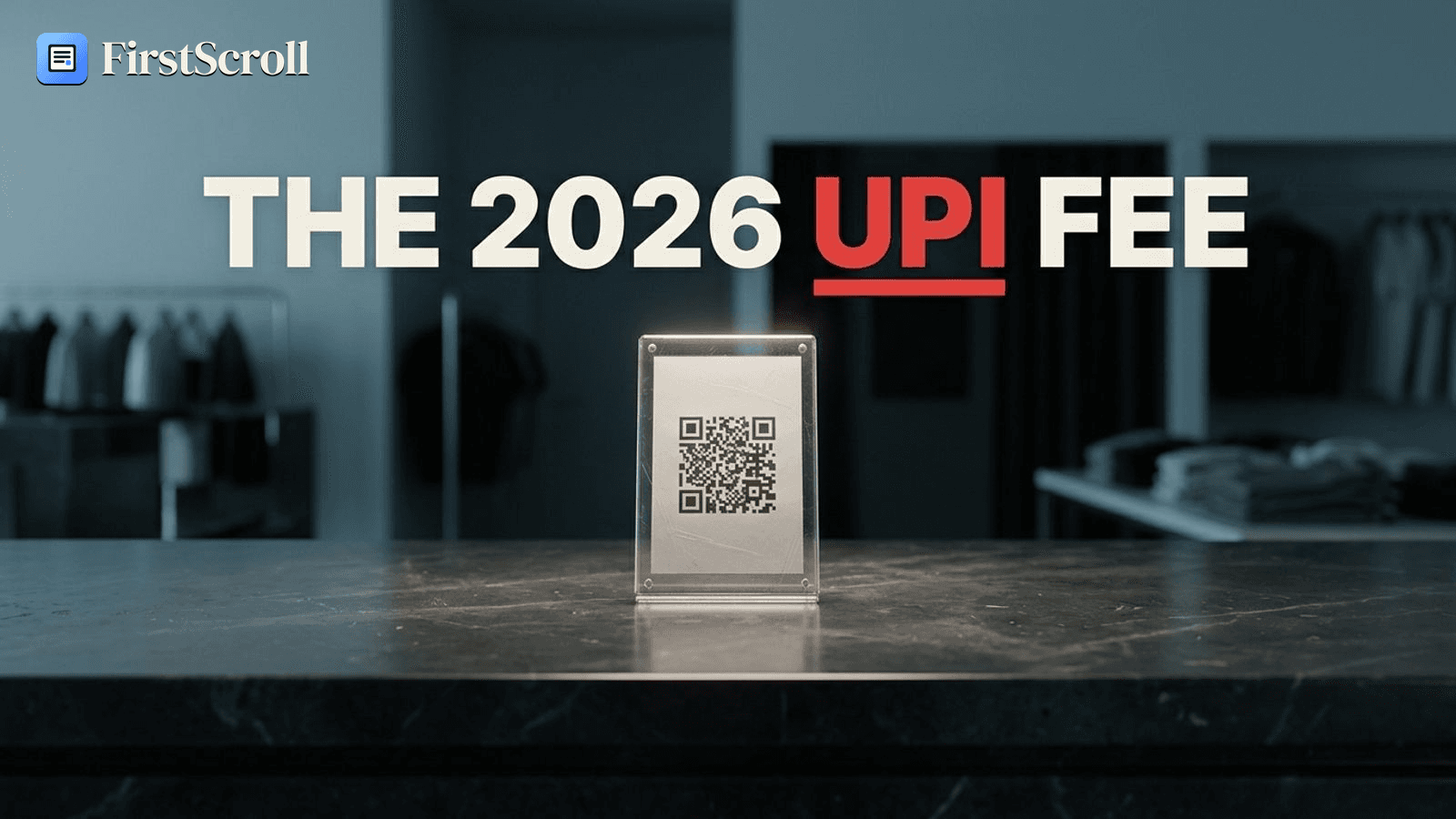
But that is about to change. From 15 October 2026, the first significant crack is appearing in the zero-fee regime that made India a global leader in digital payments.
A new 0.4% charge on UPI transactions above ₹2,000 is being introduced for certain merchant payments. While small daily spends remain free, larger purchases will now carry a cost.
The impact will not be felt equally. While your ₹400 lunch on Zomato is safe, buying a new wardrobe or investing in your future is about to get a tiny bit more expensive.
And here is the strange part. Even your investments are being targeted. A 0.02% charge will apply to capital market transactions, including mutual fund payments, starting on that same October date.
So here's the question: if UPI was built to be free to ensure everyone joined the digital economy, why is the bill finally being passed to us?
You see, the problem is not that UPI has suddenly become expensive to run. It is that UPI was never free to begin with.
For years, the government has been paying banks and payment apps thousands of crores in subsidies to keep the system running without charging users or shopkeepers. Think of it as a massive promotional campaign: the government paid for the party so that everyone would show up.
Now that nearly every Indian has a UPI app, the government is pulling back. As revenue from the Merchant Discount Rate (MDR) kicks in, the government may stop its subsidies entirely.
Think of the payment ecosystem like a public highway. To get people to use it, the government removed all tolls. Now that the highway is jammed with traffic, they are setting up toll booths, but only for the heavy trucks.
This is why the new rules focus on "large" transactions. Small orders at Blinkit or Swiggy, where average orders range from ₹380 to ₹540, will stay free because they fall below the ₹2,000 threshold.
But for retailers where customers spend more, the pinch is real. FirstCry, which sells baby products, saw an average order value of ₹2,284 in FY26. Almost every transaction there will now trigger a fee.
So who wants what here? The banks and payment apps want to finally make money after years of losses. The government wants to save its subsidy budget for other projects.
And the merchants? They are stuck in the middle. Large retailers like Nykaa could face a ₹29.9 crore annualized hit to their earnings because of these charges.
Even your mutual fund SIPs are being invited to the bill-paying party. While the 0.02% fee seems tiny, it is capped at ₹300 for transactions of ₹15 lakh and above.
Now, a fraction of a percent sounds like nothing, so why should you care? Because over time, these small leaks can add up. Even if players like JioBlackRock manage your money at razor-thin margins, these transaction costs represent a new layer of friction.
If you invest ₹1 lakh, experts estimate the difference in your returns could be about ₹12 after five years. It is not enough to ruin your retirement, but it marks the end of the "completely free" era of investing.
But here's the twist. The Finance Ministry has expressly told banks that merchants should not pass these MDR charges on to customers. In theory, you should not see a "UPI fee" on your bill.
In reality, businesses have ways of making you pay without you realizing it. Some might raise prices slightly, while others might reduce the weight of a product so the price point stays the same.
Others might nudge you toward different behaviours. Some companies might encourage you to use interest-free installment plans or other payment methods to avoid a large one-time UPI hit.
The impact will be most visible in high-value sectors like jewellery. Since almost every purchase there crosses the ₹2,000 mark, the MDR will affect every transaction, for both big showrooms and small local jewellers.
Now to be clear, the government is not being greedy. UPI has grown so large that continuing to fund it with taxpayer money forever is not sustainable. By introducing these fees, they are trying to make the system stand on its own feet.
For most of us, the ₹2,000 limit means our daily grocery runs and chai breaks will remain unchanged. The system is designed to "spare" the small spender while asking the big spenders to contribute to the upkeep of the digital highway.
So, is the new UPI fee about making digital payments expensive? Not really. It is about a maturing economy moving from a "free trial" phase to a sustainable business model.
Whether Indians will accept this new "cost of doing business" or start looking for workarounds like splitting bills into smaller chunks is something only time will tell.
Until then…
If this story helped you make sense of why UPI isn't free anymore, share it with a friend on WhatsApp, LinkedIn, or X. You might also enjoy our story on who actually paid for your UPI scans all these years.