In today's FirstScroll, we break down the new law that lets banks charge for UPI and explain why the world's biggest free payment system was never actually free.
With that out of the way, let's dive into today's story.
The Story
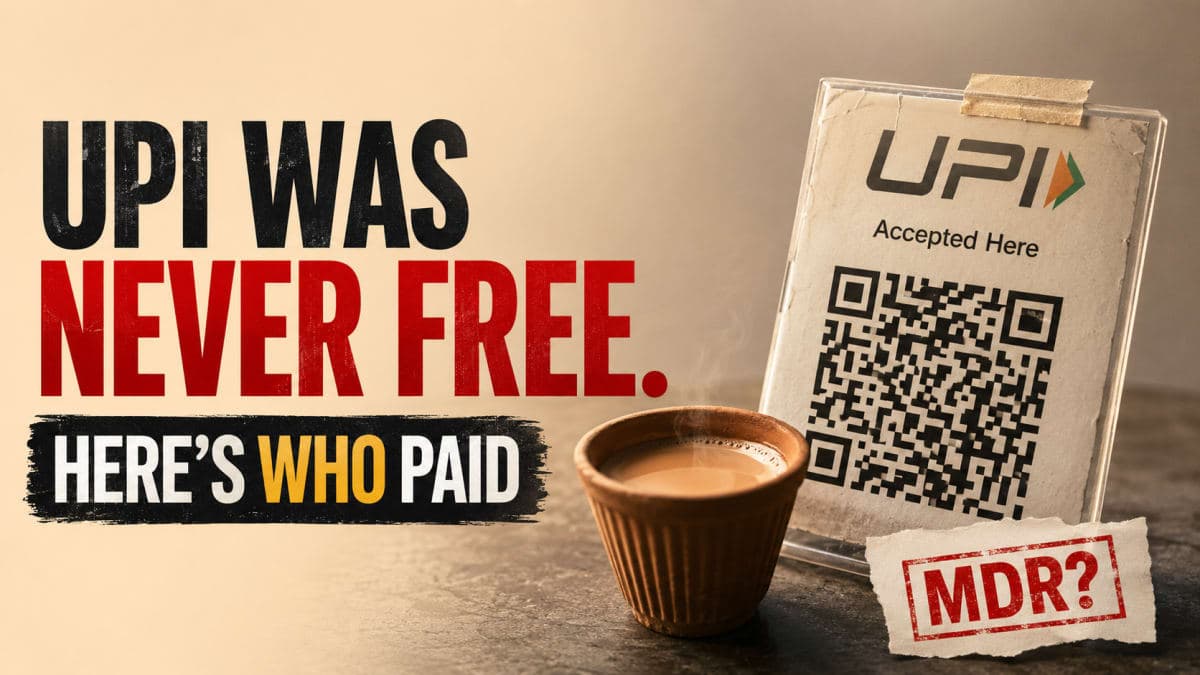
The chaiwala outside your office has a laminated QR code taped to his stall. You scan it, your phone buzzes, his soundbox announces the payment, and the tea changes hands. No card machine, no rent, no fee, no paperwork.
Behind those two seconds sits some of the most complex financial plumbing on the planet. Your bank, his bank, the app you used and a quiet body called the National Payments Corporation of India (NPCI) all fired in sequence to move your money. And for the last six years, every one of them did it for free.
Or at least, it looked free.
Then, on 6 August, the Lok Sabha passed the Taxation and Other Laws (Amendment) Bill, 2026. Buried inside a tax bill was a change to the Payment and Settlement Systems Act of 2007, the law that currently makes it illegal for banks to charge anything on UPI and RuPay debit card payments. The amendment removes that bar and lets the government decide which transactions can carry a fee.
So here's the question. If UPI was such a runaway success precisely because it was free, why is the government now writing a law to let someone charge for it?
To answer that, you need to meet a piece of jargon called the Merchant Discount Rate, or MDR. It's simply the fee a merchant pays their bank for processing a digital payment, and before 2020, shops paid roughly 1% of every card transaction as MDR. Then the government waived it entirely on UPI and RuPay to push digital payments after demonetisation and through the pandemic.
But here's the thing. Waiving a fee doesn't waive the cost.
Every UPI payment still has to travel through bank servers, NPCI switches, fraud checks and app infrastructure, and the RBI once did the math on what that journey costs. Its 2022 estimate put it at about 0.25% of transaction value, roughly ₹2.50 on a ₹1,000 payment. Puny per transaction. Brutal at scale.
And the scale is absurd. UPI processed over 24,000 crore transactions worth ₹314 lakh crore in FY26, up 30% and 21% respectively from the year before. That makes it the largest real-time payment system in the world.
So who was footing the bill all along? Mostly the government, through an incentive scheme that reimbursed banks for running the rails, plus the banks and fintechs quietly eating whatever the subsidy didn't cover.
Except that subsidy has been vanishing. It went from over ₹3,250 crore in FY24 to ₹2,000 crore in FY25, and then just over ₹400 crore set aside for FY26. Read those two trends together: the system grew 30% in a year while the money keeping it free shrank nearly 90%.
That gap is the whole story. Everyone in the chain had an incentive to force the issue.
The banks and payment firms wanted revenue for infrastructure they were running at a loss, and their lobby, the Payments Council of India, has backed the new framework as necessary for keeping the system reliable. The government wanted UPI to become self-sustaining without breaking its promise to citizens. And the finance minister has been careful to say any fee would sit on merchants, not on you.
Now, a new fee on merchants sounds like someone else's problem, so why should you care? Because the fine print decides whether your chaiwala is in the net. Government sources suggest MDR would apply only to merchants with turnover above roughly ₹1 to 1.5 crore, and only on individual payments above ₹2,000, which keeps the tea stall and your rent transfer to a friend firmly out of it.
But there's a twist here, and it isn't a domestic one.
In its March 2026 report on foreign trade barriers, the US Trade Representative flagged India's zero-MDR policy as a rule that could disadvantage foreign payment networks. Think Visa and Mastercard, which charge merchants everywhere else and struggle to compete with a rival that charges nothing. So the debate over free UPI quietly became a line item in a trade negotiation.
And there's a second, sharper twist. A day before the Bill passed, the RBI governor said consumers would ultimately bear the cost one way or another. So the finance minister says merchants will pay, and the central bank governor says the cost finds its way to you anyway. Both can be right, because merchants tend to price their costs into what you buy.
Now to be clear, nothing changes at the QR code tomorrow. The Bill only creates the power to charge; the Finance Ministry has said consumers face no charge and all person-to-person transfers stay free, the NPCI-led steering committee hasn't yet decided whether MDR will actually be introduced, and the Bill still needs the Rajya Sabha. This is the same playbook we saw when the RBI chose [a neutral stance](INTERNAL: rbi-monetary-policy-2026) earlier this year: build the tool first, decide later whether to use it.
Still, the direction is unmistakable. UPI became the biggest payment system on earth because it was free, and it was free because a subsidy paid the toll. The subsidy has run out, and the law that guaranteed "free" is being rewritten.
Whether India can start charging for UPI without breaking the very habit that made it a global success story is something only time will tell.
Until then…
If this story helped you make sense of the UPI fee debate, share it with a friend on WhatsApp, LinkedIn or X.