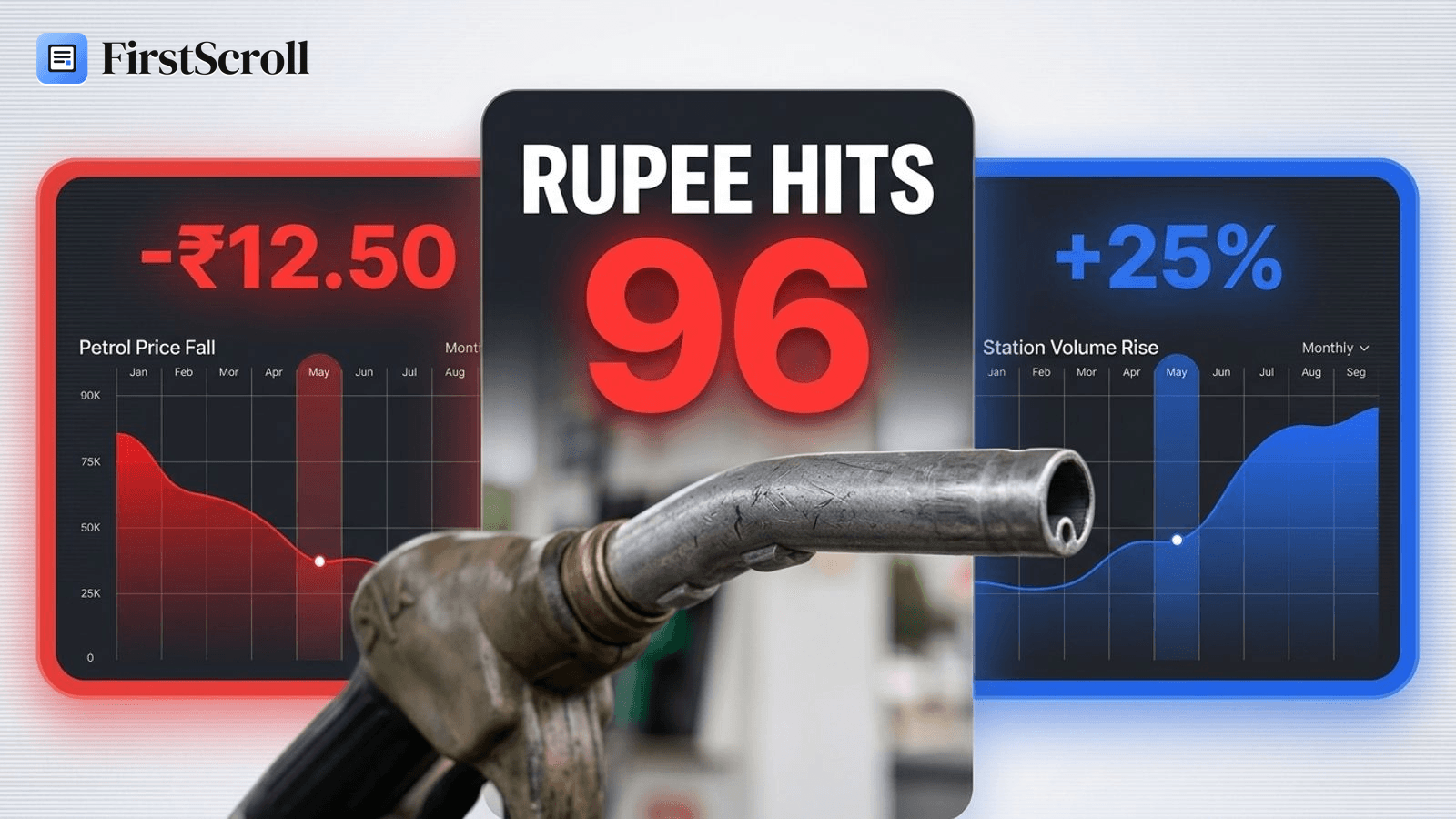
In today's FirstScroll, we break down why India’s foreign exchange reserves just saw a record $18 billion drop in a single week, and why protecting the Rupee is getting more expensive despite global efforts to cool down oil prices.
The Story
Picture a currency dealer at a large bank in Mumbai. It is a Tuesday morning in late September, and the computer screens are flashing red as news of the conflict in Iran drives oil prices higher.
The Rupee starts to wobble, threatening to hit a new low against the Dollar. Suddenly, a massive wave of Dollar selling hits the market, not from a private bank, but from the Reserve Bank of India.
This is how central banks fight back. They use their war chest to stabilize the currency so that your cost of living does not skyrocket overnight. But that protection comes with a heavy price tag.
India’s foreign exchange reserves fell $18.34 billion in a single week ended September 25. This marks a significant moment for the economy, as it represents a massive intervention to keep the currency markets from panicking.
And here is the strange part. This was the third consecutive weekly decline for our reserves. In just twenty one days, India’s stash has shrunk by more than $38 billion from its peak.
So here's the question: if India just reached a record high for its reserves, why did it have to spend $18 billion in just seven days to keep the Rupee steady?
You see, the problem is not a lack of money. It is the sudden, violent volatility caused by war and energy prices that forced the record drop in india forex reserves.
Think of India's forex reserves like a massive dam. When the global economy is calm, the water level stays high. But when a storm hits, like the current conflict in the Middle East, the RBI has to open the gates and release Dollars into the market to prevent the Rupee from being washed away.
You might wonder why the RBI buys dollars when things are good. It is exactly for moments like this. By selling Dollars and buying Rupees, the RBI mops up the excess pressure and keeps our currency from crashing.
Now, add the second ingredient: oil. India is a massive importer of energy. When a war starts in the Middle East, our cost for crude imports rises even if we end up getting less of it, because global prices have spiked.
This creates a war bill that hits everyone. Household fuel bills are already creeping up, with LPG inflation reaching 5.28% in August 2026. If the Rupee were allowed to fall freely, these imported goods would become even more expensive.
So who wants what here? The common citizen wants stable petrol and gas prices for their daily commute and cooking. The government wants to foot a lower subsidy bill and keep inflation from spiraling out of control.
And the RBI? It wants to ensure that the global panic does not trigger a domestic crisis. This is why it is rushing exporters to bring dollars home to help replenish the supply and defend our currency.
But here's the twist. While India is burning through its cash to defend the Rupee, the rest of the world is trying a different tactic to calm the markets.
On October 2, G7 countries agreed to release 100 million barrels of crude from their emergency reserves. The goal is to flood the market with oil and bring prices down, which would take some pressure off India’s shoulders.
However, India’s own safety net is relatively small. According to EIA estimates, India’s strategic oil inventory stood at 21 million barrels in Q2 2026. For perspective, China has a cushion of nearly 1.5 billion barrels.
Because our physical oil reserves are smaller, the RBI has to work harder with its financial reserves. This is why transport fuel costs like CNG inflation rose to 8.16% in August, up from 6.23% in July.
Now to be clear, the RBI is not acting out of desperation. Even after the record drop, India still holds $747.56 billion in its vault. That is down from the record $785.71 billion high we saw on September 4, but it is still a formidable defense fund.
So, is this record drop about a failing economy? Not really. It is about a central bank using its hard-earned savings to buy stability during a global storm.
Whether these massive interventions can keep the Rupee steady until the G7 oil release kicks in is something only time will tell.
Until then…
If this story helped you make sense of the record drop in india forex reserves, share it with a friend on WhatsApp, LinkedIn, or X. You might also enjoy our look at why the Rupee falls despite low oil prices.