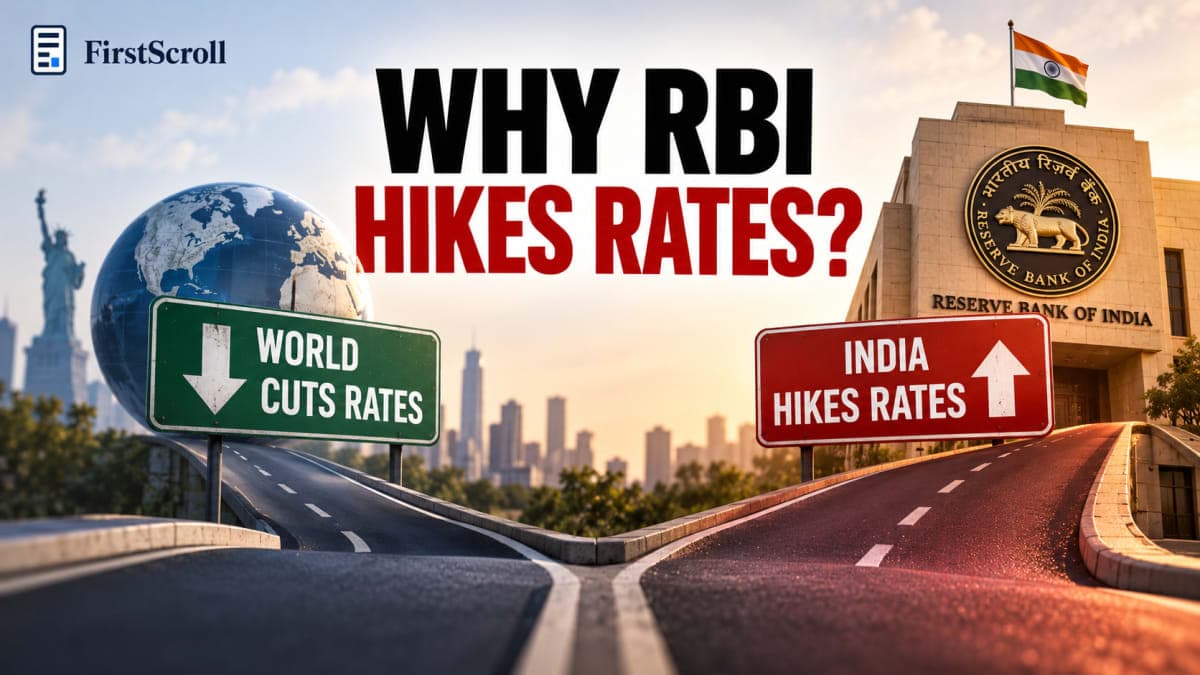
In today's FirstScroll, we break down why the RBI is planning to raise interest rates while the rest of the world is doing the opposite, and why your home loan might not get cheaper anytime soon.
The Story
Imagine you are sitting at a cafe, scrolling through global financial news. You see headlines about the US Federal Reserve cutting interest rates to help their economy breathe. You might instinctively check your bank app, hoping for a notification that your home loan EMI is about to drop.
But then you see the local news. Instead of following the global trend of making money cheaper, the Reserve Bank of India (RBI) seems to be heading in the other direction. While central banks in developed markets are easing off the pedal, India is preparing to tap the brakes.
This week, the mood in Mumbai is decidedly hawkish. Most economists expect the RBI to raise the repo rate to 5.50% on 7 October. This would be the first time the central bank has increased the key lending rate since February 2023.
It is a move that has caught many by surprise. Just a few months ago, the conversation was about when the RBI would finally start cutting rates. Now, that conversation has flipped entirely. In September, the Indian stock market felt the chill as the Sensex lost 4,476.98 points, partly due to the shifting winds of interest rate expectations.
So here's the question: if the world's biggest economies are cutting rates to boost growth, why is the RBI planning to hike them and make borrowing more expensive for Indians?
You see, the RBI does not look at what the US is doing to decide its own mood. It looks at the temperature of the Indian kitchen. While the US is worried about a slowing economy, India is looking at an inflation fire that refuses to go out.
Think of interest rates as a thermostat for the economy. When things get too hot and prices start rising too fast, the central bank raises rates to cool things down. Right now, India's headline inflation has hit a 22-month high of 4.8%, which is well above the RBI's comfort target of 4%.
Now add the second ingredient: the cost of energy. India imports most of its oil, and Brent crude has been trading above $100 a barrel lately. When oil gets expensive, everything from your morning vegetables to your weekend Uber ride gets pricier. This "imported inflation" is a risk the RBI cannot ignore.
You might wonder if higher rates will hurt India's growth. To understand that, you have to look at the numbers. India reported GDP growth of 7.8% in the April to June quarter, which was significantly higher than what the RBI had expected. When growth is this strong, the central bank feels it has enough "policy space" to raise rates without accidentally crashing the economy.
So who wants what here? The borrower wants lower rates to reduce what the repo rate actually does to your EMI and keep monthly budgets in check. The government wants steady growth. But the RBI Governor, Sanjay Malhotra, has highlighted concerns over surging asset prices and global debt levels.
This is where the Monetary Policy Committee (MPC) comes in. They have to balance the need to keep the rupee stable against a strong US dollar while ensuring that prices do not spiral out of control. Most bankers now expect a cumulative 50 to 75 bps hike by the end of the current fiscal year.
But here is the twist. Not everyone agrees that a hike is the right move right now. Madan Sabnavis, the chief economist at Bank of Baroda, stands as a lonely voice suggesting a pause. He argues that raising rates just before the festival season could dampen consumer spending, which is the engine of the Indian economy.
There is also the problem of how these rates actually reach you. Sabnavis points out that while banks are quick to raise lending rates for your loans, they are often slower to raise deposit rates for your savings because they already have plenty of cash in their vaults. If the RBI hikes rates now, it might not even achieve its goal of cooling the system effectively.
For investors, this policy gap creates a messy environment. Higher rates in India compared to the US can sometimes attract foreign money, but right now, global volatility is doing the opposite. If you've wondered why are FPIs selling Indian stocks 2026, the answer often lies in this tug of war between rising domestic rates and global uncertainty.
Now to be clear, the RBI is not trying to be difficult. It is reacting to a world where a deficient monsoon has pushed food prices up and a weakening rupee is making imports costlier. By raising rates now, the central bank is trying to prevent a much larger inflation problem down the road.
The stock market is already on edge because of this. When interest rates go up, the "safe" returns on government bonds look more attractive than the "risky" returns on stocks. That is a big reason why are bond yields rising and stocks falling in recent weeks.
So, is the RBI's move about following a global script? Not really. It is about a central bank choosing to be the cautious driver on a foggy road. While others are speeding up, the RBI believes that hitting the brakes slightly is the only way to ensure the car doesn't skid.
Whether this lonely path will successfully tame inflation without hurting the festive cheer is something only time will tell.
Until then…
If this story helped you make sense of why the RBI is hiking rates, share it with a friend on WhatsApp, LinkedIn, or X. You might also enjoy our explanation of what the repo rate actually does to your EMI.