In today's FirstScroll, we talk about a small, easy-to-miss mistake at tax-filing time that can turn your perfectly honest return into a "defective" one, and how to avoid it.
The Story
Imagine you fill out an important government application carefully. Every detail is honest, every number is correct, you've paid everything you owe. You submit it, breathe a sigh of relief, and move on with your life.
Then weeks later, an email arrives. Your application has been rejected. Not because you lied, not because you underpaid, but because you filled it out on the wrong form.
That's a surprisingly common, and entirely avoidable, fate for Indian taxpayers. And with filing season upon us, it's worth understanding before you sit down to file.
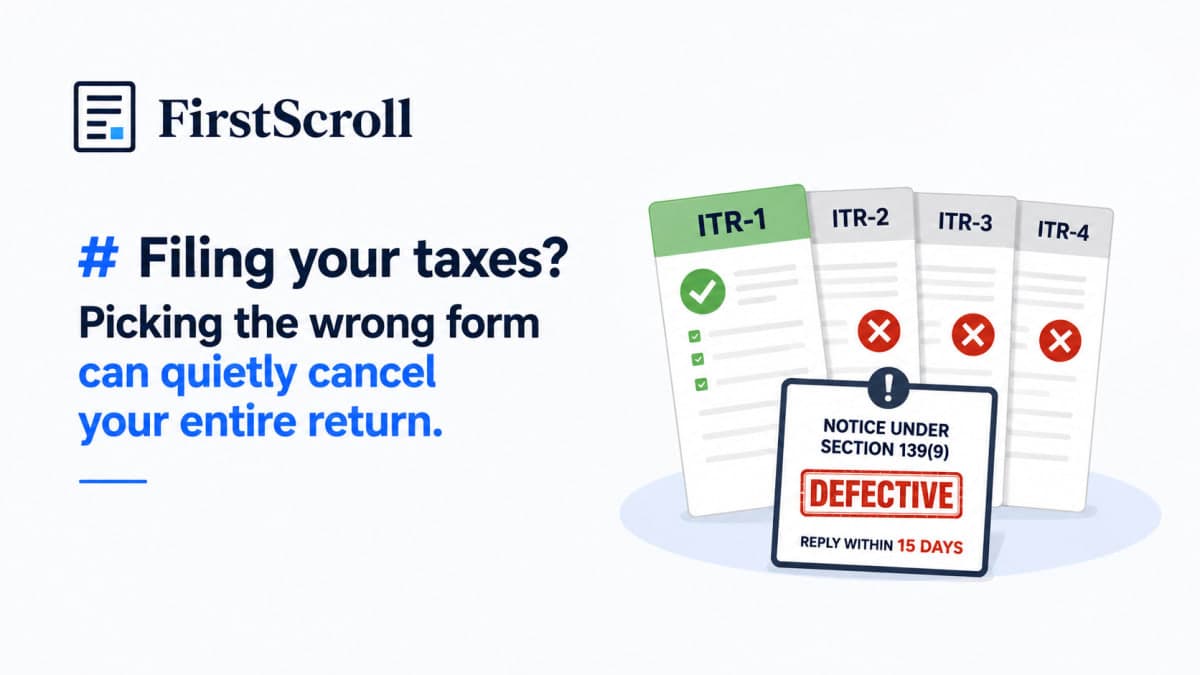
Here's the situation. When you file your income tax return, the government doesn't give you one single form. It gives you a menu of them, named ITR-1, ITR-2, ITR-3, ITR-4, and so on. Each one is designed for a different kind of taxpayer. And if you pick the wrong one, your return can be marked as "defective" under a provision called Section 139(9), even if every single number in it is perfectly accurate.
Let's unpack why this rule exists and how to stay on the right side of it.
For the uninitiated, an income tax return, or ITR, is simply the form on which you declare to the government how much you earned in a year, how much tax you owe on it, and how much you've already paid. Most salaried people earn a refund or settle a small balance through this process.
The reason there are multiple ITR forms is that not all income is the same in the eyes of the tax department. A salaried person with one house and some bank interest has a very simple financial life. A business owner, a stock trader with capital gains, someone with crypto profits, or a person with foreign assets has a far more complex one. So the government created different forms to capture these different situations properly.
Broadly, and this is a simplification, here's the logic. The simplest form, ITR-1, is meant for resident individuals with straightforward income, mainly salary, one house property, and modest other income like interest. Have capital gains from selling shares or property, or more than one house, or foreign assets? You're pushed up to ITR-2 or higher. Run a business or profession? That's typically ITR-3, or ITR-4 if you use the simplified "presumptive" scheme for small businesses.
Think of the ITR forms like different queues at an airport. There's a quick lane for passengers with just hand luggage, and a separate, more detailed lane for those checking in bags, carrying special items, or flying internationally. If you stroll into the hand-luggage-only lane with three suitcases and a surfboard, you're not breaking the law, but you're in the wrong queue, and you'll be sent back to start again. The ITR forms work the same way. Your "luggage", the complexity of your income, decides which queue you belong in.
So what actually happens if you pick the wrong queue?
This is where Section 139(9) comes in. If the tax department's system notices that you've used a form that doesn't match your income profile, it flags your return as "defective." For the uninitiated, a defective return isn't an accusation of fraud. It simply means the return, as filed, can't be properly processed, because the form doesn't capture all the information the department needs.
When this happens, the department sends you a notice, by email to your registered address and on the e-filing portal. And here's the critical bit: you typically get just 15 days to fix the defect and refile. Miss that window, and the consequences escalate sharply.
What are those consequences? They're more serious than most people realise.
First, your refund gets stuck. If the government owes you money back, it won't release it while your return is sitting in "defective" limbo. Second, and this is the big one, if you don't respond and correct the defect in time, your return can be treated as invalid, as if you never filed it at all. And a return never filed means you could face late-filing penalties and interest on any unpaid tax, the very problems you thought you'd avoided by filing on time. All because of a form mismatch.
The most common trap, by the way, is a modern one: new types of income that people don't realise have changed their tax profile.
Take crypto. A few years ago, hardly anyone had to think about it. Now, plenty of young Indians hold some. But crypto income has specific reporting rules. If you treat your crypto gains as capital gains, that generally points you to ITR-2. If you trade actively and report it as business income, you may need ITR-3. The salaried person who casually files the simple ITR-1, forgetting about their crypto profits or their capital gains from selling some shares, is exactly the person most likely to trigger a defective notice.
The same goes for someone who sold a property, earned capital gains, took on a side freelance gig, or holds foreign assets. The moment your financial life gets even slightly more complex than "salary and a savings account," the simple form may no longer fit.
So how do you protect yourself? A few practical habits make this almost foolproof.
First, before you file, take an honest inventory of every source of income you had during the year. Not just your salary. Did you sell any shares or mutual funds? Earn crypto gains? Receive rent? Do any freelance work? Hold any foreign asset or income? Each of these can change which form you need. The mistake is almost always one of omission, forgetting a source of income that quietly bumps you into a higher form.
Second, cross-check your numbers against two documents the tax department already has: your Form 26AS and your Annual Information Statement, or AIS. For the uninitiated, these are statements the government compiles showing the income and high-value transactions it already knows about you, the TDS deducted on your salary, the interest your bank reported, large transactions, and so on. If what you declare doesn't match what these documents show, that mismatch can itself make your return defective. So a simple rule: open your AIS, see what the government thinks you earned, and make sure your return tells the same story.
Third, double-check the basics at login, the assessment year especially. For income earned in the year 2025-26, you're filing for assessment year 2026-27. Selecting the wrong year is another small click that creates big headaches later.
And fourth, if your finances are even moderately complex, capital gains, business income, foreign assets, it's genuinely worth either using a reputable tax-filing platform that picks the form for you based on your inputs, or simply paying a qualified professional. The fee is almost always smaller than the cost of a stuck refund or a penalty.
But let's be clear about what this rule isn't.
It isn't a punishment designed to catch you out. A defective return notice is, in a sense, the system giving you a chance to fix an honest mistake before it becomes a real problem. The 15-day window exists precisely so you can correct course. If you respond and refile correctly, no harm done. The danger lies almost entirely in ignoring the notice, not in receiving one.
And it isn't only about the form. Wrong form is the most common trigger, but a return can also be flagged defective for other reasons, like claiming TDS credit on income you forgot to actually declare, or a name mismatch with your PAN records. The underlying principle is the same: the return must be internally consistent and complete.
Step back, and there's a quietly important lesson here about how modern tax systems work. The Indian tax department today is heavily data-driven. It already receives a stream of information about you, from your employer, your bank, your mutual fund, the registrar when you buy property. By the time you file, it often already has a rough picture of what you earned. Filing your return isn't really about informing a department that knows nothing. It's about confirming and completing a picture the government has already partly drawn.
Seen that way, the wrong-form problem makes total sense. The system isn't trying to trap you. It's trying to match what you say against what it already knows, and it needs you in the right queue, on the right form, for that matching to work.
So this filing season, before you rush through the login screen and hit submit, pause for that one extra minute. List your income honestly, open your AIS, and pick the form that actually fits your financial life. It's a tiny bit of friction now that saves you a stuck refund, a stressful notice, and a scramble against a 15-day clock later.
Getting your taxes right isn't only about paying the correct amount. It's also, quietly, about standing in the correct queue.
Until next time…..