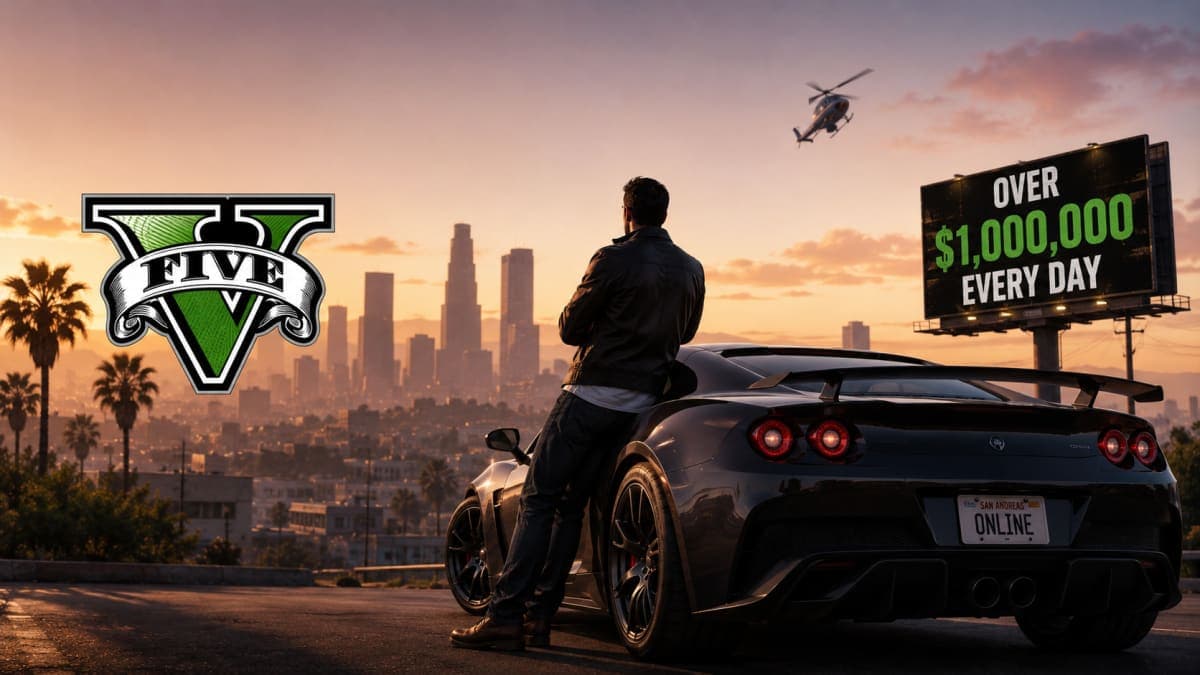
In today's FirstScroll, we break down the most ridiculous money machine in entertainment history. GTA 5 came out in 2013, the year before some of you finished school. It's older than half the phones you've owned. And it still earns more in a day than most companies earn in a month. How is a teenage video game still this rich? Let's get into it.
The Story
Imagine making a movie that earns more than Avatar, every single year, for over a decade, long after it left theatres.
That's basically Grand Theft Auto 5. Released in September 2013, it has gone on to generate over $10 billion in revenue, making it, by most measures, the most profitable entertainment product in history that wasn't a movie. Not the most profitable game. The most profitable anything in entertainment, outside cinema.
And here's the truly mad part. It still hasn't slowed down. In 2026, a 13-year-old game is still pulling in over $1 million every single day. Most games are forgotten three years after launch. GTA 5 is still a cash machine well into its teens.
So how does a game this old keep printing money like this? It comes down to a few genius moves that completely rewrote the rules of the business.
Move 1: The explosive launch that paid for itself in days.
GTA 5 cost a reported $265 million to make and market, one of the most expensive games ever. A terrifying bet. Except it wasn't, because the launch was nuclear.
The game made $815 million in its first 24 hours, and crossed $1 billion in just three days. To put that in perspective, Avatar, the highest-grossing film of its time, took 17 days to reach $1 billion. GTA 5 did it in three. The entire massive budget was recovered almost instantly. Everything after that was gravy.
But a huge launch isn't the real story. Plenty of games sell big and then fade. GTA 5 did the opposite, it got bigger over time. And that's because of the masterstroke.
Move 2: Stop selling a game. Start running a world.
Two weeks after launch, Rockstar released GTA Online, a multiplayer version where you live a second life in the game's city with friends and strangers. This single decision changed everything.
See, a normal game is a one-time sale. You buy it for ₹3,000, you finish the story in 30 hours, and you leave. The company got its money once, and that's it. Game over, for them and you.
GTA Online flipped that. Instead of finishing and leaving, players stayed. For months. For years. They weren't playing a story, they were hanging out in a living world that Rockstar kept updating with new heists, cars, businesses, and events, all for free. It stopped being a product you finish and became a place you keep coming back to. In the industry, this is called a "live service", and GTA basically perfected it.
And once players were living inside that world, Rockstar unlocked the real money printer.
Move 3: The "Shark Card" genius (and why it's a little evil).
Here's how the money actually flows. In GTA Online, you need in-game cash to buy the cool stuff, supercars, mansions, weapons, businesses. You can earn it by playing, grinding missions for hours and hours.
Or, you can take a shortcut. You can buy in-game money with real money, through something called a Shark Card. Want that ₹40 lakh in-game supercar right now without the grind? Just pay real cash and skip straight to the fun.
And this is the sneaky-clever bit. The in-game economy is deliberately tuned to make earning money slow and tedious, while the shiny new items are expensive. That gap, between how much you want the cool stuff and how painful it is to earn it, is exactly what nudges people to pull out their wallet. The friction is the feature.
These tiny microtransactions have quietly become the main event. Across its parent company, this kind of recurring in-game spending makes up around 75 to 80% of total revenue. Shark Cards alone have reportedly pulled in over $5 billion since 2013. The game stopped being a thing you buy and became a thing you keep paying into.
Move 4: The whale economy (the most surprising part).
Now here's the stat that breaks people's brains. With all that microtransaction money pouring in, you'd assume most players are spending. They're not.
According to leaked data, only about 4% of players actually spend money on the game. Ninety-six percent play completely free.
So how does 4% generate billions? Because of a concept called "whales". A small number of players spend a lot, far more than a normal person ever would. The business doesn't need everyone to pay. It just needs a small slice of heavy spenders, and the free majority actually helps, because they fill the world, making it lively and fun for the whales to show off their expensive supercars in. The free players are the audience. The whales are the customers.
It's the same logic behind many free mobile games, but GTA runs it at a colossal scale.
Move 5: Never let the game die. Just re-release it.
The final trick is patience. Instead of rushing out GTA 6 to chase the next payday, Rockstar squeezed GTA 5 for everything, re-releasing it across three console generations, PS3, PS4, and PS5, plus PC. Each new console brought a fresh wave of buyers and another sales spike for the same game.
This is why GTA 5 has sold a jaw-dropping 225 million copies, the second best-selling game of all time behind only Minecraft. Most games sell once. GTA 5 got sold again and again to new generations of players, while GTA Online kept the cash flowing in between.
So that $265 million game has now returned roughly 38 times its investment. The patience paid off so well that Rockstar was in no rush at all to release a sequel. Why kill your golden goose when it keeps laying eggs?
So, how does a 13-year-old game still print over $1 million a day?
By stopping being a game and becoming an economy. Rockstar nailed a blockbuster launch that paid for itself in days, then refused to let the story end. It turned a one-time purchase into a living world people never leave, built a clever (and slightly predatory) system that nudges them to spend real money on virtual cars, and let a tiny group of big spenders fund the fun for everyone else. Then it re-sold the whole thing to three generations of consoles.
The real lesson, and it echoes far beyond gaming, is this: a one-time sale earns you money once, but an ecosystem you can keep people inside earns you money forever. GTA didn't just make a great game. It built a machine that turns players into a permanent, recurring revenue stream.
And that machine is still humming, every single day, more than a decade later.
Until next time...