In today's FirstScroll, we break down how credit card companies make money off you and explain why paying your bill in full every month doesn't make you the bank's worst customer. It makes you their salesperson.
With that out of the way, let's dive into today's story.
The Story
Picture the most disciplined credit card user you know. Maybe it's you.
Every swipe gets paid off before the due date. Not a single rupee of interest, ever. The reward points pile up, the airport lounge access gets used, and the annual fee gets waived because you spent enough. You're playing the game and winning.
The industry even has a name for people like this: transactors. And here's the strange part. Banks don't hate transactors. They court them. They send them shiny metal cards, upgrade offers, and birthday vouchers.
So here's the question. If you never pay a single rupee of interest, why is the bank still rolling out the red carpet for you?
You see, every time you swipe your card, someone pays a toll. It's just not you.
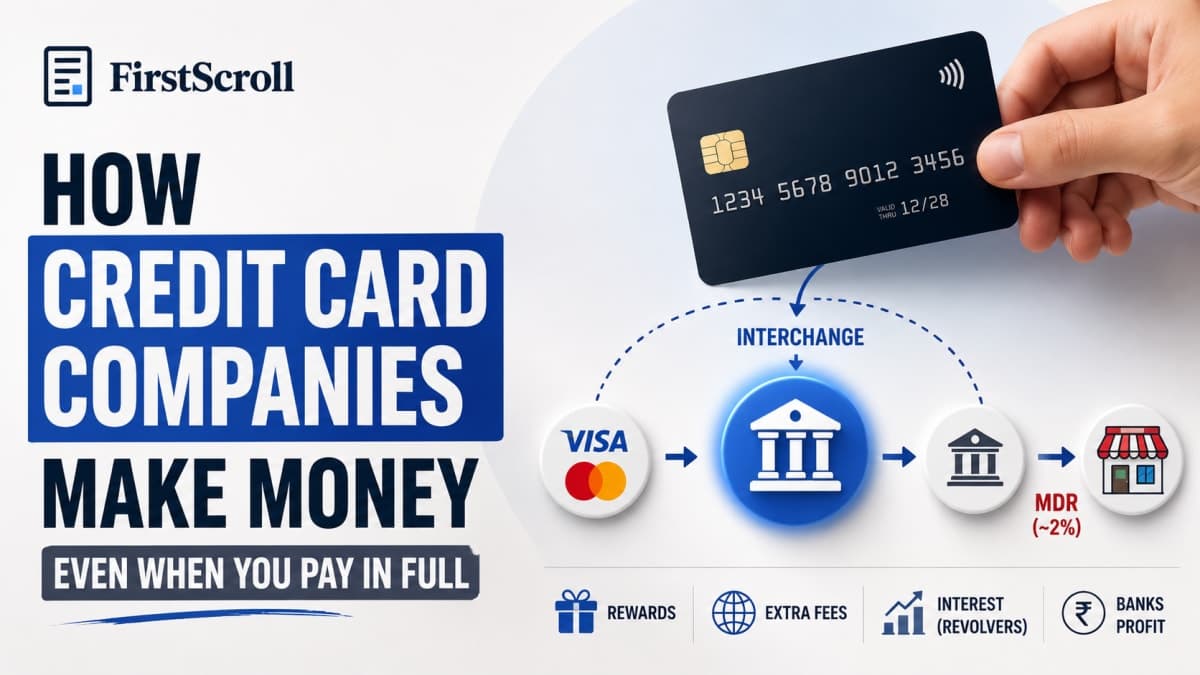
When you buy a ₹1,000 pair of shoes, the shop doesn't receive ₹1,000. It receives roughly ₹980. The missing ₹20 or so is something called the Merchant Discount Rate (MDR), essentially a fee the merchant pays for the privilege of accepting your card. That fee gets sliced three ways: a small cut to the network (Visa or Mastercard), a small cut to the merchant's bank, and the biggest slice, called interchange, to your bank, the one that issued the card.
So while you see a "free" transaction, your bank just earned money on it. Swipe by swipe, invisible to you.
And this is where the incentives click into place. For your bank, the logic is simple: the more you spend, the more interchange it collects. That's why it bribes you with reward points. A card that gives you 1% back while earning close to 2% on your swipes is still a profitable machine. The rewards aren't generosity. They're a commission for choosing their toll booth.
And for the merchant? On paper, they're the ones footing the bill. But merchants play along because card users are lucrative. They spend more, buy on impulse, and don't make the shopkeeper handle cash. Losing a ₹20 fee beats losing a ₹1,000 sale.
There's more. That annual fee you got "waived"? It was doing its job anyway, nudging you to hit a spending target. The 3.5% markup when you swipe abroad, versus the near-zero you'd pay on a good forex card? Pure margin. Even the one time you paid two days late and ate a ₹750 fee, that's a revenue line with a name and a budget.
But here's the twist. You, the disciplined, pay-in-full customer, are not where the real money is.
Industry estimates across markets consistently show that interest income is the single largest chunk of credit card revenue, often bigger than interchange and fees combined. And credit card interest is brutal. In India, unpaid balances typically compound at 36–42% a year, versus around 9–10% on a personal loan. The customers paying that are called revolvers, and they're the whales of this business.
Which reframes what you actually are to the bank. A transactor is roughly a break-even customer. Sometimes mildly profitable, sometimes not, especially if you're squeezing every reward point. So why keep you around? Because you're a bet. Banks know that life happens (a job loss, a medical bill, a wedding) and a fraction of pristine transactors eventually revolve. You're also a walking billboard for the card, and a warm lead for the bank's real products: personal loans, EMI conversions, insurance.
Now to be clear, none of this makes credit cards a scam. Used with discipline, a card is genuinely one of the rare products where an informed customer extracts more value than they give up. The system just relies on most people not being that customer.
And there's one more uncomfortable wrinkle. Merchants don't quietly absorb that 2% fee. They bake it into prices for everyone. Which means the cash-paying customer at the next counter, who earns zero points, is partly funding your free flight. Economists call this a regressive transfer: rewards flow to card-holding, often wealthier customers, funded by prices everyone pays. It's also why regulators keep circling. Europe capped interchange at 0.3%, a fraction of the roughly 2% common elsewhere, and reward programs there promptly shrivelled.
India adds its own plot twist: UPI, where merchants pay nothing at all. Every year, more small payments migrate to a rail with zero tolls, which is exactly why banks are pushing credit-on-UPI and premium cards so hard. The toll booth is being rerouted, and the banks are racing to stay on the highway.
So, is paying in full really "beating the system"? Well, you're beating the interest trap, which is the part that ruins people. But the system was never designed to lose. It earns on your swipes, prices your rewards into everyone's bills, and patiently waits for the month you can't pay in full. Whether UPI and regulators eventually dismantle that toll booth is something only time will tell.
Until then…
If this story helped you make sense of how credit cards really work, share it with a friend on WhatsApp, LinkedIn, or X.